
Stopping a drone almost always means launching something at it. A missile, a net, a jammer, another drone. That is how the counter-drone business has worked in the air for about a decade, and most of the engineering effort now goes into pushing the cost per intercept down to something a defense budget can live with.
Underwater, the US Navy spent two days in June testing the opposite idea. The weapon was air.
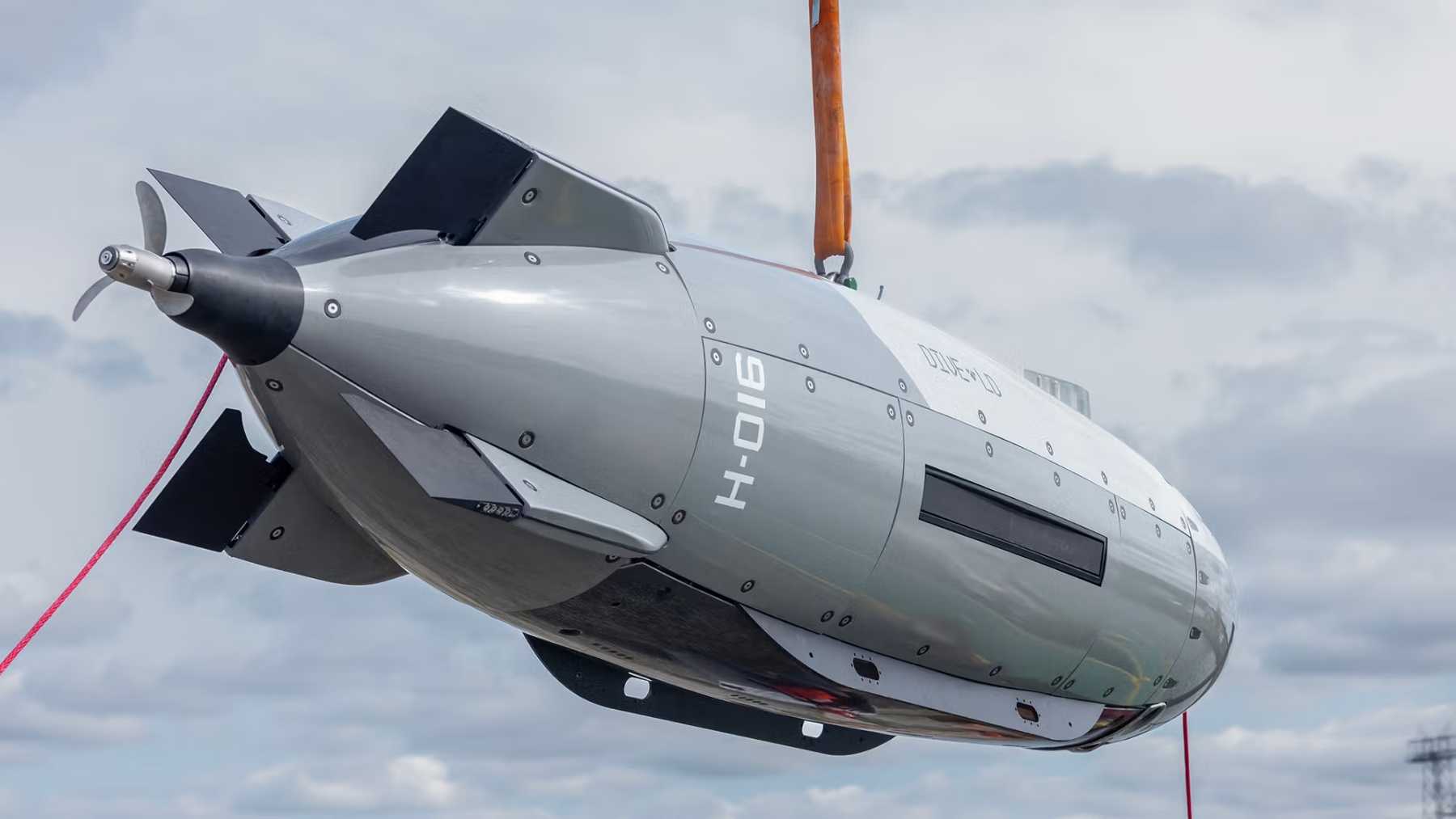
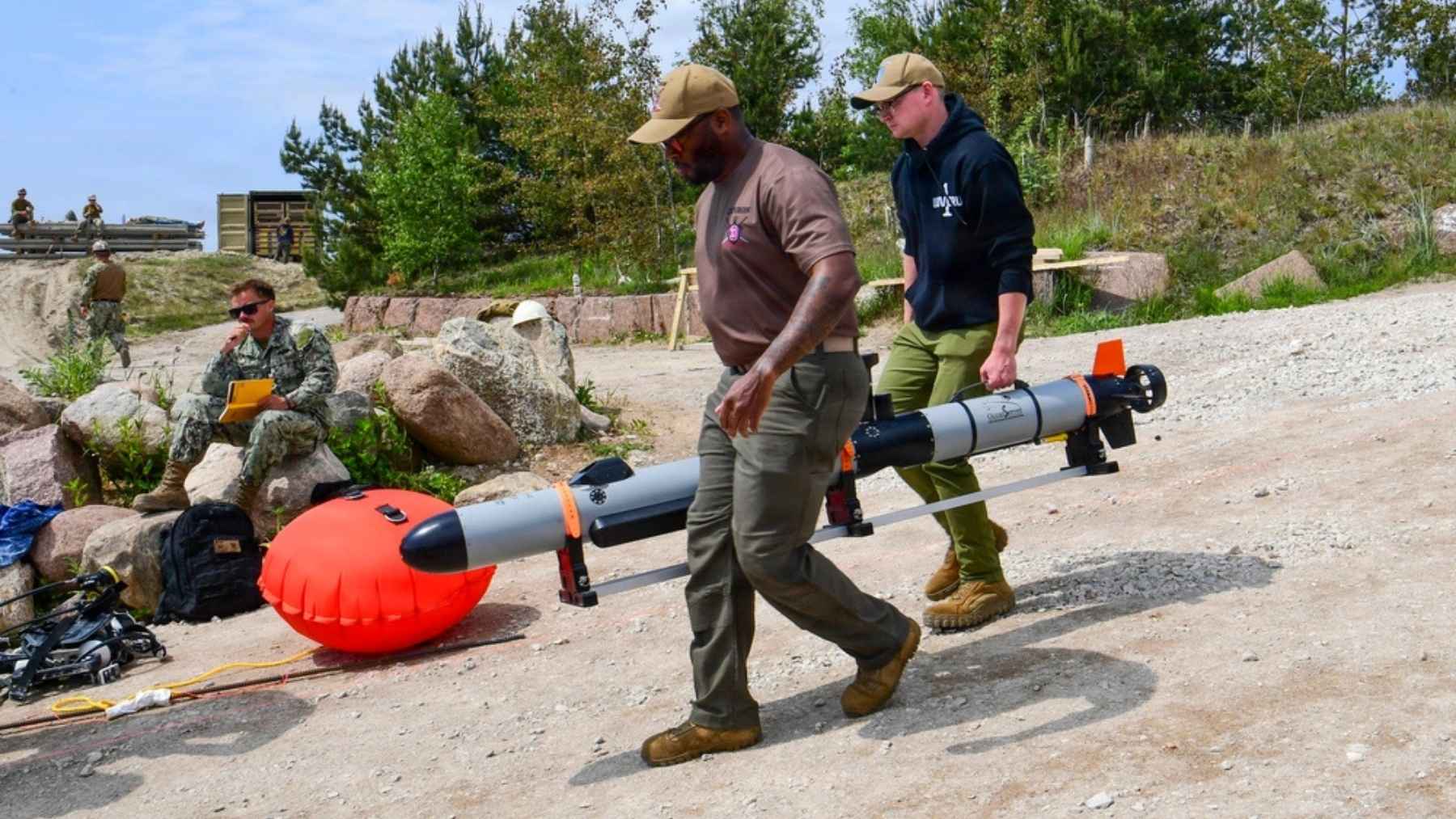
The demonstration ran at Liepaja, on Latvia’s Baltic coast, during NATO’s BALTOPS 2026 exercise. Naval Surface Warfare Center Panama City and Unmanned Undersea Vehicle Group One brought three counter-UUV technologies into the harbor: an expeditionary air curtain, an artificial kelp net, and seawater neutralization charges. The target was an Iver3, the small torpedo-shaped survey drone the Navy already uses for seabed mapping.
On its own that is a line item in an exercise report. The reason to look at it twice is the calendar. On July 24 the US Coast Guard posted a solicitation asking industry for underwater drone defeat systems it can buy off the shelf, and responses are due August 7.
The air curtain goes after four systems at once
An air curtain is roughly what it sounds like. You aerate a column of water and let the bubbles rise, which puts a moving wall between whatever you are protecting and whatever is coming for it. Ports have used the technique for years to hold back oil spills and to muffle the racket of pile driving.
What interests NSWC Panama City is what that wall does to a machine trying to swim through it. In the Navy’s own account of the demonstration, aerating the water goes after the drone’s depth sensors, its acoustic sensors, its buoyancy and its propulsion.
Four systems, one intervention, no explosives. The physics behind each of those is not exotic. A depth sensor reads pressure against a density it was calibrated for, sonar needs a predictable medium to travel through, buoyancy is a displacement problem, and a propeller in aerated water cavitates instead of gripping.
Javi Handal, a senior electrical engineer at NSWC Panama City, said the team was there to see how the curtain “disrupts and hinders UUV sensors,” and made the case for it on deployment speed, according to the Navy’s account of the demonstration. The system is pitched at anything sitting below the waterline: naval bases, military installations, ports and harbors.
The other two got a name and nothing else
The artificial kelp UUV net and the seawater neutralization charges were both listed and neither was explained. No specifications were published for any of the three technologies, no performance figures and no costs. Handal did not provide further detail when asked, according to The War Zone.
This was not a solo Navy effort either. Amphibious Construction Battalion 1, Underwater Construction Team One’s Construction Dive Detachment Charlie, a Netherlands explosive ordnance disposal element and a Latvian boat crew all worked the demonstration. Charles Humphrey, a science advisor with the Office of Naval Research Global, is credited in the Navy release with campaigning to get it into the exercise at all.
The audience was arguably the point. Watching from the pier were the Latvian Navy, the chief of staff of the Lithuanian Navy’s sea and coastal surveillance branch, and the innovation department of NATO’s Allied Maritime Command. Those are the people who would have to run this kit if it ever gets bought.
BALTOPS 2026 was the 55th edition of the exercise, with roughly 6,000 personnel from 15 allied nations. We covered the same unit’s drone operations off Liepaja when the exercise was running.
Nothing was destroyed, and the Navy has not said how well it worked
This is the part to be careful with. No kill was claimed. The Navy’s account describes learning which of the drone’s sensors were affected, not disabling a vehicle or recovering one off the bottom.
That is a normal thing for an early demonstration to produce. It is also a long way from a fielded weapon. The three systems have no published effective range, no published endurance, no published unit cost and no published probability of stopping anything.
Running your own drone through your own curtain also tells you less than running somebody else’s through it. The Iver3 was cooperative, its sensor suite was known to the people operating the curtain, and the water was a friendly harbor. A vehicle built specifically to cross a defended approach would give you a different number.
A drone already got into a defended harbor once
The reason any of this carries a budget is Novorossiysk. In December, Ukraine’s security service said it drove an underwater drone it calls Sub Sea Baby into the harbor at Russia’s Black Sea naval base and detonated it next to an Improved Kilo class submarine. How badly the boat was hurt has never been established.
The lesson the sector took from it was about access rather than damage. Something small enough to launch quietly reached a berthed submarine inside a naval base that was expecting trouble, in daylight.
Finding one of these is the hard part, and the acoustics are not on your side. Uncrewed underwater vehicles have low target strength, especially from bow and stern aspects, and put out very little radiated noise, as Kamil Sadowski, a Polish Navy anti-submarine warfare officer for 21 years, set out in an analysis for Navy Lookout. The sonars and torpedoes most navies own were built to hunt crewed submarines, and they are both expensive and poorly suited to this.
Passive listening does work at close quarters. A doctoral study out of the MIT-WHOI joint program detected a micro-UUV 96% of the time at 100 meters, about 330 feet, in a river with boat traffic going past, at the cost of an 18% false alarm rate. The work is described as the first to detect and track a UUV purely from the noise the vehicle makes itself.
Micro-UUVs are six inches or less across. A hundred meters of warning against something that small does not leave much time to decide anything, which is the argument for a defense that is already in the water and does not have to be aimed. It is also why the passive-listening side of the problem has attracted startups scattering cheap microphones across the seabed.
The Coast Guard wants something it can buy this month
The Coast Guard request went up on the federal contracting portal on Friday, July 24, under solicitation number 70Z02326RFI0005, run through the service’s Futures Development and Integration Directorate. Responses close on August 7.
The wording is unusually blunt for a procurement notice. Effective technologies exist for detecting and tracking underwater drones, the Coast Guard wrote, but very few tested and fielded systems actually defeat them.
Submissions have to sit at Technology Readiness Level 5 or higher, which means integrated and tested in a realistic environment rather than assembled on a bench. Detection-only systems will not be considered. If your product finds the drone but cannot do anything about it, the Coast Guard is not interested this round.
That condition is the whole story. The detection layer has been improving for years, from fixed hydrophone arrays to seabed sensor nodes to the large autonomous vehicles Germany now runs in the same sea. The defeat layer has not kept pace.
The Pentagon reached that conclusion in March. The Defense Innovation Unit and UK Defence Innovation opened a joint solicitation called REEF, short for Robotic Exclusion and Engagement Framework, asking for a full detect-track-classify-defeat chain with a human in the loop at every stage. Both kinetic and non-kinetic defeat options were on the table, with a stated preference for the non-kinetic ones. Bubble curtains were named specifically.
REEF closed to responses on April 3 and no awards have been announced. Four months after the Pentagon wrote bubble curtains into a solicitation, the Navy was blowing one at a drone in Latvia. We looked at the seabed barrier a Connecticut firm launched into that same window earlier this summer.
Air is the only one you do not have to reload
What Liepaja produced is a set of sensor readings and three named technologies with no numbers attached to them. That is early-stage work and the Navy has not dressed it up as anything else. The interesting part is the direction the money is moving.
The Coast Guard is not asking for a better sonar. It is asking, with a deadline of Friday, for something that stops the drone after the sonar has already found it. Nets, charges and interceptors all do that, and every one of them is gone once it has been used.
A wall of bubbles is the only candidate on the list that keeps working after it works. Whether it stops anything is the question nobody has answered on the record yet, and the people who ran the test in Latvia are not saying.