
Douglas County, Georgia, has known for more than a decade that its drinking water reservoir is too small. A study told the local water authority that the Dog River Reservoir couldn’t carry the county through another drought like the worst one in the state’s history, so the fix, which is now under construction, is to raise the dam 35 feet and more than triple the amount of water sitting behind it.
That’s what the county cares about. What I care about is how you get water out of a reservoir that’s about to be 35 feet deeper than it is today, because the answer turns out to be an 8-ton German machine that had to hold on to the rock so it wouldn’t roll itself over.
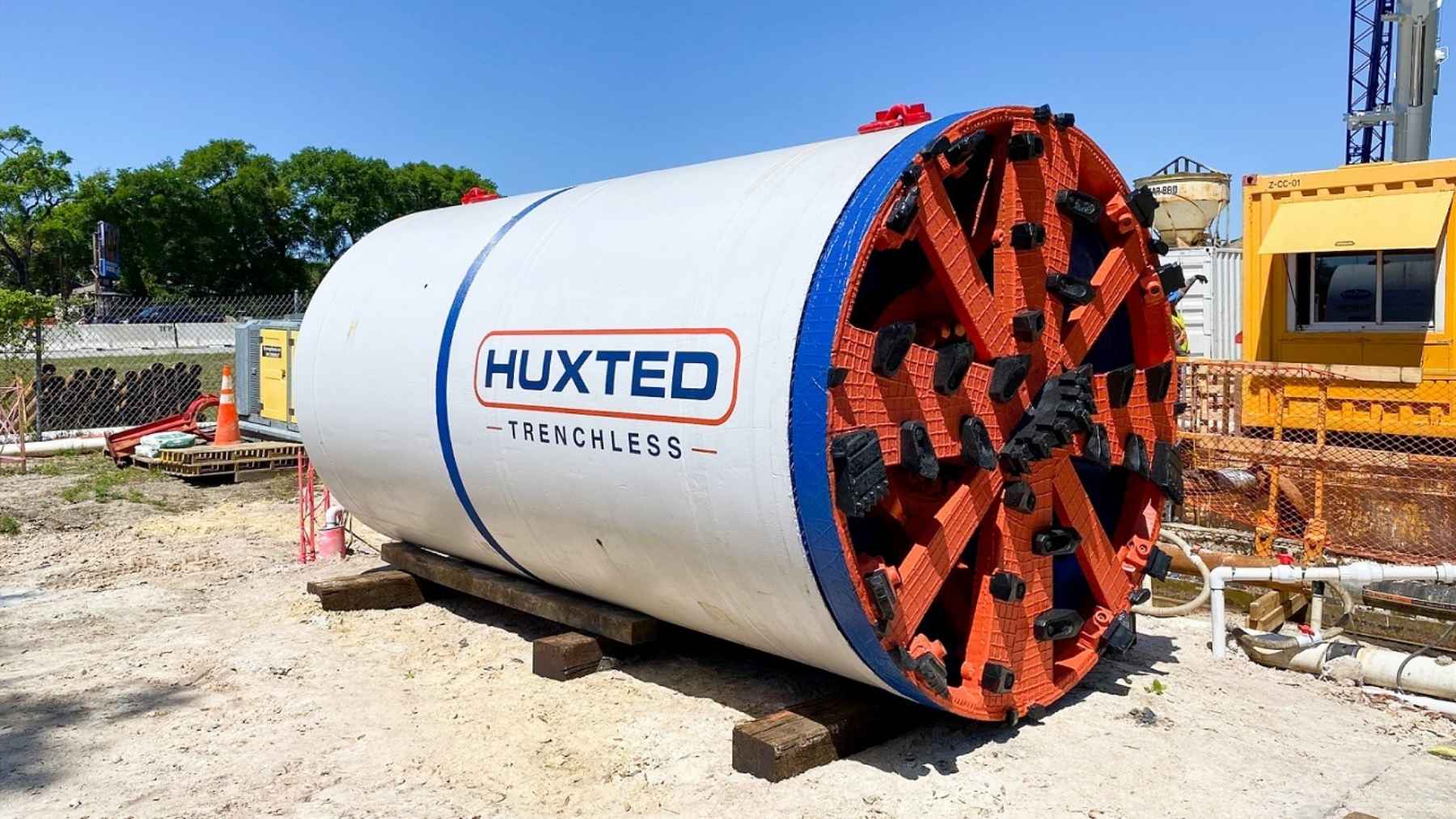
Huxted Trenchless, a microtunneling contractor out of Conroe, Texas, has finished three 51-inch water intake tunnels for the new pump station on the reservoir, according to an interview its field operations manager, Benny Burton, gave to Global Trenchless on September 29. The machine was a Herrenknecht AVN1000HR, each tunnel went in with a single pass, and the far end of every one of them was the bottom of the lake.
So what exactly is a microtunnel boring machine?
You’ve probably seen the big tunnel boring machines, the ones with names and a crew of a dozen people riding inside them under a city. This isn’t that. A microtunnel machine is a sealed steel cylinder that nobody can fit in, and an operator steers it from a cabin at the top of the shaft while a hydraulic jacking frame shoves it forward through the ground. Every time the machine advances the length of a pipe section, a new section gets lowered into the shaft and the whole string gets pushed in behind it. The cutterhead chews up the rock at the front, water (or a bentonite slurry) carries the pieces back out through hoses, and the machine basically leaves a finished pipe behind it as it goes. So in this case the three “tunnels” are really three 51-inch conduits that will carry raw water from the reservoir to the pumps.
Herrenknecht’s own description of the AVN1000HR gives you a sense of what’s going on at the front end. The HR stands for hard rock, and compared with the standard version it has a stronger main bearing rated for about 250,000 pounds of contact force, a drive that spins the cutting wheel up to 17 times a minute, and a 177-horsepower motor turning it. The wheel itself carries disc cutters tipped with tungsten carbide rather than the scraping teeth you’d use in clay.
How heavy is it? Herrenknecht’s data sheet for the AVN1000 series lists a 1,295-millimeter outer diameter, and that’s where the 51 inches come from, a shield just under 10 feet long, and a heaviest single piece of 7,600 kilograms, about 8.4 tons. The hard rock version carries that beefier bearing and drive, so I’d figure on a little more than that, but Huxted hasn’t published a weight for its particular machine.
Why does a boring machine need to hold on to anything?
Here you need to know one thing about spinning a cutterhead against hard rock, which is that the rock pushes back.
You know the feeling when a big drill bit catches in a piece of lumber: the bit stops and the drill tries to spin your wrist instead. A microtunnel machine has the same problem, just with a cutting wheel more than four feet across and several tons of steel behind it. The harder the rock and the more torque you put into the wheel, the more the body of the machine wants to rotate the opposite way. Roll a few degrees and your steering, your laser target and your slurry lines all end up pointing somewhere they shouldn’t.
Global Trenchless reports that because of the extra torque the hard rock drive puts out, this machine carries grippers located behind the trailing can, the section that follows the cutting shield, to keep the whole thing from rolling over. Grippers are essentially hydraulic pads that press outward against the tunnel wall. The body braces itself against the rock it just cut, the wheel keeps spinning, and the torque has somewhere to go that isn’t the machine’s own orientation.
It’s frankly a pretty elegant fix for a problem most people would never think a tunnel machine has. The big open-face hard rock TBMs use grippers too, but there they do the pushing as well. Here the pushing comes from the jacks in the shaft, and the grippers are purely there to stop the spin.
The exit was the bottom of a lake
An intake tunnel has one awkward requirement that a sewer or a utility crossing doesn’t. It has to end in the water.
Which means the machine doesn’t get to break through into a tidy receiving shaft on the far side. It cuts out through the lakebed, the reservoir pours into the tunnel, and somebody has to go get the machine. Huxted says it installed dual bulkheads to deal with that, which are basically two watertight barriers that keep the flooded tunnel from flooding the launch shaft where the jacking frame and the people are. Divers then handled the recovery of the machine from the reservoir.
We’ve seen this move before. A borer in Oklahoma came out through the bottom of Kaw Lake on the Enid water intake, and that recovery produced some of the strangest photos municipal waterworks have ever generated. The Dog River job is the same trick three times over, in rock, with a machine that had to hold on while it did it.
What Huxted hasn’t said is how long each drive was or how deep the tunnels run. The general contractor, a joint venture of Clark Water and Reeves Young, lists the intake scope on Clark’s project page as four microtunnels totaling nearly 550 linear feet, which works out to a little under 140 feet apiece. Huxted says three. So either a fourth drive is still to come or one of the four isn’t an intake, and I can’t tell you which from what’s been published.
What the three tunnels are feeding
The conduits lead to a new intake and pump station that will house two 2,500-horsepower vertical turbine pumps. The new dam and spillway raise the water surface from an elevation of 760 feet to 795 feet, and the Douglasville-Douglas County Water and Sewer Authority says storage goes from 1.9 billion gallons to 6.5 billion.
The reservoir itself is the county’s primary drinking water source. It originally supplied about 16 million gallons a day, was later expanded to 23 million, and the authority says that daily figure stays where it is. The extra 4.6 billion gallons are there to keep that same amount flowing through a dry year, which is apparently what that study said the old lake couldn’t do.
The price depends a bit on who you ask. The authority put it at around $390 million at its groundbreaking ceremony, the Douglas County Sentinel has used $400 million, and Global Trenchless now says $440 million. Any of those makes it the largest public infrastructure project Douglas County has ever built, and the authority closed the Dog River Recreational Complex last year because the new water level will put the boat ramp and the picnic area well underwater.
Clark lists the whole expansion for completion in 2029, and the water authority’s executive director, Gil Shearouse, has said the goal is a completed, filled reservoir by the end of that year.