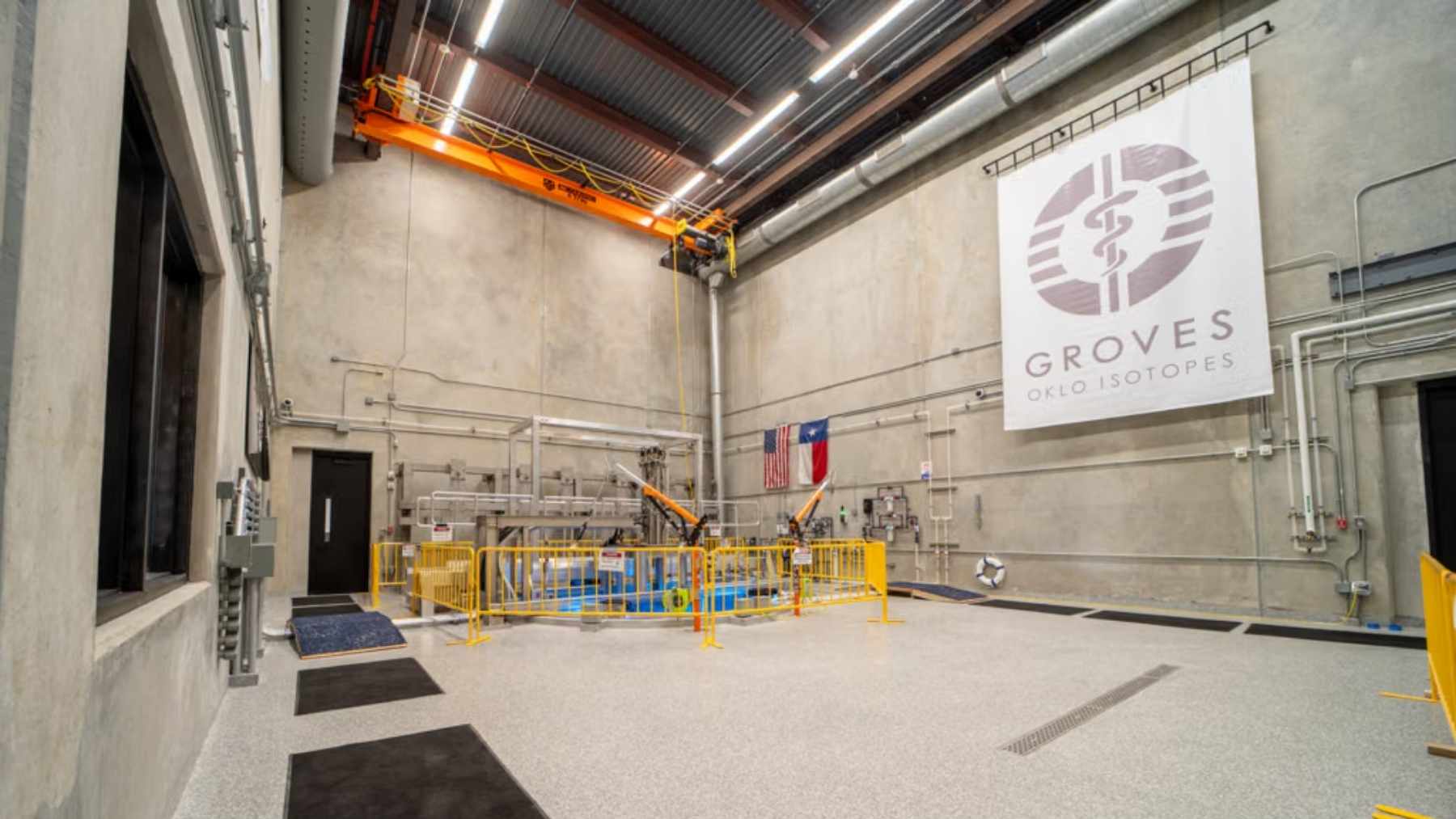

When you hear that a brand-new nuclear reactor in Texas has a chain reaction going, you probably picture a power plant: cooling towers, steam, a switchyard feeding a couple million homes. Groves, the reactor Oklo started up outside Lockhart this summer, doesn’t have any of that scenery. The whole thing fits in a building smaller than a Dollar General, and the most heat it’s allowed to make is 100 watts. That’s one old-school incandescent bulb.
The core first sustained a chain reaction on the night of August 5, a milestone Oklo announced the next morning. That made it the fifth reactor authorized by the Department of Energy to go critical this summer, and the first to do it on private land rather than a government site. And its entire planned operating life adds up to roughly 100 hours. That’s the whole program, not a first phase.
So why would anyone dig a 35-foot shaft and line it with reinforced concrete for less heat than a reading lamp?
Because the heat was never the point. Groves is what the industry calls a zero-power critical assembly, which sounds intimidating but basically means a real reactor with the dial turned all the way down. The chain reaction is completely real; it just isn’t asked to make meaningful heat. The physics of neutrons splitting atoms works the same at 100 watts as it does at full scale, so you can run the real experiment with real fuel, and you don’t need the turbines, the high pressure, or the giant cooling loops. A grid machine like the 705-megawatt reactor that keeps a third of New Brunswick’s lights on exists to push electricity out. Groves exists so a company can practice.
So what did Oklo actually build?
The most detailed public description sits in the environmental review the DOE signed off in June, and I’d argue the paperwork is more interesting than any of the press releases. The building covers about 4,600 square feet, and the reactor room takes up 1,650 of them. Under that room sits a below-grade, reinforced concrete cavity 35 feet deep and roughly 22.5 feet across, deep enough to swallow a three-story building. It’s a pool-type reactor: water-cooled, not pressurized, with the core sitting in an open tank of water rather than a sealed high-pressure vessel. If you’ve seen photos of research reactors glowing blue at the bottom of a pool, that’s the family.
The fuel’s the surprisingly normal part. Groves runs on five Framatome GAIA fuel assemblies, the same commercial design loaded into full-size light-water plants, filled with low-enriched uranium dioxide pellets. The DOE filing also rules out refueling entirely. Five assemblies go in, roughly 100 hours of operation come out, and that’s the whole run. For scale, a single large power reactor holds well over a hundred of these assemblies, and it’ll run for decades.
Everybody else went critical on government land
Groves came out of the DOE’s Reactor Pilot Program, part of a federal push that spent the summer racing small test reactors to criticality. Antares got there first at Idaho National Laboratory on June 4. Valar Atomics followed at a state-owned Utah energy lab on June 18, then Deployable Energy on June 30 and Aalo Atomics on July 4, both back at INL. Groves closed out the run on August 5, and it’s the only one of the five that happened on private land: leased ranch land in Caldwell County, Texas, on a site that held nothing but grass a year earlier.
Oklo says it put the building up in 229 days and went from groundbreaking to DOE startup authorization in just over 10 months, buying its fuel and major equipment commercially instead of drawing on government stock. Whether that impresses you probably depends on how many nuclear construction schedules you’ve sat through, but for context, the last big American power reactors took more than a decade to build. I find 229 days pretty remarkable for anything with fissioning uranium in it, and I’ll admit I went back to double-check the number.
So what happens when the 100 hours are up?
Groves isn’t done testing, by the way. It keeps working through the startup program under DOE authorization: measuring how the core behaves, checking controls, shutdown performance, procedures, and whether the people and the paperwork hold up when there’s actual uranium involved. Oklo hasn’t published a running tally of how many of those 100 hours it has used since August, and I can’t find a test-by-test schedule anywhere in the public record. There’s an endpoint on the books, though: the DOE filing puts the operational phase as complete by the end of 2026.
Then the site gets unwound. The used fuel eventually goes back to the DOE, contaminated components head to a licensed low-level waste disposal facility, the same category of site where a Vermont reactor building recently ended up, and the land gets restored to more or less its original condition. A nuclear facility with a built-in expiration date is a strange thing to read about in this industry, and I mean that as a compliment.
Those 100 hours are practice for something much bigger. Groves belongs to Oklo Isotopes, the business Oklo built around its 2024 purchase of radioisotope firm Atomic Alchemy, and the plan it feeds is a multi-reactor isotope foundry with up to four VIPR units of around 15 megawatts thermal each, roughly 150,000 times the heat Groves is allowed to make. The concept works by parking target materials near a reactor core so the neutrons transmute some of their atoms into isotopes used in cancer treatment, medical imaging, industry, and space hardware. Groves itself makes none of them, and Oklo isn’t pretending otherwise. “Groves is a low-power test reactor and will not produce isotopes,” Oklo communications head Bonita Chester told POWER magazine, adding that any future production facility needs its own design and its own licensing round.
Practicing at 100 watts before you bet on 15 megawatts strikes me as a pretty sensible way to learn this business. Per the DOE’s own environmental filing, the operational phase covering those 100 hours wraps up by the end of 2026, and the chain reaction it authorized first ran on the night of August 5.