
I’ve watched the same 48 seconds of video about a dozen times this week, and I still can’t tell you which way is up for most of it. The camera is bolted to the deck of a boat. The boat is inside a Category 3 hurricane. Everything else in the frame is either gray water standing on end or gray sky that’s about to become gray water.
The boat has no one on it, which is the only reason the clip exists.
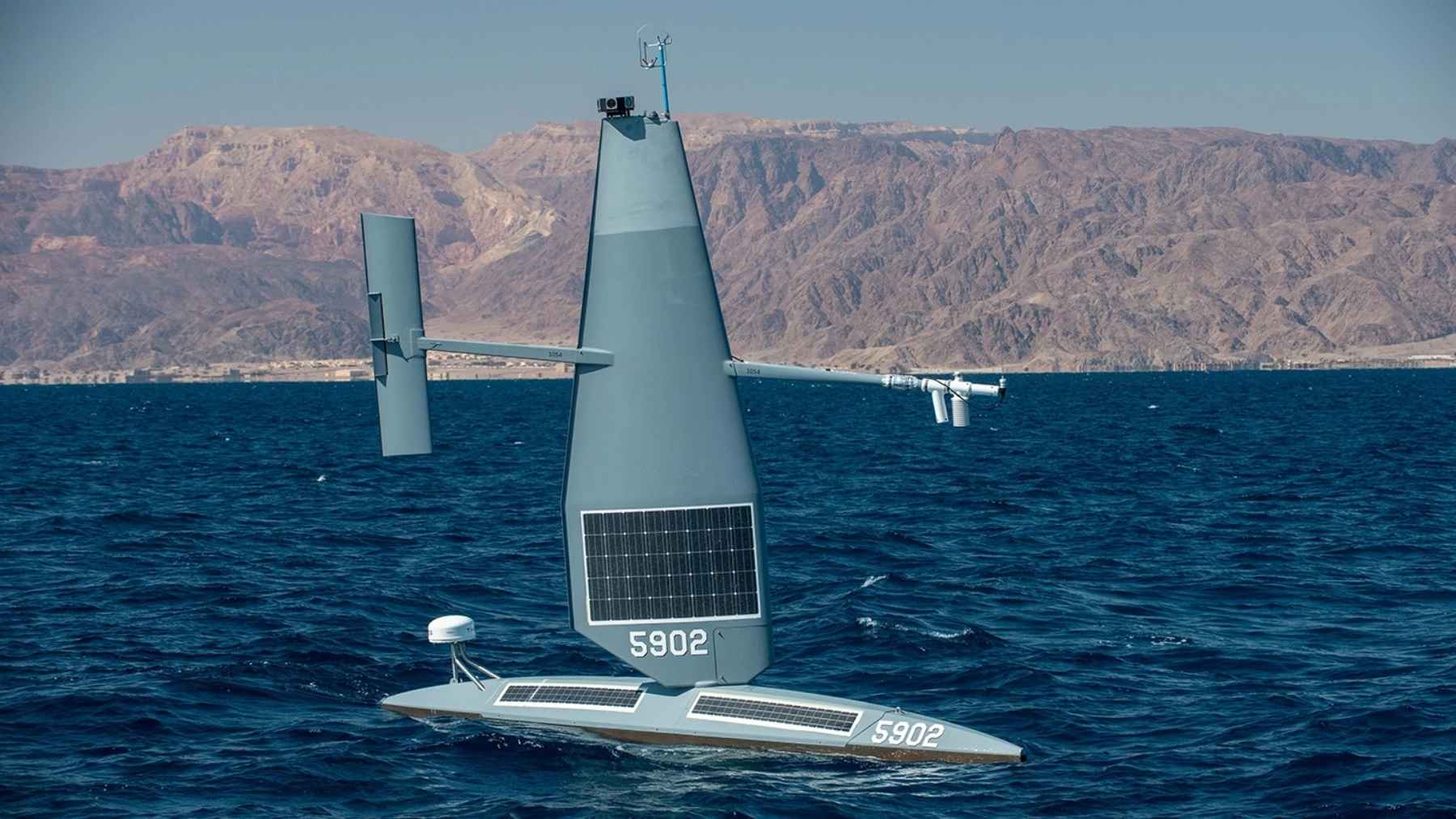
On October 9, a 23-foot Saildrone Explorer called SD-1045 was sitting about 150 nautical miles south of Pensacola when Hurricane Isaias came up the Gulf toward it. The company’s pilots, working from a control room in Alameda, California, pointed it at the northern edge of the storm, and it went in, crossed the eye and came out the other side. According to Saildrone, the boat logged wind gusts over 103 mph and waves up to 65 feet on the way through. A second boat, SD-1057, took the eastern side of the storm roughly 170 nautical miles west of Sarasota.
For reference, a 65-foot wave is a six-story building. The boat’s 23 feet long, reportedly weighs around 1,500 pounds, and cruises at one to three knots. So you’re basically looking at a dinghy with a surfboard fin getting dropped off the roof of an apartment building, repeatedly, on purpose, and then sailing home.
Isaias hit the coast that same night. The National Hurricane Center had it at 120 mph and Category 3 on Friday morning, and by evening wind shear and the coast itself had shaved it back to a Category 2. It came ashore near Destin, Florida, at about 9:30 p.m. ET with sustained winds of 105 mph and a pressure of 971 millibars, per weather.com’s recap. A gust of 116 mph showed up at Santa Rosa Sound. Around 700,000 customers lost power across the Panhandle, and two people died.
So what exactly is a Saildrone?
Picture a kayak-shaped hull with a hard vertical wing sticking up out of it instead of a sail, and a keel underneath. The wing catches wind and pushes the boat along, and the solar panels glued to the wing and the deck run the electronics. There’s no engine, no fuel and no cabin. The standard wing is 15 feet tall, the draft is about 6.5 feet, and the thing can stay out for a year or more without anyone touching it.
That’s the normal version. The hurricane version swaps the tall wing for a stubby, reinforced one.
Richard Jenkins, who founded the company, explained the logic back when the program started: the wing is usually the first thing to fail in high wind, so you make it shorter. “It reduces weight, the center of gravity is lower,” he told the Boston Globe. It’s the same idea as reefing a sail on a regular sailboat, except you don’t reef it during the storm, you bolt the short one on in port and leave it there for five months. Which is frankly a pretty elegant fix for a problem that sounds like it should need a whole new boat.
I’d also point out that the Explorer is the small one. Saildrone builds a 170-foot version that hunts submarines for the Navy. The 23-footer got weather duty.
Why would anyone sail a boat into a hurricane?
Because nobody else is down there. Hurricane Hunter aircraft fly through the storm and drop sensors on parachutes, and satellites watch the cloud tops from above. Both of those are great at telling you where a storm is and roughly how strong it is. What they’re not great at is measuring the thin layer right at the surface, where the ocean hands heat and moisture up to the storm and the storm decides whether to coast or explode.
And that deciding part is where forecasts still go wrong. Forecasters call it rapid intensification, and NOAA’s definition is a jump of at least 35 mph in sustained wind inside 24 hours. Isaias did exactly that on its way to the Panhandle. It was the first Atlantic hurricane of 2026, the latest first hurricane of the modern era by about four weeks, and AccuWeather clocked it gaining 35 mph in under 24 hours on the way in.
If you live on the Gulf Coast, you know why that matters. You go to bed with a Category 1 offshore and wake up with a major hurricane a few hours out, and your evacuation window just got a lot shorter.
So since 2021, NOAA has paid Saildrone to park these boats in the spots where storms statistically like to form, and then steer them straight at anything that shows up. The boats measure wind, air and water temperature, humidity, pressure, salinity and wave height, and they send it all back in real time, including to the National Hurricane Center while it’s writing advisories. Greg Foltz, a NOAA oceanographer and one of the mission’s lead scientists, says each storm the boats get into gives his team “more data to evaluate and improve prediction models,” per the mission announcement.
This boat has done this before
SD-1045 isn’t a new hull. It’s the same boat that sailed into Category 4 Hurricane Sam on September 30, 2021, took 50-foot waves and winds over 120 mph, and came out with the first video anyone had ever shot from inside a major hurricane at sea level. Saildrone says that clip earned it a Guinness World Record. Fox Weather says it’s gone out on every hurricane mission since.
Its partner on Isaias has a résumé too. SD-1057 went through the eye of Hurricane Debby in 2024 just days after it’d been put in the water.
The program’s grown from five boats in 2021 to 10 this year, and Saildrone’s count as of May was 21 different hulls used, 21 named storms intercepted on 46 separate occasions, and more than 2,600 days on mission. Its own spec sheet lists the highest wind speed one of its boats has ever recorded as 109.83 knots, and that’s about 126 mph. We covered the 2026 fleet when it went out in July, back when the only Category 5 on the planet was in the wrong ocean. Isaias was the first real customer.
There are 21 more of them out there right now
The two boats that met Isaias were launched out of St. Petersburg, Florida, according to the Tampa Bay Times. They’re part of a 2026 NOAA fleet of 10 Saildrone Explorers plus 13 smaller robot boats from a company called Oshen, spread across the Gulf, the Caribbean and the western Atlantic. Thirteen cheap boats backing up 10 expensive ones is arguably a smarter way to cover a storm than NOAA could’ve managed with Explorers alone. Two of the Explorers also carry carbon dioxide sensors, because NOAA wants to know how much CO2 the ocean and the air swap during a storm, and apparently the only way to find out is to be there.
There’s a fair amount Saildrone hasn’t released yet. The company’s put out the gust number and the wave number and the video, but I can’t find a pressure reading from inside the eye, a significant wave height figure, or any word on what shape SD-1045 came out in. NOAA’s own blog for the 2026 mission still says “coming soon.” Given that the 2021 boat lost zero sensors going through Sam, I’d guess 1045 is fine, but that’s a guess.
What we do know is where it’s going next: nowhere. NOAA’s mission page lists the whole fleet on station through November, and Saildrone’s boats stay at sea for the duration. Isaias came ashore near Destin at 9:30 p.m. ET on October 9, and the boat that went through it was still floating out in the Gulf the next morning, waiting for the next one.