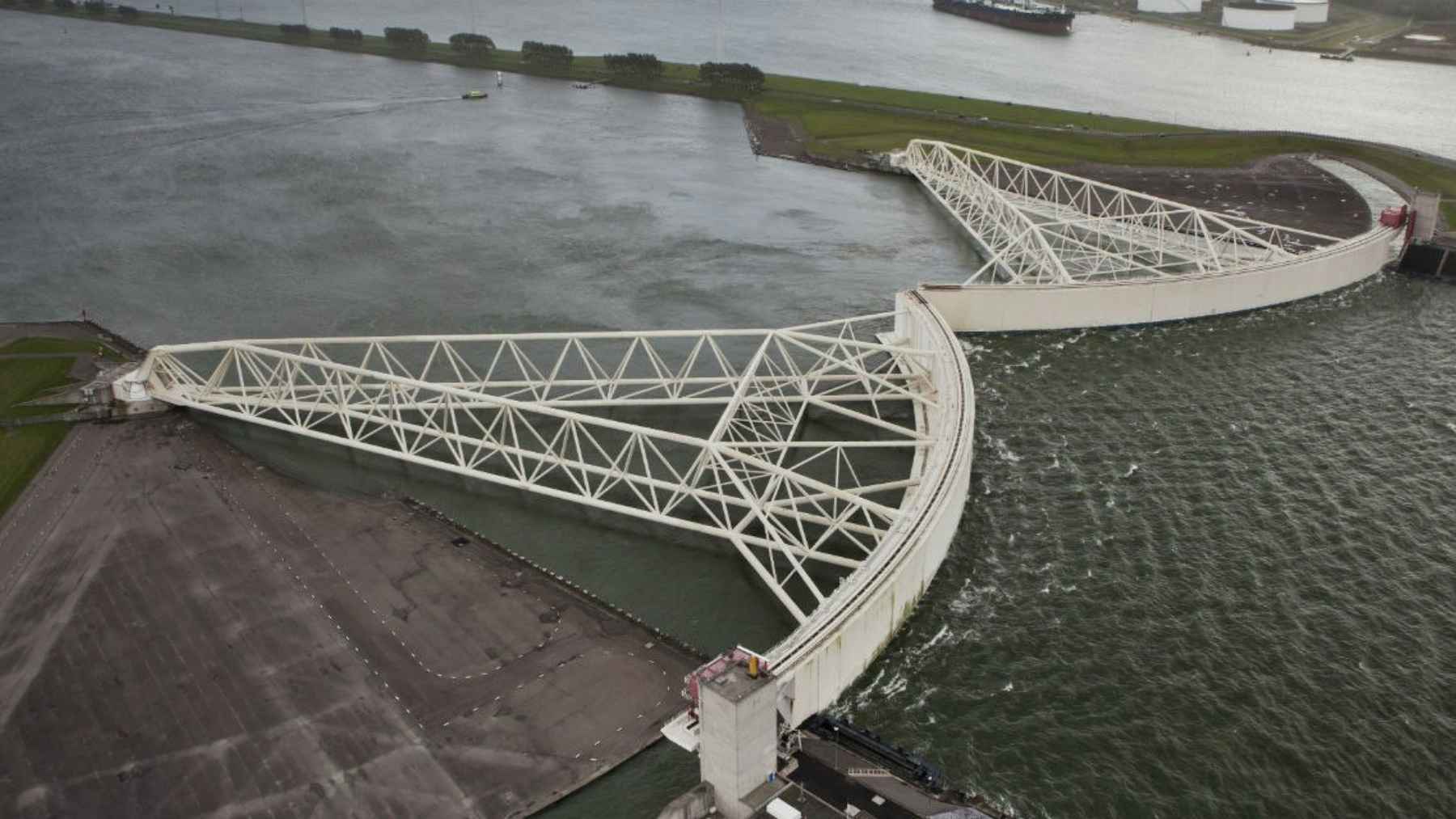

Hurricane season has about six weeks left on this side of the Atlantic. Over in the Netherlands, storm season officially started on October 1, and it’ll run all the way through April 15.
The North Sea’s the problem there. A big storm parked in the wrong spot can shove it up into the rivers around Rotterdam, and that’s called a storm surge. Strong wind and low air pressure pile seawater up against the coast, and if that lands on top of a high tide, the extra water keeps pushing inland.
So every September, right before the season kicks off, Rijkswaterstaat closes Rotterdam’s storm barrier on purpose, with a crowd watching. Rijkswaterstaat, in case the name’s new to you, is the Dutch government agency in charge of the country’s main highways, waterways and big flood defenses. You can think of it as the Army Corps of Engineers and a highway department rolled into one.
The barrier’s called the Maeslantkering (kering means barrier), and it sits on the New Waterway, the shipping channel that links the port of Rotterdam to the North Sea, near Hook of Holland on the coast. It went into service in 1997 as the last of the Delta Works, the big chain of Dutch dams and barriers, to be finished. Together with a second barrier and the dikes behind them, it protects about 2 million people in Rotterdam, Dordrecht and the surrounding area, according to the agency’s announcement of this year’s test.
So what happened on September 12?
Rijkswaterstaat had said the doors would start closing around 3:30 p.m. Dutch time that Saturday, and local outlet Westlanders.nu reported that the barrier closed right around then, with the test going to plan. Once it was done, the barrier opened back up and the ships got their channel back.
That second barrier, the Hartelkering near Spijkenisse, closed too, since the agency always shuts the two together, test or no test. Ships were kept away from the Maeslantkering from 12:50 p.m. Saturday until 4:25 a.m. Sunday. That’s 15 hours and 35 minutes, by my math.
Rijkswaterstaat called last year’s test the 28th, so by my count this one’s number 29. I couldn’t find the agency’s own write-up of this year’s closure, though, so the timing comes from its published schedule and that local report.
How do you shut a door that big?
The two doors normally wait in dry docks on opposite banks. Each one’s 689 feet long, which is just shy of two 360-foot football fields with the end zones counted. They’re also hollow. When a closure starts, the docks fill with water and the doors float out like a pair of very large barges, then swing toward each other across the channel until they meet in the middle. Compartments inside them flood, and they sink to the bottom.
Rijkswaterstaat says the doors settle on the bottom within two hours once they’ve flooded, and at a recent test, the agency clocked the whole routine (floating out, swinging shut and sinking) at a little over two hours. To open up again, the water gets pumped back out and the doors float home.
If that sounds familiar, it’s the same float-then-flood idea we’ve seen with the floating dry dock in Alabama that sinks itself to lift destroyers and the 81,000-ton tunnel boxes going down onto the Baltic seabed.
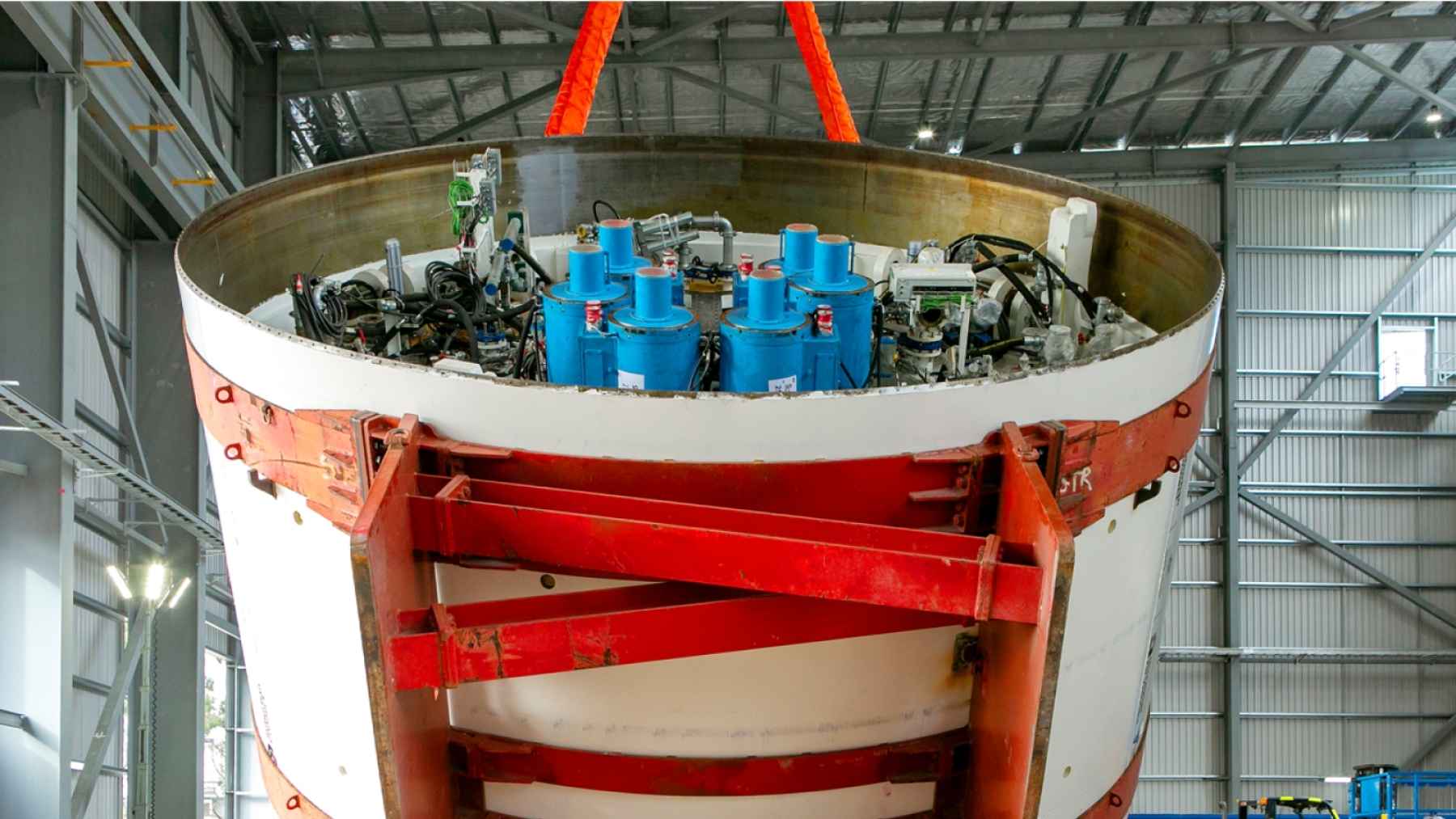
Each door swings on a single steel ball joint on the bank behind it, and frankly, those joints are the most impressive thing here. Each one measures 33 feet across and weighs about 750 tons, according to Rijkswaterstaat’s page on the barrier, which also says there’s no flood barrier anywhere with bigger moving parts. A joint like that’s got to let the door swing out across the channel and then drop to the bottom. The ball joint in your car’s front suspension does basically the same job, letting a wheel steer and move up and down at the same time. Yours just fits in your hand.
A document the agency put out for contractors says the joints are due for major maintenance in 2028, and the job involves jacking the ball up to make room to work on it. I’d pay good money to watch that.
Rijkswaterstaat doesn’t list what the doors themselves weigh, though. I found a few different numbers online, and they don’t agree with each other, so I’m sticking with what the agency actually publishes.
A computer decides when it closes
In a real storm, the barrier closes on its own once the water level in Rotterdam is forecast to reach 9.8 feet above NAP, or 9.5 feet in Dordrecht, farther upriver. Nobody has to push a big red button.
NAP stands for Normaal Amsterdams Peil. It’s basically the Dutch version of sea level, a fixed line that every water height in the country gets measured against.
Humans still keep watch, though. Rijkswaterstaat says a team of its experts is always on site when high water’s expected, keeping an eye on the automatic system and ready to step in if it’s needed.
Figures: Rijkswaterstaat, converted to U.S. units.
So how often does it really close?
Once, by its own rules. The barrier did close during storms twice before, but both times Rijkswaterstaat had temporarily set the trigger at 8.5 feet so it could test its systems in real storm conditions. The first storm to push the forecast past the official line was Storm Pia, on December 21, 2023. The doors were fully shut later that night, and every other storm surge barrier the agency runs was closed too.
Peter Vlam, who led the barrier team that night, told the agency afterward that the crew slept on air mattresses in the control room, right next to their desks. He made a point of saying it wasn’t a luxury hotel. I believe him.
Frankly, the agency’s got a pretty smart rule for long quiet stretches, too. A barrier that only ever closes for an audience can’t tell you much about how it’ll handle a gale, so if seven years go by without a storm closure, Rijkswaterstaat sets the trigger at 8.5 feet for one closure and lets the team practice under storm conditions.
Its control software is due for replacement
Rijkswaterstaat says the September test checks its team as much as the barrier, and the computer side of that operation just got a pretty rough review. The Adviescollege ICT-toetsing (AcICT), a board that reviews big IT projects for the Dutch government, gave the infrastructure minister its final advice on August 19. It says the software that controls the barrier has nearly 100 known defects that could lead to serious failure, and it calls the system’s current state unacceptable for something this safety-critical. It also says the agency’s plan for replacing that software falls short, on key points, of IEC 61508, an international standard for safety-related control systems.
Under Dutch law, the barrier can’t fail more than once in every 100 closures under storm conditions, according to the AcICT. Infrastructure minister Vincent Karremans sent the board’s advice to parliament on September 18, and the paperwork that went with it says the replacement tender, which was due out in September, won’t start until later. Rijkswaterstaat says it’ll rework the project around that standard.
The agency would like the new system in before 2030, when support for the current hardware runs out, and it’s still working out what all this does to the schedule and the budget. Until then, it says the barrier meets its legal safety requirements, with its systems tested every month, a test closure every year and the option of running it by hand.
Honestly, a review board telling the government to slow down and get safety-critical software right sounds like the system working the way it’s supposed to.
Rijkswaterstaat has the barrier on call through April 15. If you’d rather watch it close without a storm attached, the barrier’s scheduled to close again next September, crowd and guided tours included.