
Old tube TVs drew their pictures by firing a beam of electrons at the back of the screen and steering it with magnets. That’s why holding a fridge magnet up to one turned the picture into a smeared rainbow, something plenty of kids found out the hard way, usually right before a parent walked in.
Fusion reactors run into the same physics from the other side. The donut-shaped ones, called tokamaks, hold their fuel in place with enormous magnets, and those magnets bend the path of anything that carries an electric charge. That’s great for keeping a plasma of roughly 270 million degrees Fahrenheit off the walls. It’s a lot less great when you want to shoot extra heat in from outside.
So the people behind ITER, the giant international fusion experiment in southern France that took delivery of the last slice of its plasma chamber on October 2, settled on a fix that sounds a little backward. You build a beam out of charged hydrogen, because charged particles are the only kind you can speed up with voltage. Then you take the charge back off before the beam ever reaches the magnets.
The machine that handles the first half of that trick weighs about 16.5 tons, and it’s now sitting in a lab in Padua, Italy. On October 5, ITER reported that it had passed its site acceptance tests, along with the last big component of the test rig it’ll live in. It hasn’t fired a beam yet.
So what is MITICA?
MITICA stands for Megavolt ITER Injector and Concept Advancement, and it’s probably not an accident that it’s also Italian for “mythical.” It’s a full-scale stand-in for ITER’s two neutral beam injectors, the machines that’ll help heat its plasma, and each of those is rated for up to 16.5 megawatts. Consorzio RFX, an Italian fusion lab, hosts the test site, which already runs a smaller sibling called SPIDER that only tests the ion-making end at a tenth of the voltage.
Just so we’re clear, MITICA won’t make a single watt of electricity. It’s a test rig. Its whole job is proving the heater works at full size before ITER gets its own pair.
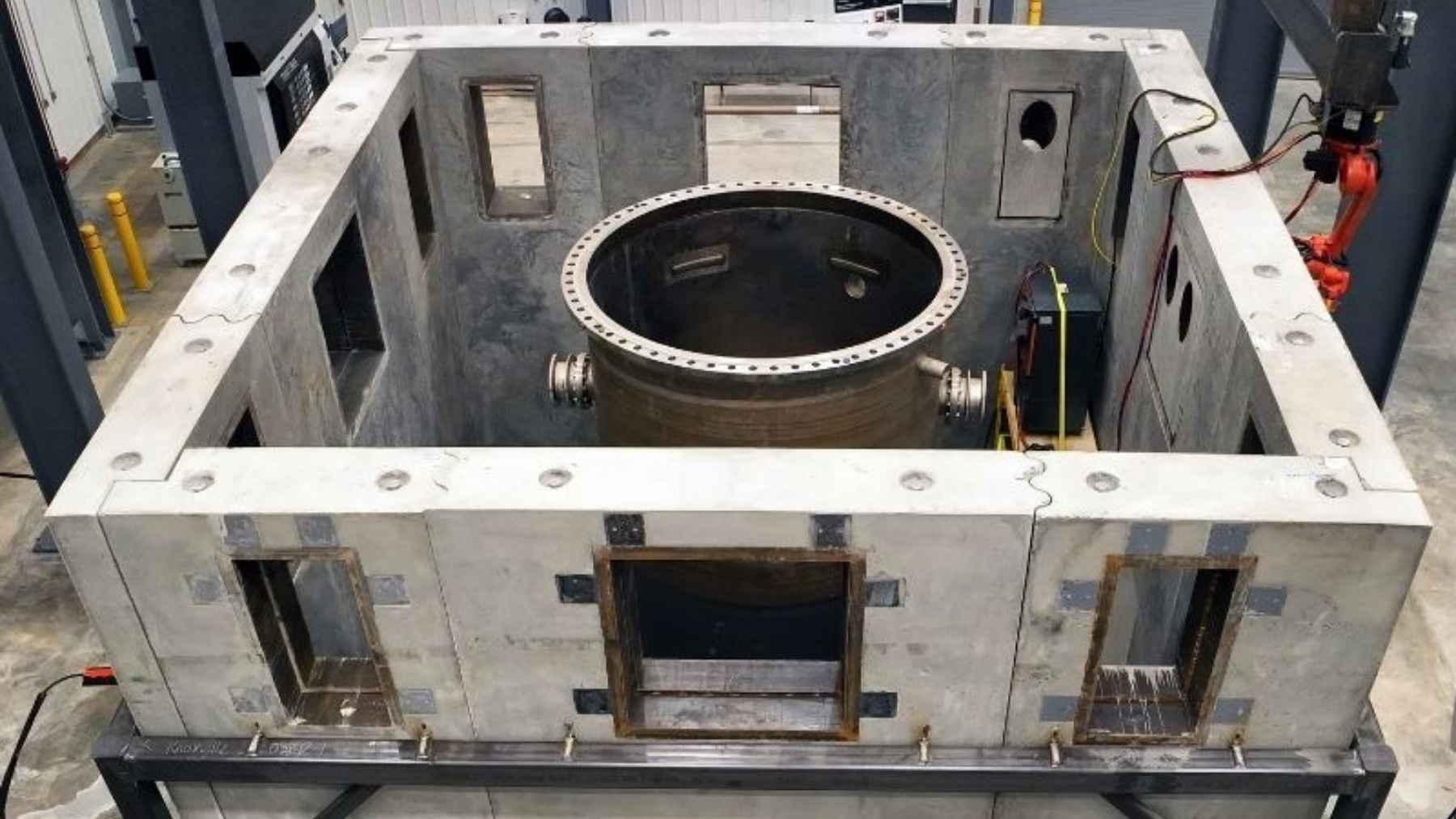
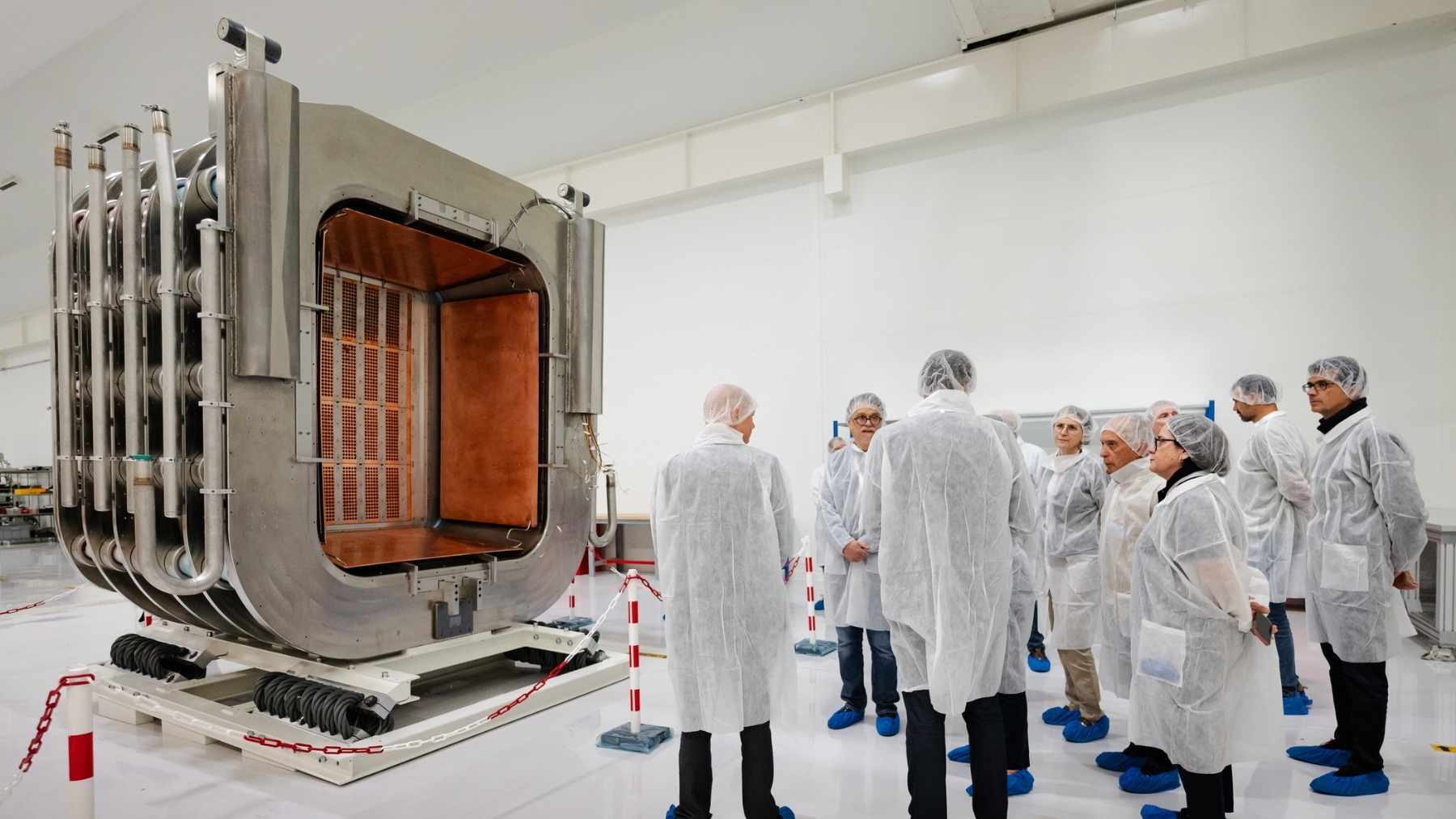
The 16.5-ton piece is the beam source. ITER lists it at just under 10 feet wide, just under 10 feet deep and almost 15 feet tall, so it’d clear a regulation basketball rim by nearly five feet. Inside, eight radio-frequency drivers, set up in four pairs, zap hydrogen or deuterium gas until it’s a plasma. One grid, coated to help the process along, pulls the negative ions out, and the grids stacked behind it speed them up.
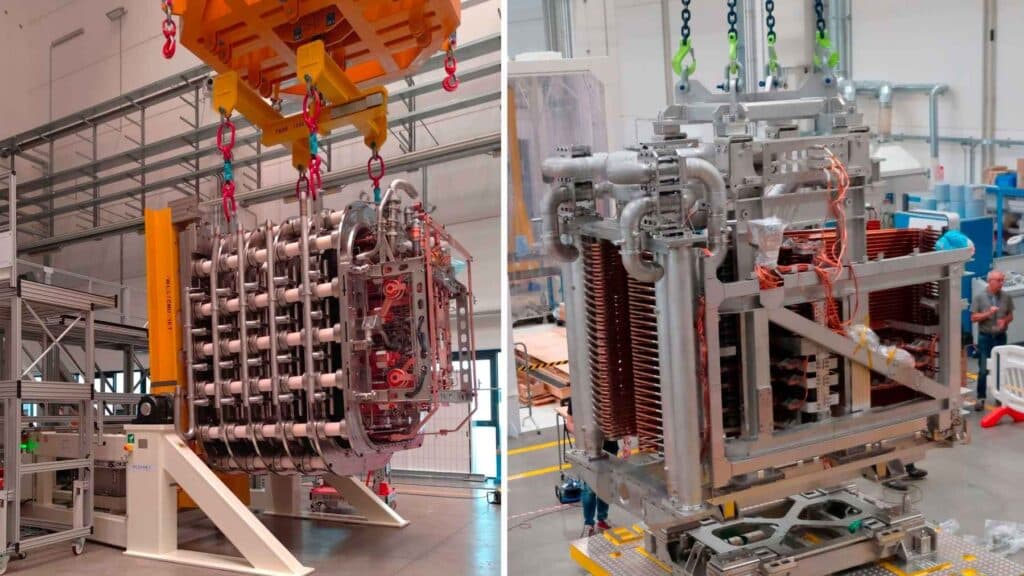
That stack is where the precision gets a bit silly. According to Consorzio RFX, the source uses seven perforated copper grids, lined up so 1,280 separate little beams can pass through all of them. Fusion for Energy, the EU agency that supplied most of MITICA’s parts, says those holes had to be aligned to within micrometers. A micrometer is roughly a hundredth of the thickness of a sheet of printer paper.
Then there’s the voltage. The grids push the ions through five 200-kilovolt steps, and those add up to about a million volts. ITER puts the beam’s power at up to 40 megawatts and calls MITICA’s source “the most powerful ion source ever built.”
So why negative ions?
Because at these speeds, a fast positive ion almost never grabs an electron, while a fast negative ion gives up its extra one pretty easily. A negative hydrogen ion is just a hydrogen atom carrying one electron too many. RFX says the whole system runs negative for exactly that reason: it makes the next step, neutralization, work better.
The neutralizer is basically a box of thin gas
Downstream of the source, the beam runs through the neutralizer. It’s four channels built from five copper panels, with a faint wisp of hydrogen or deuterium gas inside. The fast ions crash into the gas molecules, lose their extra electron and keep going at the same speed. Now they’re neutral atoms, and a tokamak’s magnets can’t steer them.
It isn’t a clean swap, though. RFX puts the neutralizer’s efficiency at about 50 to 60 percent, so a big share of the beam comes out still charged. Electric fields yank those leftovers sideways into a component called the residual ion dump, which is built to soak up around 19 megawatts on its own.
So the beam sheds a lot of power on the way out. The source produces up to 40 megawatts of ions, and each ITER injector is rated for up to 16.5 megawatts of heat in the plasma. Frankly, that’s a pretty lossy way to warm something up. But ITER’s counting on two of these injectors anyway, which tells you something about how hard it is to push heat deep into a plasma that size.
Yes, the beam source weighs 16.5 tons and each injector is rated for 16.5 megawatts. No, that doesn’t mean anything. I checked.
Everything is finally in Padua
A French contractor assembled and tested the beam source in Tarbes, near the Pyrenees, with 18 specialist firms feeding it parts, according to Fusion for Energy. The source arrived in Padua by road in mid-June and passed a helium leak test shortly after. That’s the standard way to prove a box that’s supposed to hold a vacuum actually can. A couple of weeks later, the calorimeter showed up from a workshop in northern Spain.
The calorimeter is basically the injector’s backstop. It’s two movable panels packed with copper-alloy tubes set close together, cooling water running through them, and built-in sensors that measure the beam’s strength and shape. During MITICA’s tests it’ll stay closed and take the hit, since there’s no plasma at the other end to aim at.
There’s a catch, though. ITER says the calorimeter design can handle a full-power beam hitting it at up to roughly 1.3 megawatts per square foot. But Fusion for Energy says the unit sitting in Padua is meant for low-power commissioning, and an upgraded calorimeter for the high-power runs is still being worked on. So the backstop in Padua right now isn’t built to take the full blast.
Engineers looked the source over, measured it, leak-tested its cooling lines and ran electrical and insulation tests. ITER says it still needs some adjustments to its ceramic-to-metal seals, based on what the team learned running SPIDER. Those seals are the joints where an insulating ceramic part meets metal, and on a box that’s going to sit at nearly a million volts, you really want those joints right.
So when does it actually fire?
Not this year. ITER says installation in Padua should get going in spring 2027, and commissioning is penciled in for that summer.
Meanwhile, the power supply’s had a rough patch. A fault in MITICA’s 1 MV insulation transformer threatened the program, and ITER says running jobs in parallel and reshuffling the schedule cut the expected delay from about ten months to five. I couldn’t find anything from ITER on what actually failed inside that transformer. It does say repairs are nearly done. Five months is arguably a rounding error by fusion standards, which is a pretty depressing thing to type.
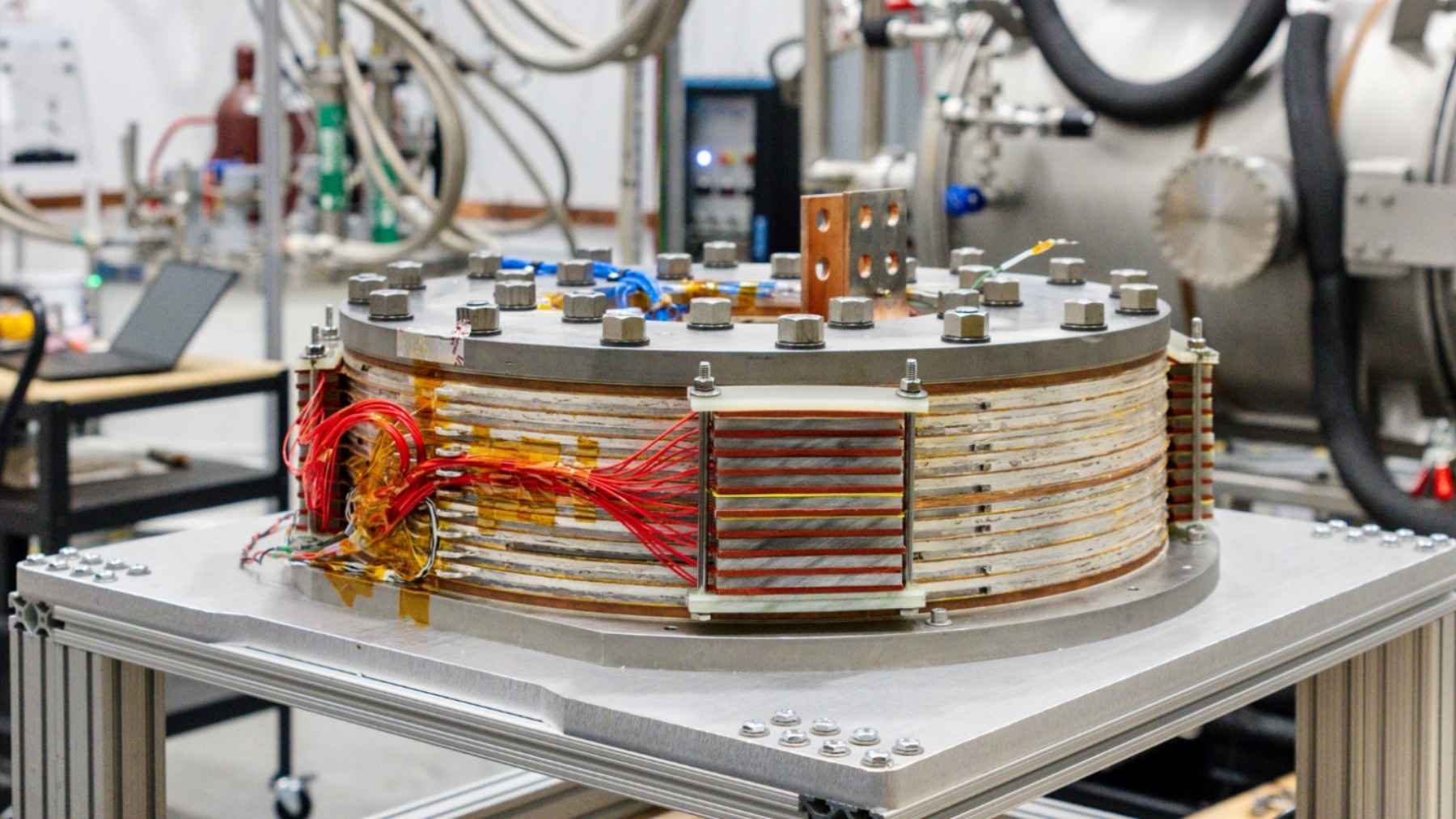
Next, engineers want to run the power supplies that feed the accelerator grids all the way to 1 MV, hooked up to a dummy load. A dummy load is a stand-in that soaks up the power, so you can crank the system all the way up without anything real on the other end. ITER says testing of cryogenic panels is underway too.
The vacuum side has its own odd details. According to RFX, the cryopumps lining MITICA’s 49-foot steel vacuum vessel are partly coated with an absorbent made from coconut shells, which traps hydrogen once it’s chilled to roughly 450 degrees below zero. I didn’t expect coconuts to show up in a million-volt fusion story, but here we are.
The beam source and its backstop will sit in Padua until then. ITER put the updated timeline out on October 5: installation kicks off in spring 2027, and MITICA’s commissioning is penciled in for summer 2027.