
Anyone who’s driven past a big solar farm in Texas or Arizona early in the morning has probably seen the panels all tipped toward the east, like a field of satellite dishes waiting on the same broadcast. Come back late in the afternoon and they’ve swung west. That’s a single-axis tracker doing the only job it’s ever had, which is wringing as much electricity as it can out of every hour of daylight.
A research center in northern Spain wants a tracker to take orders from an olive tree instead.
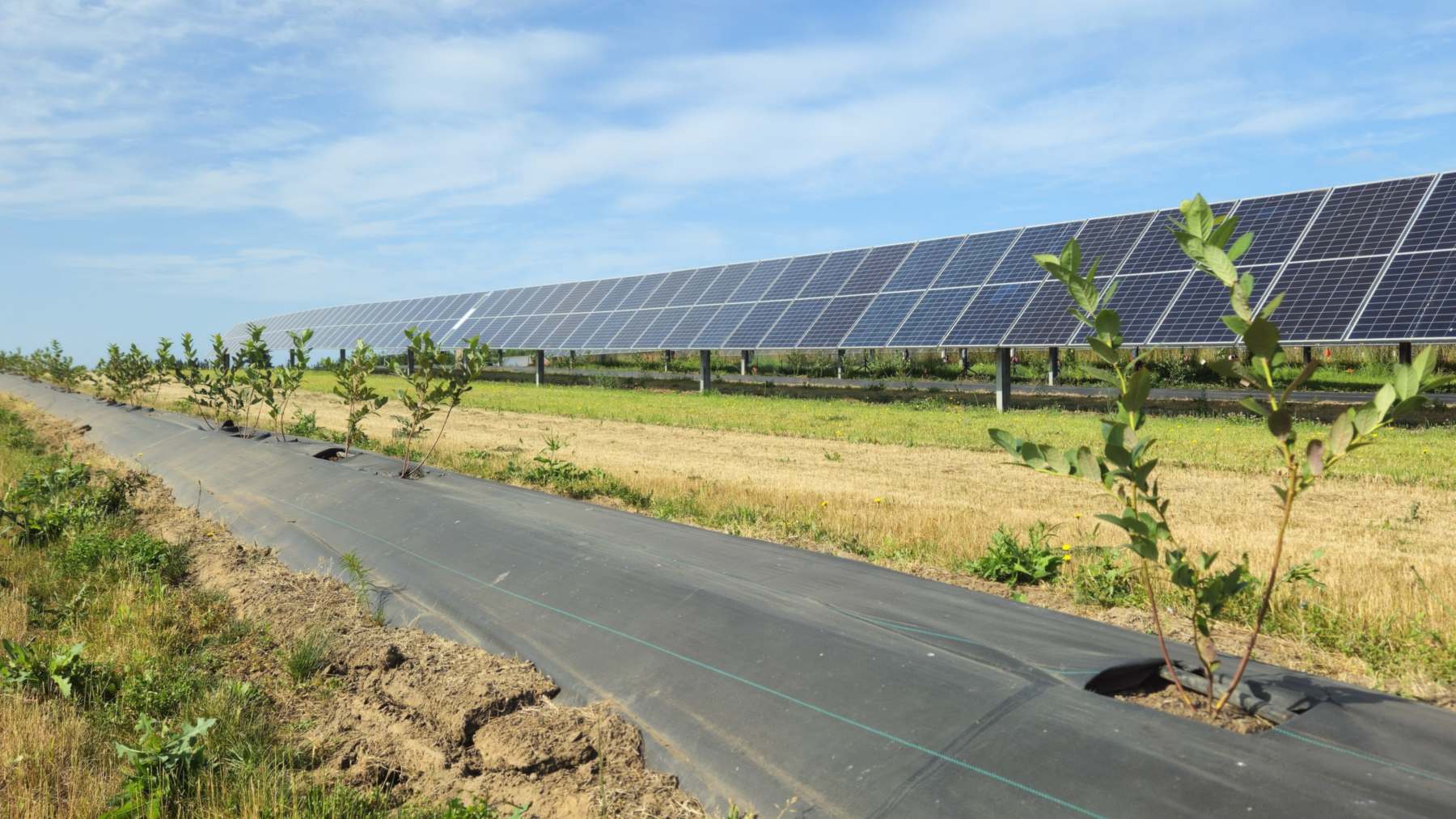
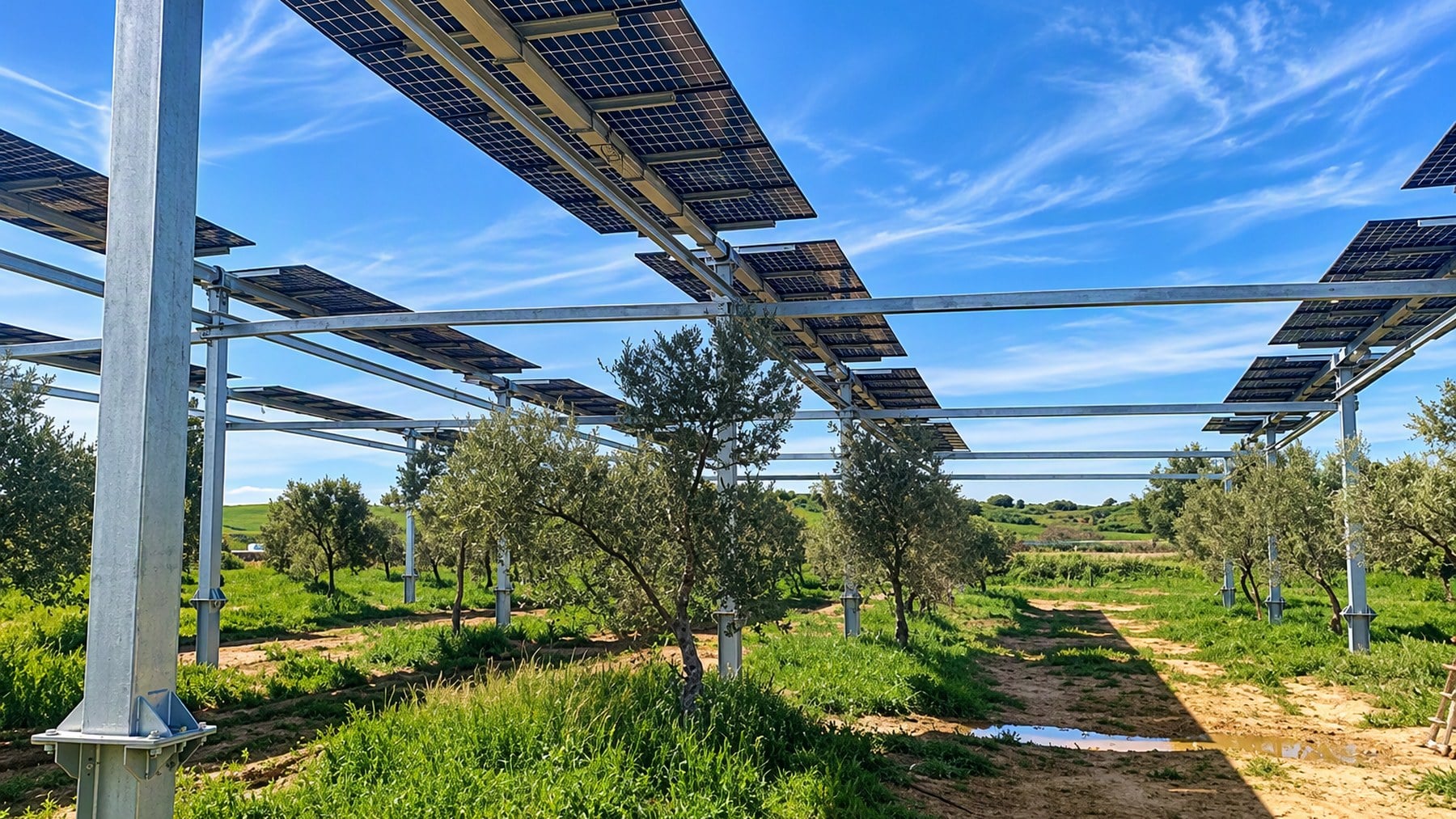
CENER, Spain’s national renewable energy research center, finished building two of these rigs over an organic olive grove in Navarre in April. It announced the project, called IGUZKITZA, on November 5. As far as the people behind it know, it’s the first overhead single-axis tracking system of its kind installed over olive trees anywhere in the world.
It’s a fair hedge, and a useful one. You might remember the Spanish olive oil bottler we covered last month that’s raising solar panels 13 feet over its trees in the south of the country. Those panels are fixed. These ones are built to move, and the idea is for them to move when the trees need it, rather than chasing every last watt.
So what’s actually standing in this olive grove?
Two steel frames on a farm called Biosasun, near the village of Dicastillo. CENER built them with ALLOTARRA, an association of organic olive growers. The farmers bring the trees and CENER brings the engineering and the software.
Between them, the two rigs carry 280 panels and about 160 kilowatts of peak capacity. Plenty of utility solar farms in the US run to hundreds of thousands of panels, so what you’re looking at here is a field experiment in solar trackers over olive trees.
The panels are bifacial, which means they make electricity from both faces. The top side catches the sun directly, and the underside picks up whatever light bounces back off the ground. Each row sits on a long shaft that a motor rotates through the day, and that’s all a single-axis tracker really is.
Then there’s the height. CENER’s press release puts the modules about 16 feet up. Its conference poster gets more specific, listing about 16 feet for one rig and about 15 for the other. As far as I can tell, that’s the height of the structure, not the gap between the panels and the treetops.
There are two rigs because olives get picked two different ways
Traditional Spanish groves plant olives as individual, open-centered trees spaced out on a grid. Growers call the shape “vaso,” or vase. If you’ve never seen one at work, a machine grabs each trunk at harvest and shakes it while an upside-down umbrella underneath catches the olives as they rain down.
Newer groves grow olives as hedgerows instead. The trees are packed into long, narrow rows, and a tall harvester drives right over the top of each one, straddling it like a tractor on stilts.
CENER built one roof for each. The vaso rig covers trees spaced about 23 by 26 feet apart, and its posts follow the same grid as the trees, so it’s safe to assume the shaker can still get to every trunk. It carries 112 panels, about 60 kilowatts, over roughly 9,700 square feet.
The hedgerow rig sits over rows about 16 feet apart. Its frames span about 33 feet, with two rows of panels on each span. That one has 168 panels, about 100 kilowatts and close to 10,800 square feet of coverage.
CENER labels the first rig as east-west tracking and the second as north-south tracking, and it doesn’t spell out which way the rotating shaft runs in each case. That’s a slightly annoying thing to leave vague, because it decides whether the panels follow the sun from east to west or tilt north and south instead. I’d rather not guess.
Frankly, building around the harvester is the right call. Olive growers aren’t going to rip out trees that took years to mature just to suit a solar rack, so a roof that only works with one kind of grove would be a pretty hard sell.
The panels haven’t moved for the trees yet
The clever part CENER is promising is software. It’s built a model that works out, tree by tree, how much shade the panels and the steel throw on each part of the canopy. On top of that sit tracking algorithms meant to angle the panels to protect the olives from too much sun and other extreme weather, and to squeeze extra power out of the bifacial panels when the trees don’t need the help.
None of that’s running. The poster says the electrical hookup was only done recently, so the algorithms couldn’t be put to work, and every measurement so far was taken with the panels lying flat over the trees.
So did flat, motionless panels do anything for the olives?
Apparently, yes, at least on one day. CENER’s poster lists the readings as averages of 10 measurements taken between 10 a.m. and 1 p.m. on July 21, with the air somewhere between 77 and 90 degrees. Compared with control trees growing without panels, the soil under the rigs was more biologically active. The trees under the panels lost less water through their leaves. Their leaves were greener, with more chlorophyll. They took up nutrients better. And they showed lower levels of anthocyanins, which are pigments plants tend to build up when they’re stressed.
There are no percentages in any of it. CENER hasn’t published how big those differences were, and I’d treat one summer morning as an encouraging first look rather than a verdict.
The grove is wired up for a lot more than one morning, though. The poster lists eight dendrometers alone, plus light meters on both faces of the panels, soil probes, and wind, rain and snow gauges. A dendrometer measures how thick a trunk is. Olive trunks actually shrink a little on a hot afternoon as the tree runs short of water, so a dendrometer is basically a stress gauge you strap to a tree. Eusebio Gainza, who spoke for the farmers’ group, gave Navarre’s regional parliament a sense of scale in May. He told lawmakers a trunk about 8 inches thick can lose about a fifth of an inch by mid-afternoon on a 100-degree day, and nearly stop breathing.
Gainza’s pitch for the whole thing was refreshingly down to earth, according to the session transcript. Fruit growers in his part of Navarre already throw plastic over their trees in summer when there’s too much sun, he said, and plastic won’t stand up to a hailstorm. Solar panels are built to take hail. He also told lawmakers the plan is for the trees to effectively drive the panels, through a digital model of an olive tree that learns over the next few years when to ask for sun and when to ask for shade.
Tilting solar over fruit trees isn’t brand new, to be fair. We’ve covered a French apple orchard with a tilting solar canopy aimed at sunburned fruit. Olives are a tougher customer, arguably, because these trees live for decades and the grower can’t just swap the orchard out.
There’s plenty CENER hasn’t said
CENER hasn’t named the company that built the trackers. The panel model isn’t listed either.
If you were hoping for a price tag, you’re out of luck. Gainza told lawmakers the costs are another story but that this is experimentation, which is about as close to a price as anyone’s gotten. The amount of electricity the rigs have produced so far isn’t public, and neither is where that power goes.
We don’t know when the protective software switches on, either. The poster lists it as ongoing work, with the effect on the olive crop to be measured after harvest. That’s the number growers will care about most, and I’d want to see it before anyone calls this a win.
The project was paid for by the government of Navarre and the European Regional Development Fund. CENER showed its first results on a poster at the EU PVSEC solar conference in Rotterdam, held September 14 to 18, and Gainza told Navarre’s lawmakers on May 29 that IGUZKITZA is due to wrap up at the end of this year.