
Floating solar has a simple pitch. You run out of cheap, flat land, so you float the panels on a lake or reservoir instead and leave the fields for farming. The catch is always the same question: what happens to the water sitting under all that glass?
A new project in the Philippines answers it by not floating at all. VinEnergo, the energy arm of Vietnam’s Vingroup, has teamed up with Philippine solar developer SunAsia Energy to build 422 megawatts-peak (MWp) of solar that stands on steel piles above the water, over ponds still being farmed for fish.
The two companies signed the deal on June 26 in Hanoi, splitting the capacity across three sites, with the plants due online in 2027 and 2028. Panels up top, aquaculture below, on the same patch of water. The pitch this time isn’t really about saving farmland. It’s about not shutting down the fish ponds to put up a power plant.
Putting large-scale solar on the same water that fishing communities live off has been a real point of friction across Southeast Asia. The stilts are, in part, an engineering answer to that fight.
Solar on stilts, not solar on floats
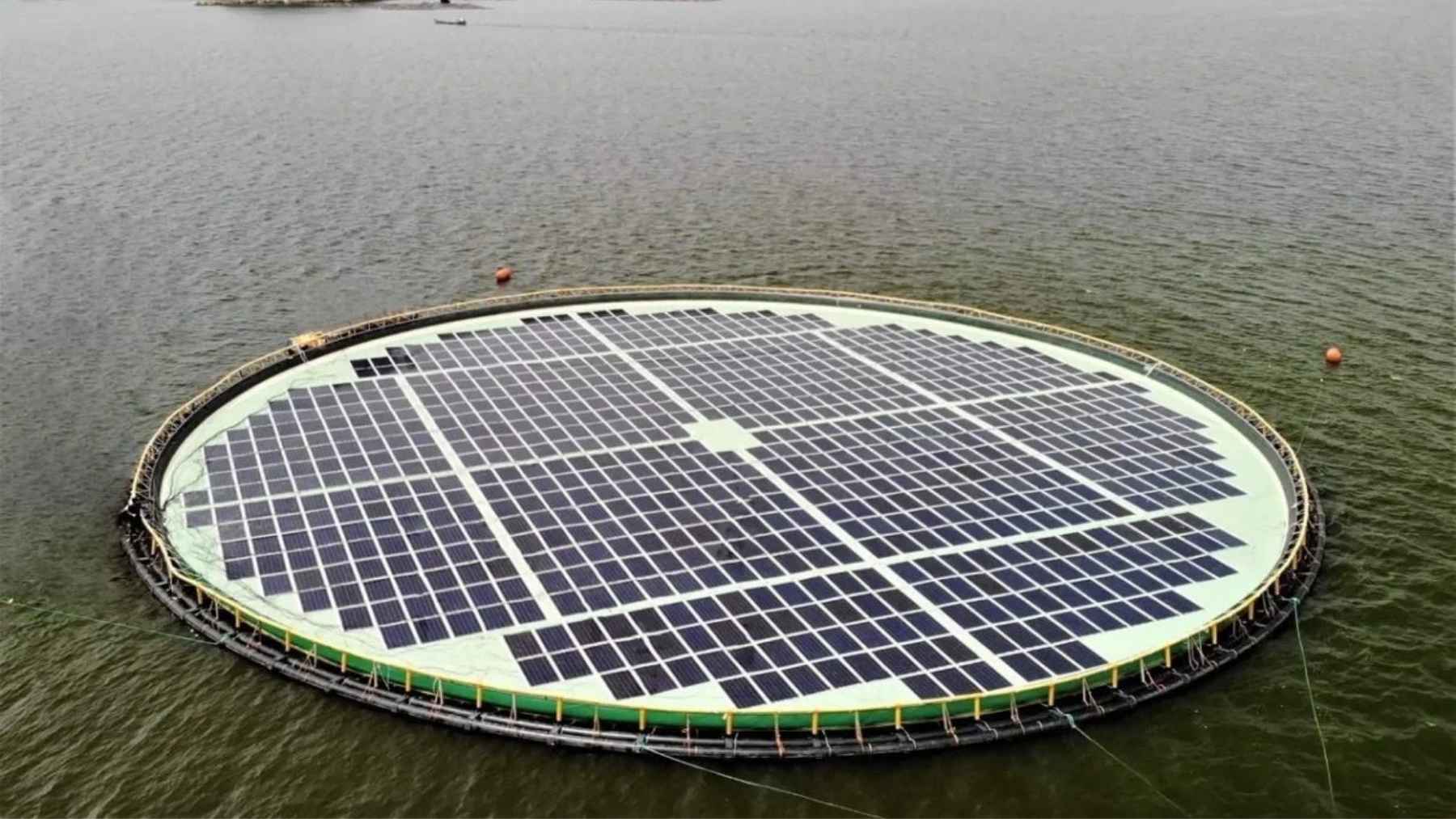
Most of the floating solar you’ve seen is exactly that: panels bolted to plastic pontoons that sit on the surface and drift a little with the water. The array covers the water like a lid. That lid is the whole worry, because shading the surface changes what can live beneath it.
The system SunAsia and VinEnergo are using, which they call “Solar on Stilts,” works more like a pier. Steel piles are driven into the pond bed, and the panels ride on top of them, lifted clear of the surface. The water column underneath stays open, boats can pass through, and the ponds keep operating.
It’s the same structural trick behind China’s 1-gigawatt HG14 plant off Shandong, where nearly 3,000 fixed-pile platforms sit in shallow sea with fish farming going on below. The Philippine version brings the idea inland, onto ponds people already fish for a living.
There’s a weather angle too. The Philippines sits squarely in the typhoon belt, and a rigid, piled structure stands up to rough conditions better than pontoons floating on the surface.
Others have gone the other way and tried to make the shaded water under floating panels friendlier to life instead. A Dutch floating-solar project hung shellfish cages beneath its panels and later counted hundreds of fish. Stilts skip that problem by barely shading the water at all.
Three plants, nearly 700,000 panels
The 422 MWp splits across three utility-scale plants. The biggest, 181 MWp, goes up in Macabebe, in Pampanga north of Manila. The other two land in Negros Occidental, down in the Visayas: 126 MWp in Sagay and 115 MWp in Silay.
Together that’s close to 700,000 solar panels riding on pile structures, plus roughly 62 kilometers of new transmission line strung across Negros and Pampanga to move the power to the grid, according to solar trade publication PV Tech.
In their joint announcement, VinEnergo and SunAsia say the finished plants should power about 278,000 households and cut carbon emissions by more than 460,000 tons a year, which they equate to planting some 21 million trees. Lifetime revenue, per the companies, tops $1.5 billion.
The build’s price tag is fuzzier. Trade outlets including Renewables Now have put it at around $406 million, though the developers didn’t attach an official number. ING advised VinEnergo on the transaction and SGV & Co. advised SunAsia.
It’s VinEnergo’s first project in the Philippines, and it stretches SunAsia’s floating-solar map out of Luzon and into the Visayas.
Signed with the energy secretary in the room
The signing wasn’t a quiet back-office affair. VinEnergo CEO Nguyen Anh Khoa and SunAsia CEO and chairperson Tetchi Capellan inked the agreement in Hanoi with the Philippines’ Energy Secretary, Sharon Garin, and Vietnam’s ambassador to Manila, Lai Thai Binh, standing by.
The timing wasn’t random either. The announcement landed while the Philippines was hosting the ASEAN Summit, which made it as much a diplomatic set piece as an energy deal.
Capellan framed the model as one where “food production and clean energy generation can thrive together,” and VinEnergo pitched floating solar as a way to share Vietnam’s experience protecting local livelihoods while it builds out power. The corporate label for all of it is the “food-energy-water nexus”: one footprint doing more than one job.
Why the water, and not just a field
The obvious question is why bother building over a pond at all, instead of a nice dry field.
Because in the Philippines, flat open land isn’t lying around. It’s an archipelago of more than 7,000 islands, much of it mountainous, and the land that is flat tends to already be growing food that’s politically hard to pave over. Water is the surface with room to spare.
The ponds in question aren’t a side detail. Milkfish and tilapia raised in coastal and inland ponds are staples of Philippine aquaculture, and Negros Occidental has long been one of the archipelago’s more productive fishpond regions.
The grid gives the panels a reason too. Coal still generates around 60% of Philippine electricity in recent generation data, while solar sits at roughly 3 to 4% of the mix. Clean capacity that doesn’t require bulldozing farmland is exactly what the government is chasing.
The same land-versus-water math is nudging solar onto reservoirs elsewhere. Britain is weighing plans to blanket its lakes with panels, on a debate about where a crowded country can put its clean energy.
Stacking power on top of fish is a pitch SunAsia has been making for a while. In 2023, the company and partner BlueLeaf Energy won rights to develop 1.3 gigawatts of floating solar on Laguna Lake, the country’s largest freshwater lake, a ten-block award covering roughly 1,000 hectares that rolls out in phases toward 2030. The VinEnergo deal changes the setting: not one giant lake, but working fish ponds, with the aquaculture left running rather than pushed aside.
What’s signed, and what’s still on paper
Worth being clear about where this stands. Nobody has driven a pile yet.
The June announcement kicks off an 18-month stretch of engineering, technology selection, and lining up contractors before real construction starts. Commissioning is targeted for 2027 and 2028, and on a project this size, that’s a target rather than a promise.
The engineering still has to prove itself at scale on live ponds. Pile-supported arrays are sturdier than pontoons and leave the water open, but they cost more to build than panels on dry ground, and running 62 kilometers of fresh transmission across two provinces is its own job.
The concept is sound and already running elsewhere. Whether it pencils out across three Philippine sites is what the next year and a half is meant to settle.
For a country leaning on imported coal with little flat land to spare, a plant that makes power and keeps the fish ponds working underneath is a clean fit, assuming the stilts hold up outside a calm, shallow pond and the math survives construction.
The thing to watch isn’t the megawatt count. It’s whether the fish farmers underneath end up treating the panels as a neighbor or a nuisance. Standing a power plant over a working pond only pays off if the pond keeps paying off too.
Image Credit: PV Tech