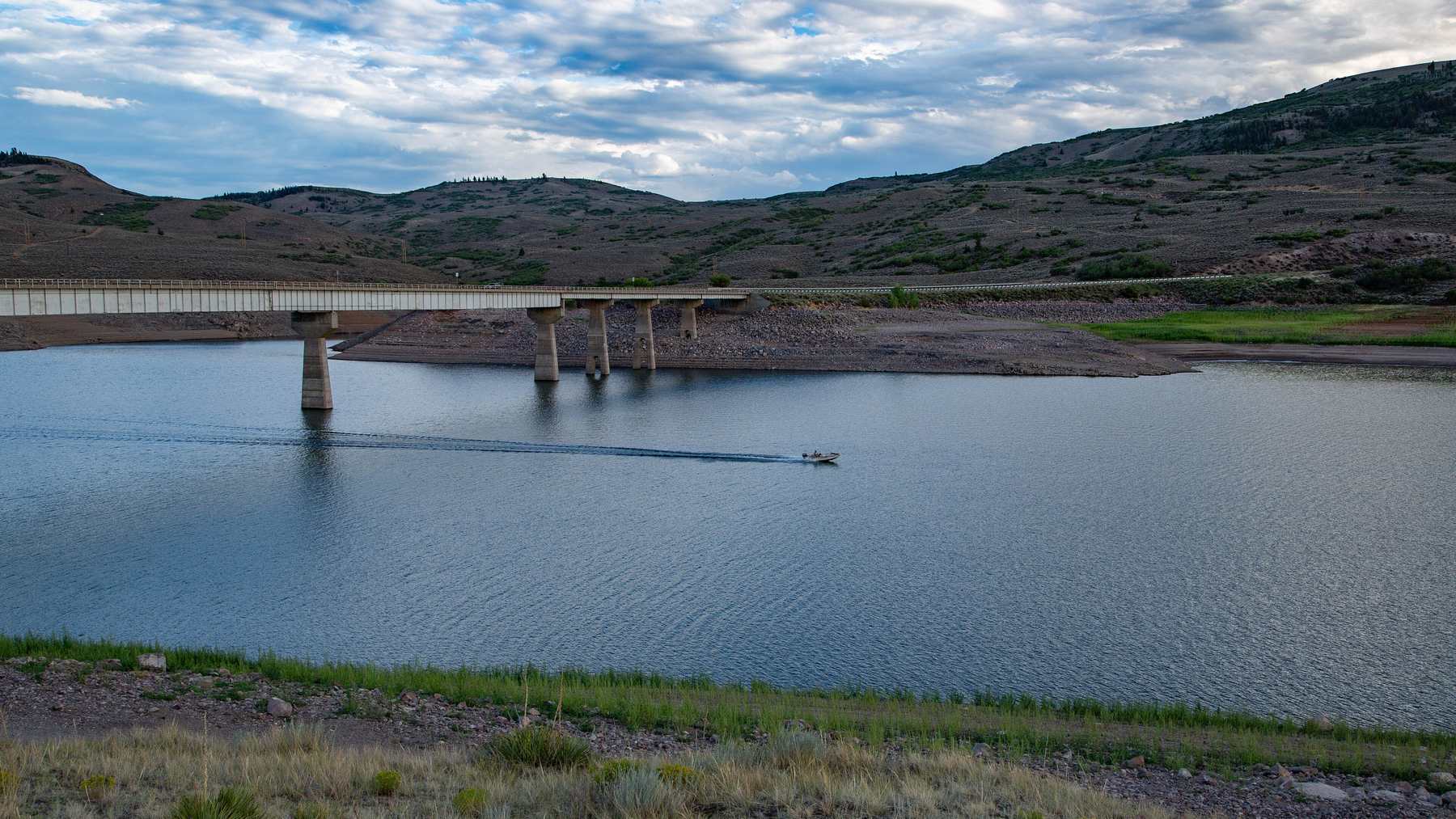

Ask anyone in Colorado to name the biggest lake in the state and you’ll probably hear Blue Mesa. That’s been the answer for about as long as the lake has existed. This summer, it stopped being true.
According to CPR News, the drought has shrunk Blue Mesa Reservoir so badly that Lake Granby, up north, has taken the title. And honestly, losing a trophy is the least of its problems. The dam holding Blue Mesa back runs a hydroelectric plant, and that plant needs a certain amount of water sitting above its intakes to work at all.
Reclamation’s weekly hydrology summary had the lake at 7,412.06 feet above sea level on October 22, at 17 percent of capacity. The line where the turbines stop getting water is 7,393 feet. I did the subtraction so you don’t have to, and it comes out to 19 feet.
So what does 19 feet of water actually buy you?
Blue Mesa Dam is a 390-foot pile of dirt with two turbines in it
Blue Mesa Dam sits on the Gunnison River about 30 miles downstream of the town of Gunnison. It’s a zoned earthfill embankment, which basically means a carefully layered mountain of compacted soil and rock rather than a concrete wall like Hoover. Reclamation puts it at 390 feet tall and 785 feet across the crest, built from 3.08 million cubic yards of material.
(Reclamation’s own fact page gives the height as 390 feet in its written overview and 502 feet in the table right underneath, which is a slightly odd thing for an agency to disagree with itself about. I’m going with 390, since that’s the figure in the agency’s own description of the dam.)
Full, the reservoir behind it holds 940,700 acre-feet and covers 9,180 acres. If you don’t live out West, an acre-foot is a foot of water spread over an acre, roughly 326,000 gallons. It’s a 20-mile-long lake when it’s healthy, and right now it isn’t.
The water that makes electricity drops through a single 16-foot steel pipe, called a penstock, that splits to feed two turbines. Reclamation uprated both generators from 30,000 to 43,200 kilowatts back in the 1980s, so the Blue Mesa Powerplant is rated at 86.4 megawatts. Caleb Foy, a senior water resources engineer at the Colorado River District, told KVNF in August that at full pool that’s enough for at least 34,000 homes.
It’s also what’s known as a peaking plant. It doesn’t run flat out around the clock. It ramps up when demand on the grid spikes, say a hot afternoon when everybody’s AC kicks on, and backs off when it doesn’t.
Minimum power pool is the elevation where the lake gets too close to the turbine intakes for the plant to keep running. Below that line, Reclamation can still push water downstream through the dam’s outlet works. It just doesn’t make any electricity doing it.
Another 35 feet down, at 7,358 feet, is dead storage. That’s water sitting below the lowest way out of the dam, and it stays put. Foy told KVNF he didn’t know of any concerns about running Blue Mesa below power pool for a while, which is a pretty different situation from Glen Canyon Dam, where the outlet valves have a shaky track record.
So how did it get this low?
Short version: it barely snowed. Blue Mesa hit its high point for the year on January 19 and has been sliding since late March, according to Reclamation’s Aspinall Unit status page. KVNF reported that April-through-July inflow, the snowmelt season that’s supposed to refill the lake, came in at 151,000 acre-feet, the lowest on record.
Not everybody thinks the weather deserves all the blame. Sonja Chavez, who runs the Upper Gunnison River Water Conservancy District, told CPR News she thinks Reclamation let too much water go too early in the season. The agency’s answer was that it plans releases off 24-month forecasts and adjusts them as conditions change.
I’d argue both of those things can be true at once. Forecasting snowmelt in a year with almost no snow is a bit like guessing your paycheck before your boss has decided whether you’ve got a job.
By midsummer, Reclamation was trying to stretch what was left. Together with the US Fish and Wildlife Service and the State of Colorado, it cut the flow target at the Whitewater gauge on the lower Gunnison to 500 cubic feet per second, down from the roughly 1,050 that June and July usually call for. KVNF reported the cut keeps about 500 acre-feet a day in the lake.
On October 1, Reclamation’s update had about 210 cfs running through the Black Canyon of the Gunnison, while the Gunnison Tunnel pulled roughly 560 cfs off for farms. At a late-August operations meeting, the agency said it could hold flows below the dams as low as 200 cfs through February to rebuild storage, according to Aspen Journalism.
You may be wondering why they don’t just close the gates and let the lake fill up. Because the water’s already spoken for. Federal rules require releases for endangered fish like the razorback sucker and humpback chub, and the Gunnison Tunnel carries water to around 80,000 acres in the Uncompahgre Valley under a senior right that’s older than the dam.
Blue Mesa isn’t bailing out anyone else, either. KVNF reported that Flaming Gorge, not Blue Mesa, carried this year’s drought-response release toward Lake Powell. Below Powell, Hoover Dam is on track to lose most of its generating capacity as Lake Mead drops.
The boats were the first thing to go
The National Park Service runs recreation on the lake, and it spent the summer retreating. In July it moved the Elk Creek marina out to deeper water, along with about half of the Lake Fork marina. Since August 24, all three boat ramps at Elk Creek, Lake Fork and Iola have been limited to boats you can carry in by hand.
Amy Riser, whose family has run Elk Creek Marina for more than 40 years, told CPR News the season effectively ended on July 5 and the family lost about half its income. That’s a pretty brutal summer for a business that normally runs from May through September.
The lake itself isn’t in great shape either. Warning signs went up over toxic blue-green algae, and Giulio Del Piccolo, an aquatic biologist with Colorado Parks and Wildlife, told CPR News he expects fewer of the kokanee salmon the lake is known for in the years ahead.
So will the turbines actually stop?
Probably not, if Reclamation’s own estimate holds. Bart Deming, who manages the agency’s Western Colorado Area Office, told CPR News that in a worst case Blue Mesa could briefly stop generating by April, and put the odds that it won’t happen at 90 percent.
Why April and not tomorrow? From Reclamation’s numbers, the lake dropped from 7,413.20 feet on September 30 to 7,412.06 on October 22, a little over a foot in three weeks. At that pace it’d take well over a year to burn through 19 feet. The risky stretch is presumably early spring, when the farms start calling for water again and the snowmelt hasn’t shown up yet.
The forecast looks fairly decent on paper. Reclamation’s October numbers put next April-through-July inflow into Blue Mesa at 600,000 acre-feet. That’s 94 percent of average. Still, a normal year doesn’t refill a lake that’s sitting at 17 percent, and everyone on the river knows it. Steve Pope, who runs the Uncompahgre Valley Water Users Association, told CPR News he isn’t counting on El Niño to bail anyone out until he’s “shoveling snow.”
I’d love to tell you how much electricity Blue Mesa is making this week. I can’t. Reclamation publishes how much water goes through the turbines each day, but I couldn’t find a live megawatt figure anywhere, and Foy said back in August that output was already falling.
Reclamation’s next Aspinall Unit Operations Group meeting, the public session where it lays out plans for Blue Mesa and the two dams below it on the Gunnison, is scheduled for January. On October 22, the lake sat 19.06 feet above the turbine line.