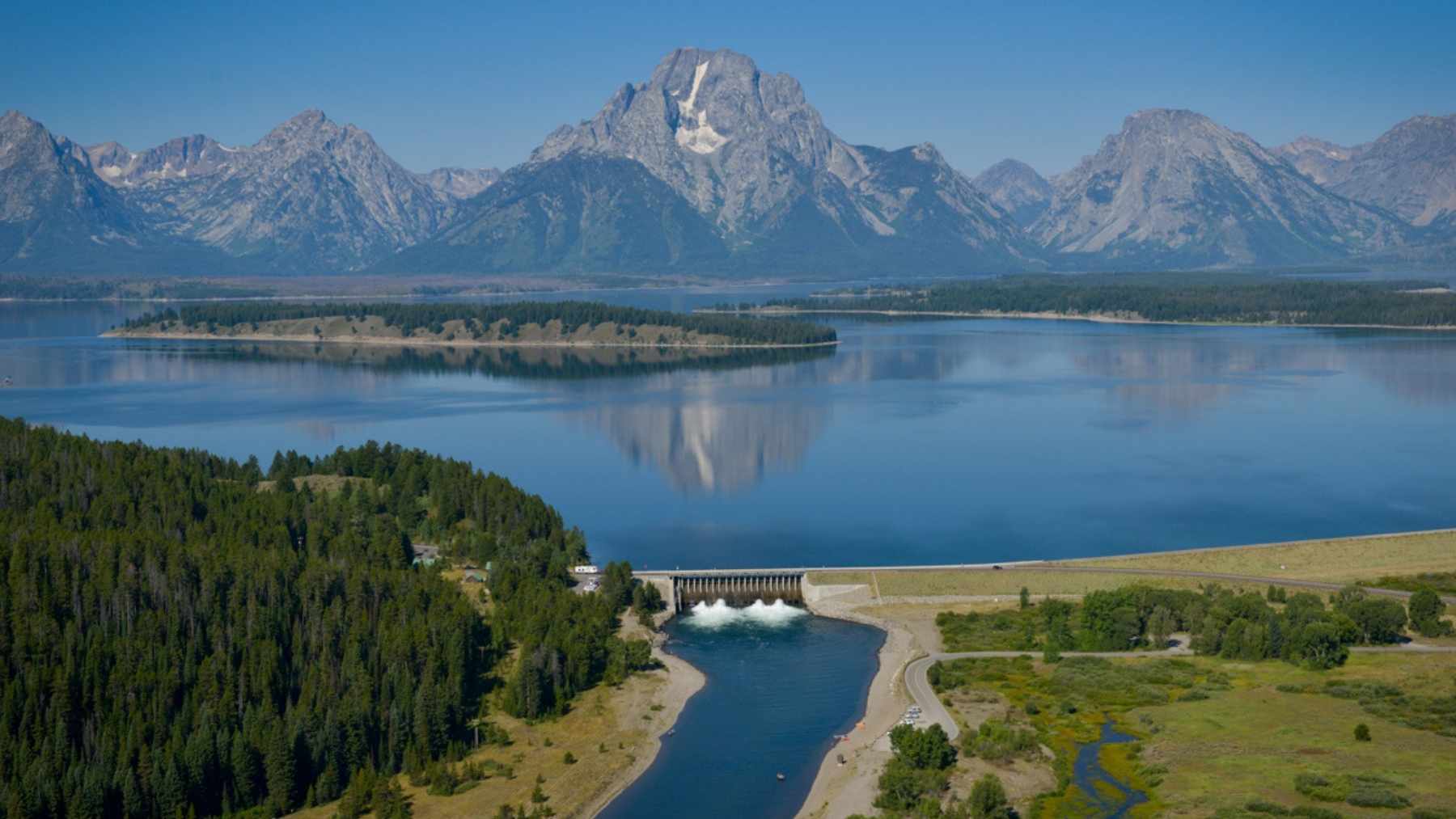

Jackson Lake is the big one at the north end of Grand Teton National Park, the lake on all the postcards with Mount Moran sitting behind it. It looks about as natural as a lake can look.
And it mostly is a natural lake. But the top 30 feet or so of it belong to a dam, and the water in those 30 feet belongs to farmers in Idaho who filed for it more than a century ago.
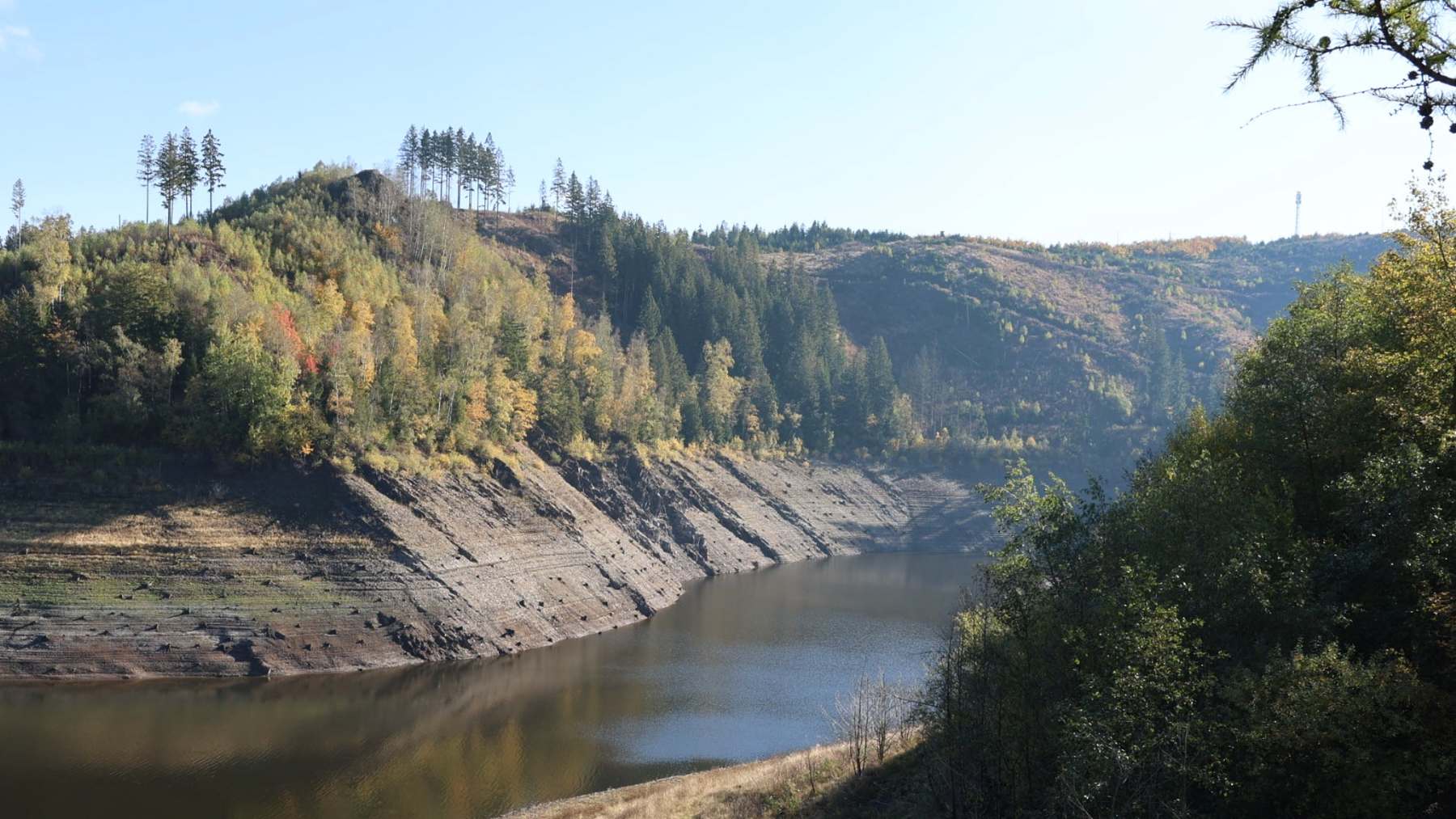
This summer that arrangement got tested about as hard as it’s been tested since the dam was rebuilt in the late 1980s. The Bureau of Reclamation ran Jackson Lake Dam at roughly 5,000 cubic feet a second for most of July and August, which KHOL says was about double a typical year, and the lake dropped from 816,722 acre-feet on June 1 to 63,942 at the end of September. That’s 7.5 percent of what it’s built to hold.
Then the flow got cut to a trickle, the side channels of the Snake River went dry, and a state biologist spent the first half of October walking buckets of fish back to the river.
So why is a Wyoming lake being run for Idaho?
If you’ve never dealt with Western water, an acre-foot is the amount that covers one acre a foot deep, about 326,000 gallons. Jackson Lake Dam was built to store 847,000 of them, and Reclamation’s own history of the dam says the whole point from the start was the Minidoka Project, an irrigation project hundreds of miles downstream in Idaho.
The first dam was a temporary log crib that partly failed within a few years. The concrete gravity dam with earth wings that replaced it was raised in 1916 to its current structural height of 65.5 feet, and it’s been holding Idaho’s water ever since.
So the lake sits inside a national park, but the water in it was spoken for before the park existed. Which is, frankly, a slightly odd thing to have at the heart of Grand Teton, and most visitors standing at the overlook have no idea.
Idaho runs on a system called “first in time, first in right.” Whoever put the water to use first holds the senior claim, and in a dry year the senior claim gets filled before anyone else gets a drop. Farmers in Idaho’s Magic Valley hold rights that trace back to the dam itself. Fish in Wyoming don’t hold any.
That matters because the state that owns the fish doesn’t own the water, and this year the two wanted very different things from one dam.
From 5,000 cubic feet a second to 280
Five thousand cubic feet a second is roughly 37,000 gallons a second going through the dam, and Reclamation’s daily Hydromet record shows the outflow sitting between 4,850 and 5,230 cfs on every single day from June 18 to September 8. The lake held 474,069 acre-feet on August 1 and 206,747 on September 1.
You can watch it drain in the data, a little under 9,000 acre-feet a day through August, and there’s nothing unusual about any single day in there. It’s the three months together that did it.
Then came the stretch the fish people were worried about.
Every fall, Reclamation ramps the outflow down to a winter flow. This year the winter number was 280 cfs.
The Wyoming Game and Fish Department and Trout Unlimited had asked for a gradual ramp-down, because fish that moved into the side channels during three months of high water need time to find their way back to the main river before those channels dry up. According to KHOL, the public radio station in Jackson, Reclamation initially proposed what would’ve been the slowest ramp-down in decades, then reversed course the week it met with senior water rights holders.
The Hydromet numbers back that up. Outflow was still 5,090 cfs on September 8.
It was 2,050 by September 20, 607 on September 30, and 278 on October 3. So the Snake went from a spring-runoff kind of flow to a late-fall kind of flow in a little over three weeks.
Reclamation hasn’t said much publicly about why the slow plan was dropped, beyond Game and Fish describing it as input from downstream water users. Brian Stevens, who KHOL identifies as the bureau’s chief engineer for the dam, couldn’t talk to the station before its deadline.
Back in August he’d told KHOL the usual aim is to draft the lake from full down to about 76 percent going into winter, and that this year it would end up somewhere between 1 and 10 percent. He wasn’t wrong.
How do you get a fish out of a puddle?
You shock it. Not hard, just enough.
Electrofishing is pretty simple in principle. Someone wears a backpack with a battery in it and dips a pole into the water, the current stuns everything within a few feet for a couple of seconds, and a second person scoops the floating fish into a net before they come around. It’s how biologists count fish without hurting them, and it turns out it’s also how you empty a dying pool.
Earlier this month, Wyoming Game and Fish biologist Diana Miller led a group of volunteers from Trout Unlimited, the Snake River Fund and a local fly-fishing outfit down the Moose-to-Wilson stretch of the Snake, inside the park, going pool to pool. Alicia Brisson of Trout Unlimited’s Jackson Hole chapter ran the shocker and showed new volunteers how to stun and then net.
Miller then carried each bucket just under a quarter mile back to the main river, counted what was in it by species, and let it go. Mostly dace and suckers, with the occasional young cutthroat trout.
Arguably the least glamorous conservation work there is. From the looks of things, also some of the most useful.
Miller’s count came to about 2,000 stranded fish in pools that held 7,000 last year, which she’d expected, because this year’s ramp-down, for all the complaints, was still slower than last year’s. You should treat that 2,000 as a count from the pools her team actually worked, not a total for the river. Miller herself told KHOL there are probably hundreds of these pools along the Snake and her team got to a few of them.
The fish had a rough summer before any of this. The Snake below the dam hit 70 degrees for weeks at a time, which isn’t a temperature native cutthroat trout handle well, and the state put a voluntary fishing closure on that stretch for the first time. Some of that’s the weather.
Some of it, per KHOL, is that Jackson Lake Dam pulls its water from a relatively shallow part of the lake, where the sun has already been at it, rather than from the cold water down deep. Double the usual flow of warm water, it turns out, isn’t the same thing as a cold river.
Lowest since the dam was rebuilt
I went through Reclamation’s daily storage records for Jackson Lake going back to 1985 to see where 63,942 acre-feet actually sits. Three years come in lower, and all three are from the late 1980s: 46,200 in 1986, 55,000 in 1987 and 57,400 in 1988.
That’s when the dam was being reinforced to meet new earthquake standards, after the Borah Peak quake in Idaho, and the lake was held down for the work. Since then, no year has gone below 77,955, the 2004 low.
So this isn’t a record. It’s the lowest the lake has been in 38 years, and the only time it’s been lower, someone was deliberately holding it down to pour concrete. KHOL describes the lake as having “neared all-time lows,” and I’d put it a little more carefully than that, but the gap between 63,942 and 57,400 isn’t a large one.
We’ve spent a lot of this year writing about reservoirs on the Colorado, with Lake Mead at its lowest since Hoover Dam first filled and Lake Powell running out of margin behind Glen Canyon Dam. Jackson Lake’s a different animal.
There aren’t any turbines at the dam, so no one lost a megawatt. The hydropower on this stretch of the Snake is at Palisades, downstream. What Jackson Lake lost was its margin, and the fish lost their side channels.
Farther down, Idaho’s had its own problems with the Snake this year, with Idaho pumping copper into the Snake near Twin Falls to kill off quagga mussels, and 1,700 water users pulling from the stretch below.
The lake is coming back, slowly
One thing that’s easy to miss if you only read the early-October headlines: the lake’s refilling. Since Reclamation cut the outflow to the 265 to 280 cfs range on October 3, more water’s been coming into Jackson Lake from the upper Snake than has been leaving it.
Storage was 65,370 acre-feet on October 3 and 76,324 on October 23, so the lake’s put back about 11,000 acre-feet in 20 days, a little over 1 percent of capacity. At 9 percent full it’s still a long way from the 76 percent Reclamation would normally like to see going into winter, and no one I’ve read is willing to guess at next spring’s snowpack yet.
The last Hydromet reading Reclamation had posted as of this writing was for October 23: 76,324 acre-feet in the lake and 267 cubic feet a second going out. The USGS gauge on the Snake near Moran, just below the dam, read 266 cfs at 3:45 a.m. on October 24.