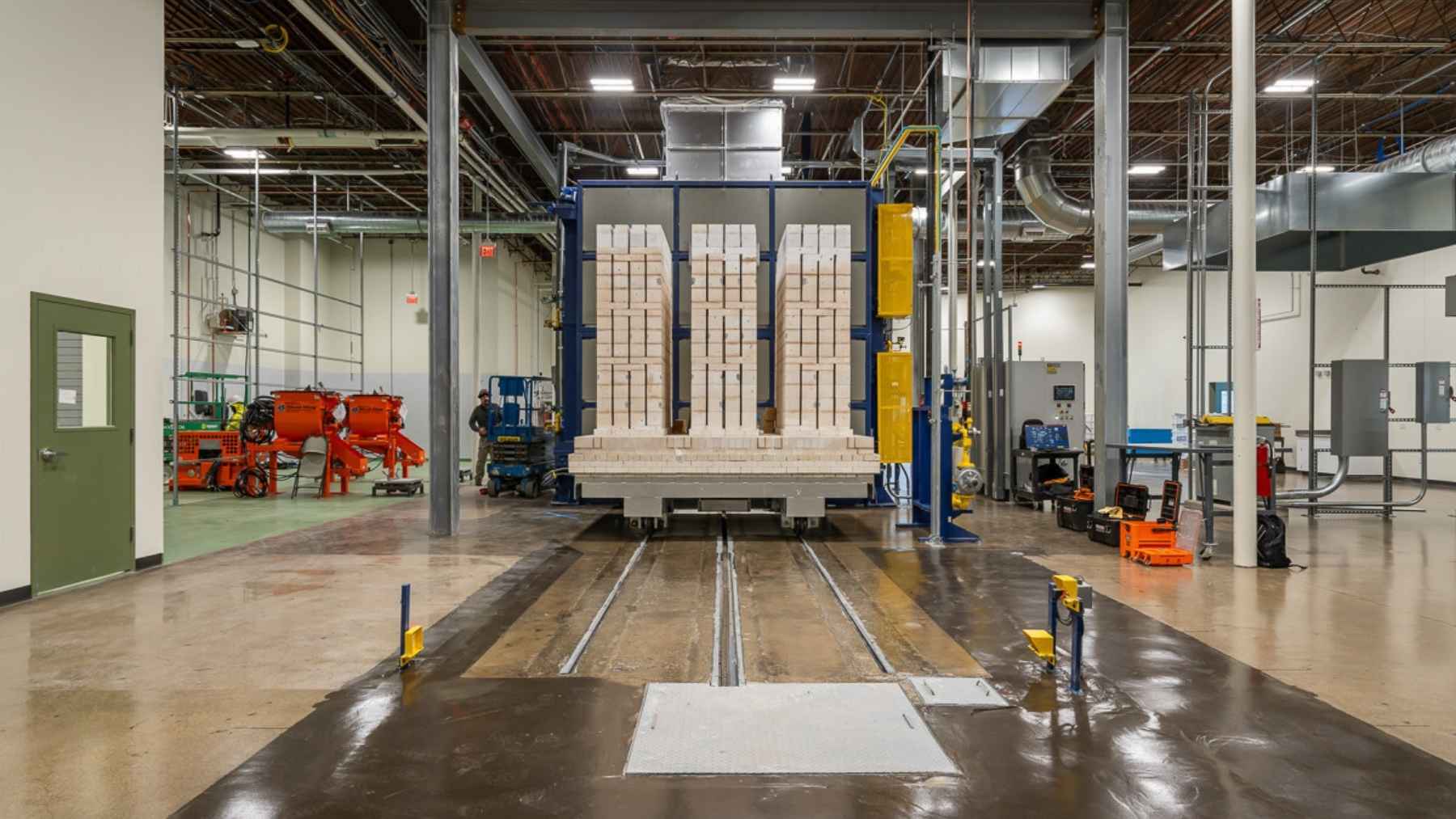

Cement starts out as rock, and the rock has to be cooked until it very nearly melts. Inside a kiln, powdered limestone and clay fuse into gray pellets called clinker, and grinding those pellets with a little gypsum gives you the cement in the bag. For about as long as anyone’s made the stuff at industrial scale, the heat has come from burning things. Coal, gas, shredded tires. A cement kiln will eat pretty much anything that holds a flame.
Now a Boston company has built a battery that gets hot enough to play in that league, and one of the biggest cement makers on Earth has signed up for two of them. The battery is a box of glowing ceramic bricks.
Electrified Thermal Solutions announced the agreement with Holcim on September 15. The first phase covers two of its Joule Hive Thermal Battery units, 20 megawatt-hours between them, folded into what Holcim calls its electrification roadmap. Holcim is the Swiss building-materials giant, more than 48,000 employees across 45 countries, and it’s also an investor in Electrified Thermal. So the two weren’t exactly strangers when they signed.
Ram Muthu, Holcim’s Head of Operational Excellence, called electrified high-temperature heat “one of the advanced technologies we are incorporating in our decarbonization strategy,” and said the deployment lets Holcim evaluate its potential. What the announcement doesn’t say is which plant gets the units, or when they’ll run. I went looking for both and couldn’t find either.
One thing can be ruled out, though: the United States. Holcim spun off its entire North American business as a separate company called Amrize in June 2025, so its cement plants today sit across Europe, Latin America, Asia, the Middle East and Africa. Wherever these bricks land, it won’t be anywhere near an American highway. Which is a little funny, because the only place you can watch one run right now is Texas.
So how do you store electricity in a brick?
Run current through anything with electrical resistance and it heats up. That’s your space heater, your electric stove, the defroster lines on your rear window. Most heat batteries use the effect secondhand: heating wire glows, and a big stack of firebrick soaks up what the wire throws off. That’s how the 100-megawatt-hour brick tower making steam for a California oil field does it.
Electrified Thermal cut out the middleman. Its ceramic conducts electricity, so the current runs through the bricks themselves and the stack works as heating element and storage in one piece. The company says the system takes anything from 480 volts up to 100 kilovolts straight off industrial power, charges when electricity is cheap or plentiful, and hands the heat back on demand at up to 3,275°F, its listed figure for 1,800°C. Frankly, that’s an elegant bit of engineering, because in most electric heaters the element is what fails first, and here the element is a pile of refractory brick. Electrified Thermal says the engineering firm DNV has independently validated the core materials for a 20-year lifetime.
So why hasn’t anybody plugged in a cement kiln?
Mostly because of how hot it has to get. The material inside the kiln needs to reach roughly 2,642°F, about 1,450°C, before clinker forms, and the flame driving the process burns hotter still. Ordinary electric heating taps out well short of that, which is why cement has stayed a combustion business, along with steel, glass and chemicals. Even the press release admits cement is among the hardest industrial processes to electrify, and companies don’t usually open by telling you how hard their new job is.
There’s a reason to try anyway. Industrial heat eats up about a fifth of the world’s energy, by Electrified Thermal’s accounting, and the hottest slice of it hasn’t had an electric option at all. If a brick battery can really hold clinker territory day after day, it’s selling into a market with basically no electric competition.
The Texas demo has more than 1,000 hours on the clock
Electrified Thermal switched on its first megawatt-scale Joule Hive early this year at the Southwest Research Institute in San Antonio. The unit charges from the grid and stores 20 megawatt-hours as heat. It blows that heat out as hot gas at up to 2,730°F for ordinary industrial work, and delivery can be pushed to the full 3,275°F for the customers who need it hottest. Daniel Stack, the company’s CEO and co-founder, says the system has now logged more than 1,000 hours of operation.
Is 1,000 hours a lot?
Sort of. It works out to about six weeks of running nonstop, and it isn’t the decades a kiln has to survive, but it’s real hardware making real heat at commercial scale, and that’s rarer in this field than you’d think.
Hot bricks are suddenly a crowded field
If you’ve spent any time on this site, you’ve watched the category fill up. Rondo, the wire-and-firebrick outfit from a few paragraphs ago, has been making steam for a California oil producer for over a year. Antora runs solid carbon blocks at a South Dakota ethanol plant on cheap wind power. Fourth Power wants to out-heat everybody with graphite bricks at 4,352°F and liquid tin for plumbing. Everybody’s cooking something.
Cement is arguably the meanest customer any of them could chase, and Electrified Thermal picked it anyway. I suspect the logic is simple: if the bricks hold up in clinker country, nearly every other industrial process runs cooler, and cooler suddenly looks easy.
The agreement announced on September 15 covers the first two units and 20 megawatt-hours, and Electrified Thermal says both companies are already evaluating additional spots across Holcim’s operations for the same technology.