
Every solar farm has to sit on something, and that something is usually a field that used to grow food. That fight gets tedious fast, which is why floating solar keeps coming up in countries that ran out of cheap flat land years ago. Reservoirs, gravel pits and flooded quarries are already dead water, and nobody is planting anything on them.
A cement plant in Belgium pushed that logic about as far as it goes.
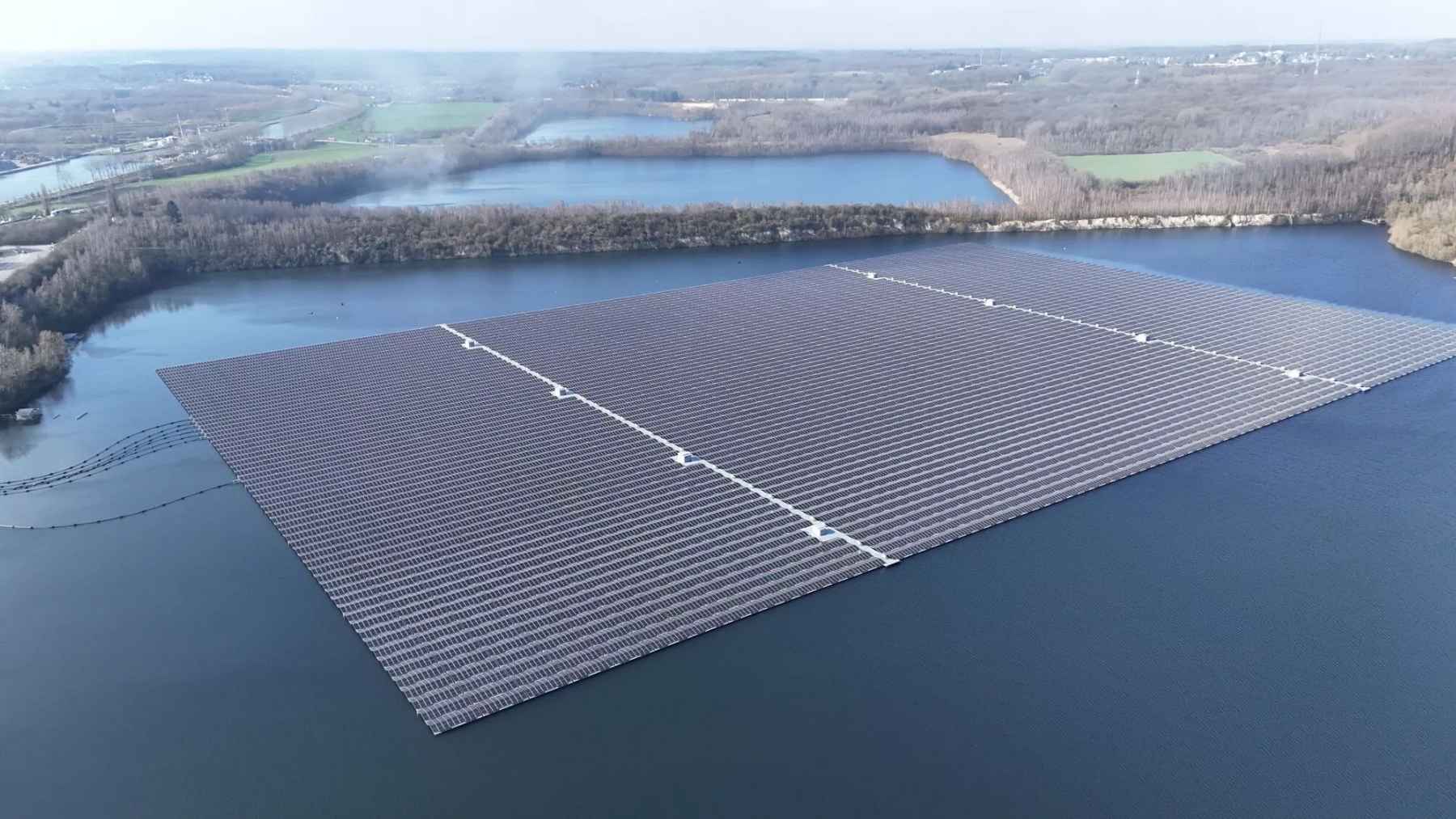
Holcim and TotalEnergies covered a flooded chalk quarry at the Obourg site near Mons with 55,000 solar panels, 31 megawatts in total, floating on water the company created by eating its own raw material for a century. The array was inaugurated on March 20 and puts out around 30 gigawatt hours a year.
None of that electricity goes to the grid. It walks next door into the cement plant.
And the machine those panels were sized to run is the half that has stopped moving.
The lake is the hole the plant dug for itself
Cement has been made at Obourg for more than 110 years, and for most of that run the site fed two wet-process kilns on chalk quarried on the doorstep. Wet process means grinding the raw material into a slurry and then boiling the water back out of it inside the kiln, which is about as energy-efficient as it sounds.
That chalk is nearly gone. Holcim’s project documentation puts the exhaustion of the Obourg reserves at around 2034, which is why the replacement kiln is built for dry-process limestone hauled in by rail from the Tournaisis area instead.
What the old quarry left behind was a pit deep enough to fill with water and call a lake. The panels went on top of it.
The whole island is tied to the bottom, and nothing touches the banks
Floating arrays get moored one of two ways: cables down to the lakebed, or lines out to the shoreline. Obourg went entirely to the bottom.
Per Holcim’s own account of the project, the panels are anchored only to the floor of the pond and not to the banks, on the reasoning that the shallow edges are where most of the life in a quarry lake actually is. Trade publication Industrial Info Resources counted 128 anchors holding the island in position. Construction was also scheduled around nesting, with work suspended through breeding seasons, according to Stany Vaes, Holcim Belgium’s head of sustainability, corporate affairs and communication.
Getting the power ashore took more than 2,290 feet of horizontal directional drilling (over 700 meters), so the cable run to the substation goes under the landscape rather than across it.
Anchoring to the bed instead of the bank is quietly becoming the default on industrial water. A Dutch quarry lake at Bomhofsplas did the same under 73,000 modules and then hung shellfish cages underneath to see what moved in. Germany’s biggest floating plant, on a flooded lignite pit at Cottbus, is moored to the old mine floor and still sat finished for months without sending a kilowatt-hour anywhere, because the rising lake beat the grid connection to it.
Obourg does not have that problem, because Obourg does not need a grid connection.
The customer owns the shoreline, and that is the entire trick
All 30 gigawatt hours a year get consumed on site. TotalEnergies calls it the largest floating solar plant in Europe dedicated to self-consumption, and that qualifier is doing real work. The Sellingen array in the Netherlands is bigger in raw terms at 41.1 megawatts peak. What Obourg has that Sellingen does not is one industrial buyer standing on the same bank.
That is worth more than it sounds. No interconnection queue. No power purchase agreement. No transmission to build or pay for.
Holcim expects the array to cover up to 15 percent of the electricity used by its new plant by 2030, which the company equates to roughly 8,500 homes, and to avoid 110,000 metric tons of CO2 over its operating life. Vincent Michel, who runs the GO4ZERO program for Holcim Belgium, gave Industrial Info the practical version: “On sunny days, we will be self-sufficient.”
The same logic is turning up at a fraction of the size. A Bavarian gravel works stood 2,600 panels bolt upright on its own lake for exactly this reason: the crusher and the power plant share a shoreline.
The carbon capture is the half that stalled
GO4ZERO is a two-phase program worth more than 500 million euros, backed by an EU Innovation Fund grant awarded in 2023.
Phase one is the kiln. A dry line replaces the two wet ones, cutting CO2 by close to 30 percent per ton of clinker, with first clinker due in 2027.
Phase two is where the plant was supposed to get to net zero. The kiln is built air-oxyfuel switchable, meaning it can burn on oxygen rather than air so the exhaust comes out concentrated in CO2 instead of diluted with nitrogen. Air Liquide’s Cryocap OXY unit then purifies that stream past 99.5 percent, Fluxys pipes it to the Antwerp@C export hub, and it gets liquefied, loaded onto ships and stored under the North Sea. Design capacity is about 1.1 million tons of CO2 a year.
The final investment decision on that half was due in February. Holcim did not take it.
Michel told Belgian media the risk was too high and that signing then would be “pure suicide,” as reported by Global Cement. The blocker is not the capture hardware. It is that the CO2 has nowhere to go until the terminal and pipeline work at the Port of Antwerp is actually sanctioned, which leans in turn on BASF’s decisions there. Obourg’s net-zero date slipped from 2029 to late 2030 or early 2031.
Air Liquide and Holcim did sign an agreement in late February to develop the capture unit anyway, and both were explicit that the investment decision still depends on more partners across the chain plus public support, including regulatory clarity and de-risking mechanisms. The GO4ZERO page still lists 2029.
Some scale on what is parked. Obourg makes about a quarter of Belgium’s cement and emits roughly a million tons of CO2 a year. The solar array avoids 110,000 tons across its entire lifetime. The capture plant was the instrument that actually moved the number, and the instrument is sitting still.
North America ran the same experiment and got the same answer
This is not a European failure mode. It is a cement industry failure mode, and the freshest case is in Alberta.
On August 19, Heidelberg Materials confirmed it has delayed the full-scale carbon capture project at its Edmonton cement plant, the one marketed as the building sector’s first at that scale. It was meant to be running by the end of 2026, capturing more than a million tons of CO2 a year and sending it to Enbridge’s Wabamun hub.
David Perkins, vice president of sustainability and public affairs at Heidelberg Materials North America, told Edmonton outlet Taproot that carbon prices came in below what the business case assumed. Capital costs could now reach 2 billion Canadian dollars against the 1.36 billion the project was announced at in 2023, according to International Cement Review. A lessons-learned report on the project found the capture technically feasible and put the blame for delay on policy uncertainty.
The American version happened faster and harder. In 2025 the Department of Energy canceled 24 awards worth about $3.7 billion, and the largest were cement: $500 million apiece for Heidelberg’s plant in Mitchell, Indiana and National Cement’s plant in Lebec, California, plus $189 million for Brimstone.
The floating solar column of the US ledger looks nothing like that. NREL put the technical potential on federally controlled reservoirs alone at 861 to 1,042 gigawatts, enough to run something like 100 million homes. Wood Mackenzie expects the country to actually add less than one gigawatt by 2033, mostly because ground-mounted panels are cheaper and the water sites are awkward.
Obourg is the exception that shows why. It got built because it needed exactly one thing that already existed: a customer standing on the same shoreline with a meter and a kiln. No permit fight over farmland, no queue, no counterparty.
Everything else about pulling the carbon out of cement needs a pipeline nobody has built, a port terminal nobody has sanctioned and a carbon price nobody can forecast far enough out to underwrite a nine-figure bet. Holcim finished the easy half and got a very good aerial photograph out of it. The hard half is still somebody else’s investment decision.