
Solar power has one flaw so famous it barely needs saying: the sun goes down. Factories, inconveniently, do not. A cement kiln or a steam boiler wants heat at 3am with the same appetite it has at noon, and for about a century the answer to that mismatch has been to burn something.
The fix everyone talks about is batteries. But lithium cells store electricity, and most of what heavy industry actually burns gas for is not electricity. It is heat, enormous amounts of it, and running that heat through a chemical battery first is an expensive detour.
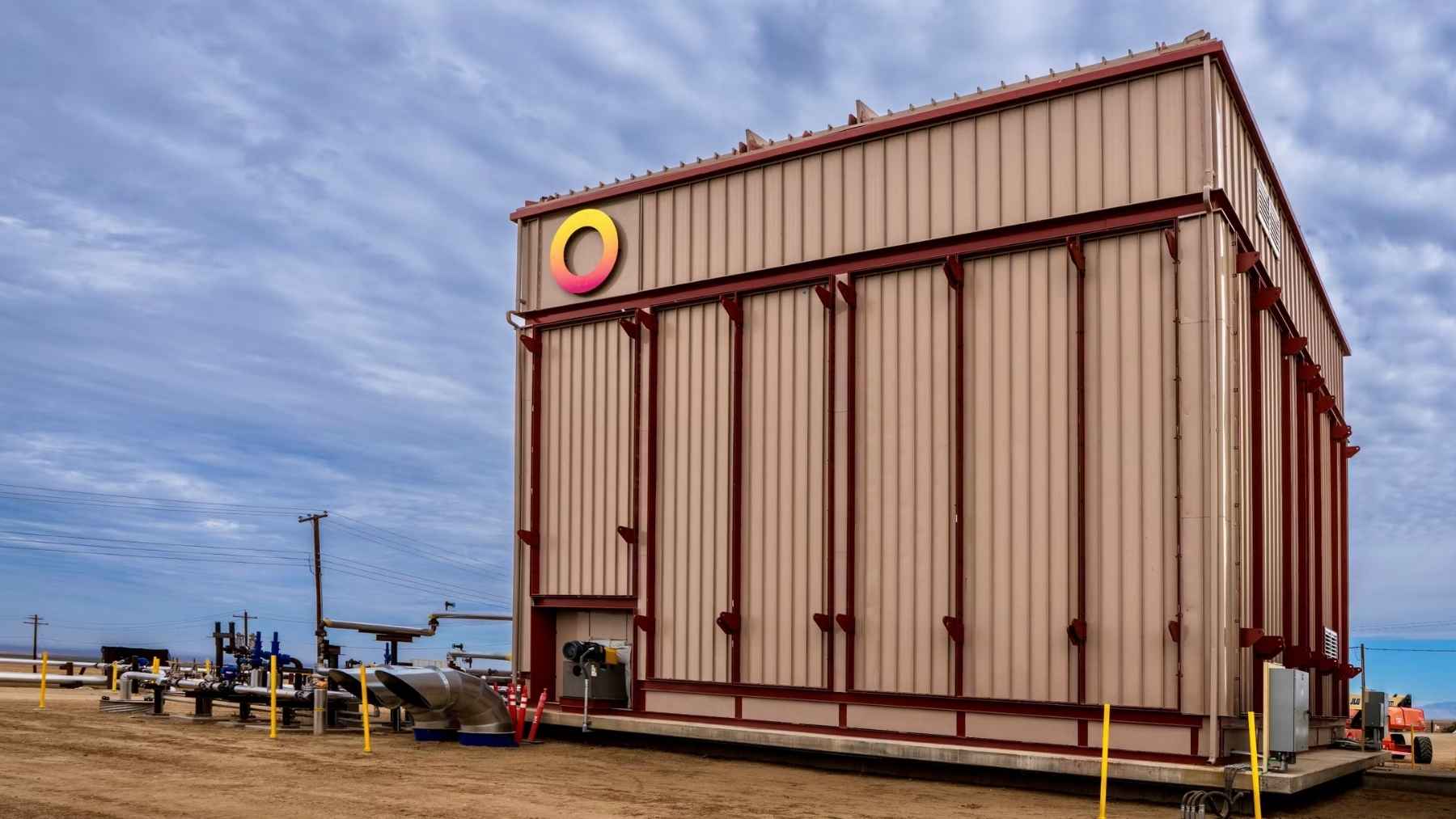
So here is the version without the detour. For roughly a year now, a machine in Kern County, California has been soaking up sunlight during the day and pushing out high-pressure steam around the clock, every single night, automatically. It is a 100-megawatt-hour tower of refractory bricks that Rondo Energy heats past 1,000°C (1,832°F), and the company says it is the largest industrial heat battery on Earth.
The building it lives in looks like a four-story prefab office block. The customer that owns it pumps crude oil. We will get to that part.
The whole machine is brick and toaster wire
Strip away the branding and a Rondo Heat Battery is two very old ideas stacked together. Electric heating elements, the same basic joule-heating wire that glows in your toaster, convert solar electricity into radiant heat at essentially 100 percent efficiency. That heat pours into a huge stack of refractory brick, the stuff blast furnaces have been lined with for over a century.
The stack is not a solid block. John O’Donnell, Rondo’s cofounder and chief innovation officer, described the internal layout to IEEE Spectrum as a three-dimensional checkerboard of brick and open chambers, a geometry that keeps temperatures uniform and lets the thing charge fast. “We can turn charging circuits on and off as fast as you can turn your toaster on and off,” he told the magazine.
Discharging is even simpler. A blower pushes air up through the hot bricks, the air comes out superheated past 1,000°C, and if you want steam instead of hot air, you inject water. Turn the airflow up or down and you have a throttle. No combustion, no flame, no exhaust stack.
The bricks lose less than 1 percent of their stored heat per day, according to Rondo, and the round-trip efficiency, meaning how much of the electricity that goes in comes back out as useful delivered heat, came in above 97 percent across the first 10 weeks of verified operation. The storage medium cannot catch fire, explode, or leak anything toxic, because it is brick. There are no scarce minerals in it either. The system produces zero on-site emissions, which in California also means it needed no air permits.
The first customer pumps oil, and that is not an accident
The machine sits at a Holmes Western Oil Corporation facility in Kern County, the heart of California’s oil patch. Holmes uses steam flooding, an enhanced oil recovery technique where steam gets injected down the wells to loosen heavy crude so it flows. That steam used to come from a gas-fired boiler. Now one of those boilers has been swapped for the brick tower and a 20-megawatt solar array, as Canary Media reported when the system went commercial.
Yes, the greenest steam in the San Joaquin Valley is being used to produce more oil. O’Donnell has been upfront about the trade, telling Canary Media the world has to be decarbonized as it currently exists, and the cut is real: about 13,000 metric tons of CO2 avoided per year from that one boiler swap, by his figure.
The economics explain the customer choice better than any philosophy does. California prices industrial carbon through its cap-and-trade program, and its Low Carbon Fuel Standard rewards fuel producers who lower the carbon intensity of what they sell. Cut the gas out of your steam and both ledgers move in your favor.
Holmes also had one advantage most factories can only dream about: enough spare land around the facility to build its own 20 MW solar farm with no grid connection at all. The array charges the bricks directly, off-grid, which sidesteps utility rates entirely. Rondo delivered the whole project with zero lost-time injuries, and the steam feeds into the existing plant piping alongside the remaining gas boilers, with no changes to how the facility runs.
Six cheap hours in, 24 hours of steam out
The accounting works because the battery does not need power all day. It charges during roughly the six cheapest solar hours and then discharges heat for the full 24, day after day, on automatic.
That schedule happens to match a very real California problem. The state now produces so much midday solar that its grid operator routinely curtails it, meaning perfectly good clean power gets switched off because nobody can absorb it. Japan has started shutting off entire solar farms for the same reason, and California’s answer so far has mostly been gigantic lithium grid batteries that store the surplus as electricity.
A heat battery attacks the same glut from the other side. Instead of storing cheap midday power to sell back as evening electricity, it stores it as 1,000°C heat and sells nothing back, because the factory next door drinks all of it as steam. Industrial heat is about a quarter of global final energy use, so the pool of potential customers is not small.
Rondo builds the systems to deliver steam at up to 100-plus bar, over 1,450 psi, into standard steam flanges. Which means the brick tower bolts onto the same pipes a boiler used to feed. The Holmes unit had already hit every milestone for daily automatic operation, performance and reliability within its first 10 weeks, per the company’s October 16, 2025 announcement, and Rondo still lists it as operating today. As CEO Eric Trusiewicz put it at the time, “The Rondo Heat Battery is now proven at industrial scale.”
A year in, the hot-brick business is getting crowded
The Kern County unit was the proof point, and the order book that followed reads like a world tour. Weeks after the California announcement, Rondo and SCG switched on a 33 MWh heat battery at a cement plant in Thailand, billed as the first of its kind at a cement facility. A 100 MWh unit for a Heineken brewery, charged by solar from Portuguese utility EDP, was signed in November 2025. And in January 2026, Rondo and chemicals giant Covestro broke ground on another 100 MWh system at the Brunsbüttel chemical park in Germany, due to be commissioned by the end of this year and sized to cover about 10 percent of that site’s steam.
Rondo is not alone in the hot-object business, either. Antora Energy, whose approach stores heat in solid carbon blocks at up to 2,400°C, has been running its own giant installation at a South Dakota ethanol plant, the one we covered as a fleet of glowing toaster boxes banking wind power. Two weeks ago Antora raised $550 million to point the same idea at data centers. When the checkbooks get that large, a technology has stopped being a science project.
The honest caveat comes from Rondo itself. O’Donnell told Canary Media the company’s long-range target for its storage service is $30 per megawatt-hour, and the Holmes project is not close to that number yet. It penciled out because the customer owns the system, had free land for solar, and operates in a state where carbon costs real money. Places without those three ingredients are a harder sell, and the cancellation of federal industrial-decarbonization grants under the Trump administration, which defunded planned Rondo installations for Diageo and Eastman, has not made the American math any friendlier.
Still, the core fact stands and it is a strange one to type. The largest battery of its kind on the planet is a pile of bricks in an oil field, it has run every night for a year on nothing but sunshine, and the boiler it replaced has not been missed. If the cheapest way to keep steam moving at 3am turns out to be a glowing stack of masonry, industry will not spend long being sentimental about the flame.
 @brianweight ROOKIE1 month ago