
Most border crossings come with a booth, a gate arm and somebody in a uniform asking where you’re headed. The crossing between Port Huron, Michigan, and Sarnia, Ontario, has all of that up on the Blue Water Bridge. Underneath the bridge, though, the border is just a river.
Something strange turned up in that river recently. Sarnia Mayor Mike Bradley, who’s run the city of about 72,000 people for 38 years, saw an unmanned boat going by in the St. Clair River and couldn’t work out what it was. He told CBC’s As It Happens it looked “like something from Mars.”
It wasn’t from Mars. It was from Alameda, California.
The boat was a Saildrone Voyager, one of six drone sailboats the US Coast Guard has had working the Great Lakes since May. Bradley says he only found out what he’d seen through the Detroit News, which had been reporting on the program. Nobody has put an exact date on the sighting. CTV News, which ran the story on October 23, only says it happened recently.
He isn’t happy about any of it. Bradley told CTV the deployment is “a huge slap again to Canada on our sovereignty,” and he’s frustrated that nobody on the US side told Sarnia it was coming. Frequency News reports he wants local officials to get a proper explanation of what the drones collect and how that information gets used.
So what was sitting in the river?
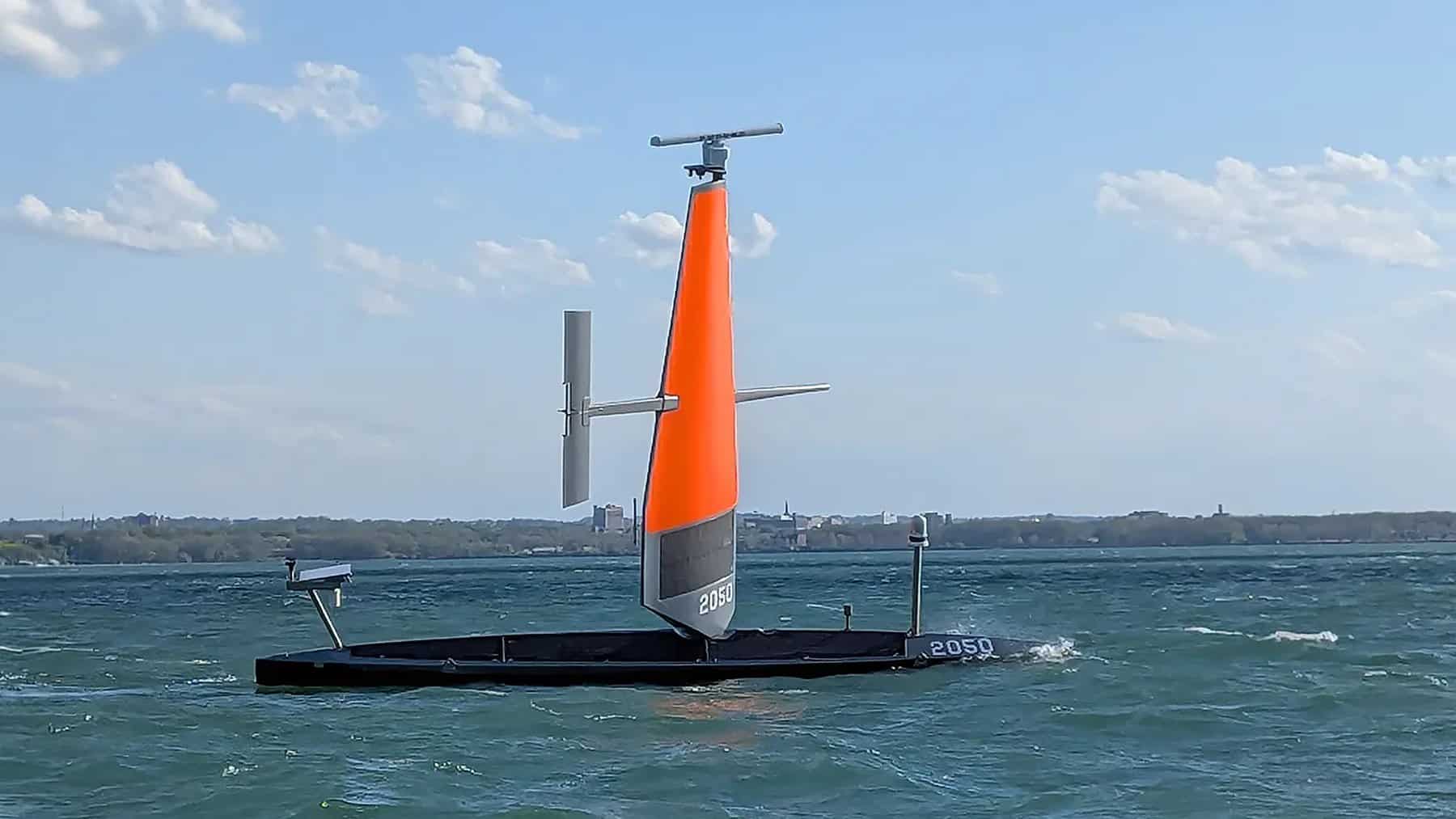
Basically, a floating sensor post with a sail on it. The Voyager is 33 feet long, with a rigid wing that stands about 20 feet tall and a keel that reaches roughly 6.6 feet below the waterline. Saildrone doesn’t publish a weight for it, so I can’t tell you how heavy one is.
It also isn’t quite the sailboat it looks like. The Coast Guard’s own release describes the propulsion as hybrid-electric, with the wing helping out and solar panels topping up the batteries, and the Voyager spec sheet lists an electric motor as the main drive. The company gives a working speed of 5 knots, a little under 6 mph, and says the boat can stay out about 100 days between service stops.
The hardware is what the mayor is actually worried about. Each Voyager carries high-resolution cameras, radar and AIS receivers, and the spec sheet adds an infrared camera and a Starlink connection for getting all of it back to shore.
If you haven’t run into AIS before, it’s a radio beacon that ships use to broadcast who they are, where they are and where they’re going. A boat that switches it off doesn’t disappear from radar, though, which is pretty much why the Voyager carries both.
Human operators on land watch the boats around the clock and can take manual control whenever they need to, according to the Coast Guard Great Lakes District.
Six boats on five lakes
A lot of the coverage gets muddled at this point. The Coast Guard’s contract with Saildrone was signed in March for $15.5 million and covers 16 Voyagers. But that fleet is split between the Great Lakes and the North Atlantic off New England, where the boats watch fishing grounds. The Great Lakes get six of them, as both CTV and the Detroit News report. So if you’ve seen 16 quoted for the Great Lakes, that’s the whole contract, not the Lakes.
Six boats for more than 90,000 square miles of water sounds a little thin, frankly. The Coast Guard’s way around that is to fence them in. Anthony Popiel, who manages unmanned systems for the Great Lakes District, told the Detroit News that each of the four Coast Guard sectors on the Lakes drew its own patrol boxes, and those sectors decide where the drones sail inside them.
The St. Clair River is a pretty tight squeeze by comparison. It runs about 40 miles from Lake Huron down to Lake St. Clair, and its northern stretch averages around half a mile across. So a 33-foot boat with a 20-foot orange wing sailing through there isn’t exactly going to blend in.
Sarnia sits right where Lake Huron pours into the river, directly across from Port Huron. Lake freighters, weekend boaters and a big petrochemical complex on the Ontario shore all share that water. You can see why a mayor looking out at that river would notice a boat with nobody on it.
We covered the first Voyagers to go into Lake Erie back in June. The same model has since picked up a yearlong surveillance job with the Swedish Navy in the Baltic, too.
The mayor isn’t buying it
Bradley’s argument is basically that the drones are fixing a problem the Great Lakes don’t have. He told CBC that thousands of boaters on the river and on Lakes Huron and Erie will now end up on camera, and he wants Ottawa to push back.
In the Detroit News piece, he went further. He said Canada and the US have gone from sharing a famously open border to a militarized one.
I get why that lands in Sarnia. The Detroit News describes US-Canada relations as being at their lowest point in decades, and a camera-carrying boat that nobody warned you about is arguably the worst possible way to introduce new hardware to a border town.
The Coast Guard’s position is that Canadians aren’t the target. It told CBC back in June that the boats aren’t there to surveil Canadians, and its release says the sensors are focused solely on maritime domain awareness. That’s a mouthful. It basically means keeping track of what’s moving on the water, and spotting anyone out there who’s either in trouble or up to something.
None of this is brand new for the Coast Guard, either. It’s been using the same company’s drones for a few years in the Southwest and Southeast, on drug and migrant interdictions, search and rescue, and illegal fishing. The Great Lakes and New England jobs just push that work north.
So where does the footage go?
Bradley keeps coming back to this one, and it’s a fair question.
The Coast Guard doesn’t own or operate the drones. Saildrone does. Coast Guard units log into the company’s mission portal to see what a drone sees in real time, and Popiel told the Detroit News that “data that’s recorded by the Saildrone stays with the Saildrone.” He said the Coast Guard doesn’t keep it.
Which raises the obvious follow-up: what does Saildrone keep, and for how long? I couldn’t find an answer. Saildrone didn’t respond to CBC, and Popiel sent the Detroit News to the company for anything about data collection. Frankly, telling a Canadian mayor that a private contractor holds the footage instead of the government is a slightly odd form of reassurance, though I doubt that’s how the Coast Guard meant it.
For what it’s worth, the same Voyager fleet has kept busy off New England. The company says its boats in the Northeast covered more than 19,000 nautical miles between June and August while watching the fishing grounds.
The Coast Guard’s window for the Great Lakes runs from May through October, and the boats come out of the water before the lakes ice over. On October 22, Saildrone announced an $8.5 million extension that keeps its Northeast boats working for the Coast Guard through spring 2027. Popiel told the Detroit News he expects Saildrones back on the Great Lakes next year.