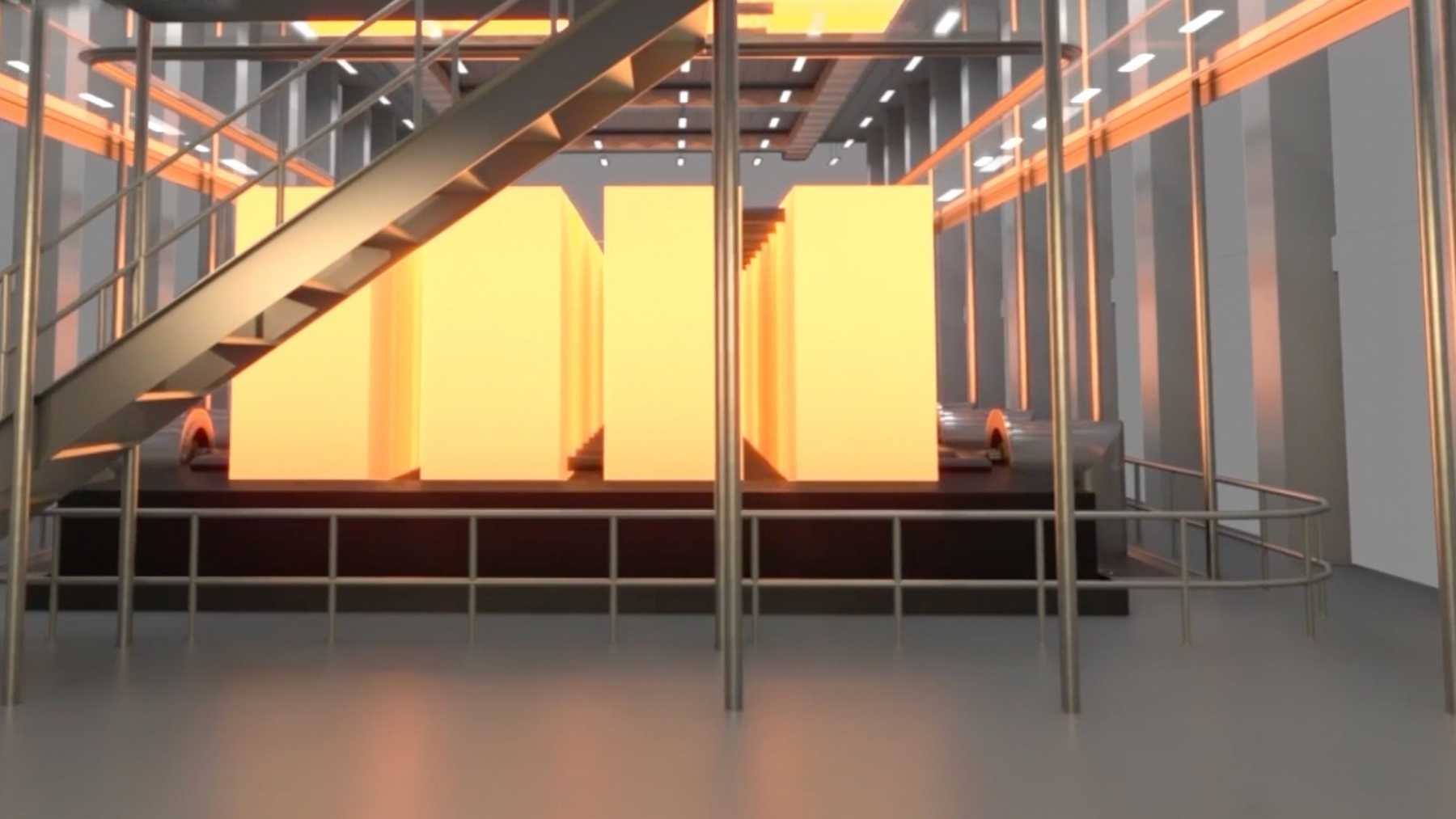

Anything hot enough gives off light. You have seen it in a campfire, on an electric stove burner, in the orange end of a blacksmith’s iron before it goes back on the anvil.
Keep pushing the temperature and that glow gets brighter fast. Much faster than the temperature itself climbs, in fact. Double the absolute temperature of an object and it does not emit twice the light, it emits roughly sixteen times as much, because the emission scales with the fourth power of temperature.
A company outside Boston named itself after that exponent and built its entire business on it. Fourth Power, spun out of MIT by mechanical engineering professor Asegun Henry, heats graphite bricks until they are white-hot, then harvests the light itself and turns it back into electricity.
The bricks run six feet long and 20 inches thick. Henry told MIT News the system operates between 1,900 and 2,400 degrees Celsius, which is 3,452°F to 4,352°F, or somewhere north of half the surface temperature of the sun. Moving heat around at those numbers is the part nobody else has solved, and Fourth Power’s answer is to pump liquid metal.
The tin is the whole trick
Most thermal storage systems shove hot gas or molten salt through metal pipes. Metal pipes have a ceiling, and it is a lot lower than 2,400°C.
Henry inverted the problem. Instead of building the plumbing out of metal and pushing something else through it, he built the plumbing out of graphite and pushed metal through it. The metal is tin.
Tin gets picked for one boring, decisive reason: it does not react with carbon at any temperature. No corrosion, which is what eventually kills every other high-temperature loop. It also melts at a very reachable 232°C (about 450°F) and does not boil until 2,602°C, so it stays liquid across an absurdly wide band.
Graphite has a second useful quirk. Unlike almost everything else on the planet, it gets stronger as it heats up. The company says on its own site the whole assembly is designed for more than 30 years of service, sealed inside an argon enclosure so the carbon cannot oxidize.
Building a pump that survives this was the first hurdle, and Henry cleared it back in 2017. His ceramic-and-graphite pump moved liquid tin at 1,200°C, hot enough for Guinness to certify it as the hottest operating liquid pump anyone had ever built. The company grew out of that machine.
The cells get dipped in and out of the light
Charging is unglamorous. Cheap grid power runs through heating elements, the graphite bricks soak it up, and the stack sits there glowing.
Discharging is where it gets strange. Liquid tin leaves the bricks at 2,400°C, flows through graphite pipes and pumps, and passes thermophotovoltaic cells that work like solar panels tuned for a white-hot emitter instead of the sun. The tin cools as it gives up energy, then loops back through the bricks to reload.
The on-off switch is mechanical and almost comically simple. “You can basically dip the cells into the light and get power,” Henry told MIT News, and pulling them back out shuts the whole thing down.
Those cells are not vaporware. In 2022, a team led by Henry and Alina LaPotin at MIT, with the cells fabricated at the Department of Energy’s National Renewable Energy Laboratory, published a two-junction TPV device in Nature that hit 41.1% efficiency off a 2,400°C emitter. NREL put the average at 36.2% across the useful temperature range, against a previous world record of 32%.
That is a heat engine with no moving parts outperforming a steam turbine. It is also the number that caps the entire concept, and we will get to that.
Power density is the actual sales pitch
Ask Henry why the temperature has to be this extreme and he does not talk about physics for very long. He talks about square footage.
Hotter material transfers heat faster, which means the hardware doing the transferring can be smaller, which means the whole plant gets cheaper. Fourth Power’s claimed number is roughly 100 megawatts per acre. Henry told MIT News that most storage technologies land around 10 megawatts an acre or less.
A full commercial block, in the company’s plan, pairs 25 megawatts of output with 250 megawatt-hours of capacity on a pad roughly half the size of a football field. Power and storage are separate modules, so a customer buys one of each for a 10-hour battery and bolts on a second storage module to make it a 20-hour battery.
Standing losses are quoted at about 1% of stored heat per day. That is what makes the long-duration pitch work at all, and it is why the company talks about anything from 10 to over 100 hours of discharge rather than the four hours a lithium farm typically delivers.
Everyone in hot rocks is chasing data centers now
Fourth Power is not alone in the business of cooking solid material with cheap electricity. It is, however, one of the smaller players in a field that suddenly has enormous amounts of money in it.
Antora Energy closed a $550 million Series C on July 30, co-led by G2 Venture Partners and Eclipse. Antora heats solid carbon to the same 2,400°C and already has a 5-gigawatt-hour installation running at a South Dakota ethanol plant. “From factories to data centers, energy is the bottleneck to industrial growth,” said co-founder and CEO Andrew Ponec.
Rondo Energy runs firebrick at lower temperatures and has been making steam every night for a year in Kern County, California. Tempo Energy, formerly Redoxblox, uses a mixed metal oxide ceramic and has pilots slated for early 2027.
All of them have started talking about data centers, which is a slightly odd pivot for a product whose main output is heat. Latitude Media reported on August 18 that Antora’s Series C announcement mentioned data centers five times, while its 2024 Series B announcement did not mention them once.
Isshu Kikuma, an energy storage analyst at BloombergNEF, told the outlet that for heat batteries the ideal customer “would be the industrial players,” meaning steel, cement and chemicals. Getting electricity back out generally means bolting a steam turbine onto the side.
This is the one place where Fourth Power’s weirder architecture looks like an advantage. Its system was never designed to sell heat. The thermophotovoltaic cells are the product, so there is no turbine to add, no water loop, no rotating machinery at all.
The catch is that none of these companies, Fourth Power included, has announced a major data center deal. Nobody has commercialized a heat battery at large scale for electricity yet, and the long-duration crown currently belongs to a different chemistry entirely: Form Energy’s iron-air batteries, which are being built in West Virginia to hold 100 hours of power for a Google data center.
The one material Fourth Power cannot buy at home
Antora’s press release makes a point of saying its batteries need no supply-constrained critical minerals. Fourth Power leans on the same argument, and for the graphite it holds up well: the company says its carbon comes from a byproduct of petroleum refining, a category in which the United States is among the largest exporters on Earth.
The tin is a different story. Tin sits on the Interior Department’s final 2025 List of Critical Minerals, published in the Federal Register last November alongside 59 other commodities.
The numbers behind that designation are stark. According to the U.S. Geological Survey’s 2026 Mineral Commodity Summaries, tin has not been mined in the United States since 1993 and has not been smelted here since 1989. Net import reliance for refined tin was 77% of apparent consumption in 2025, sourced mostly from Peru, Bolivia, Indonesia and Brazil.
Prices have been ugly, too. The International Tin Association logged a nominal all-time high on January 14, with the LME three-month contract closing at $53,462 per tonne. The association pinned the surge on investor activity rather than fundamentals, and noted that China’s nonferrous metals industry body had called the rally “unreasonable.”
None of this is fatal, and it is worth being precise about why. Tin here is a working fluid in a sealed loop, not a consumable like the lithium in a cell. You buy the inventory once and it circulates for the life of the plant, which the company puts at three decades.
Still, the metal doing the hardest work in a system marketed on energy independence arrives on a boat. And the reason it is expensive right now is solder demand from the AI buildout, which is the same buildout Fourth Power wants as a customer.
What has to happen next
Fourth Power says it has raised $45 million to date, across a $19 million Series A led by DCVC in December 2023 and a $20 million Series A Plus led by Munich Re Ventures in September 2025. Set against Antora’s $550 million, that is a rounding error, and the company has said publicly it is preparing a Series B.
It has the real estate. In January it took 47,500 square feet at a new advanced manufacturing campus on Middlesex Turnpike in Bedford, Massachusetts, which is now its phase-one headquarters and the site of the demonstration unit.
That demonstration is the whole ballgame. An integrated 1 megawatt-hour system, built from full-scale commercial components, is what the Series A Plus was raised to commission, and the company has described it as the last step before customer deployments. In March it was slated for later in 2026. As of late August there has been no announcement that it has been switched on.
There is also the efficiency question. A lithium-ion battery hands back the overwhelming majority of what you put into it. A thermal system running through a 40-percent-class conversion step does not come close, which means Fourth Power is asking utilities to throw away more of every kilowatt-hour in exchange for storage cheap enough that the waste stops mattering.
That trade is either brilliant or it is not, and a 1 MWh box in a Boston suburb is the only thing that will settle it.
CEO Arvin Ganesan, who ran global energy policy at Apple before this, framed the market gap plainly when the last round closed: existing solutions are “too slow to deploy, too expensive for customers, and oftentimes both.” Fourth Power has spent three years and $45 million arguing it can be neither. The graphite needs to start glowing.

















The batteries providing short term power, and the graphite longer term.
Thus the US could double energy supply without expensive, grid and power plant build outs.
Solar built over agricultural canals and
water reservoirs that suffer from huge evaporation, could make up for declining hydro, and graphite storage gives long term stability.
All that is laking is implementation.