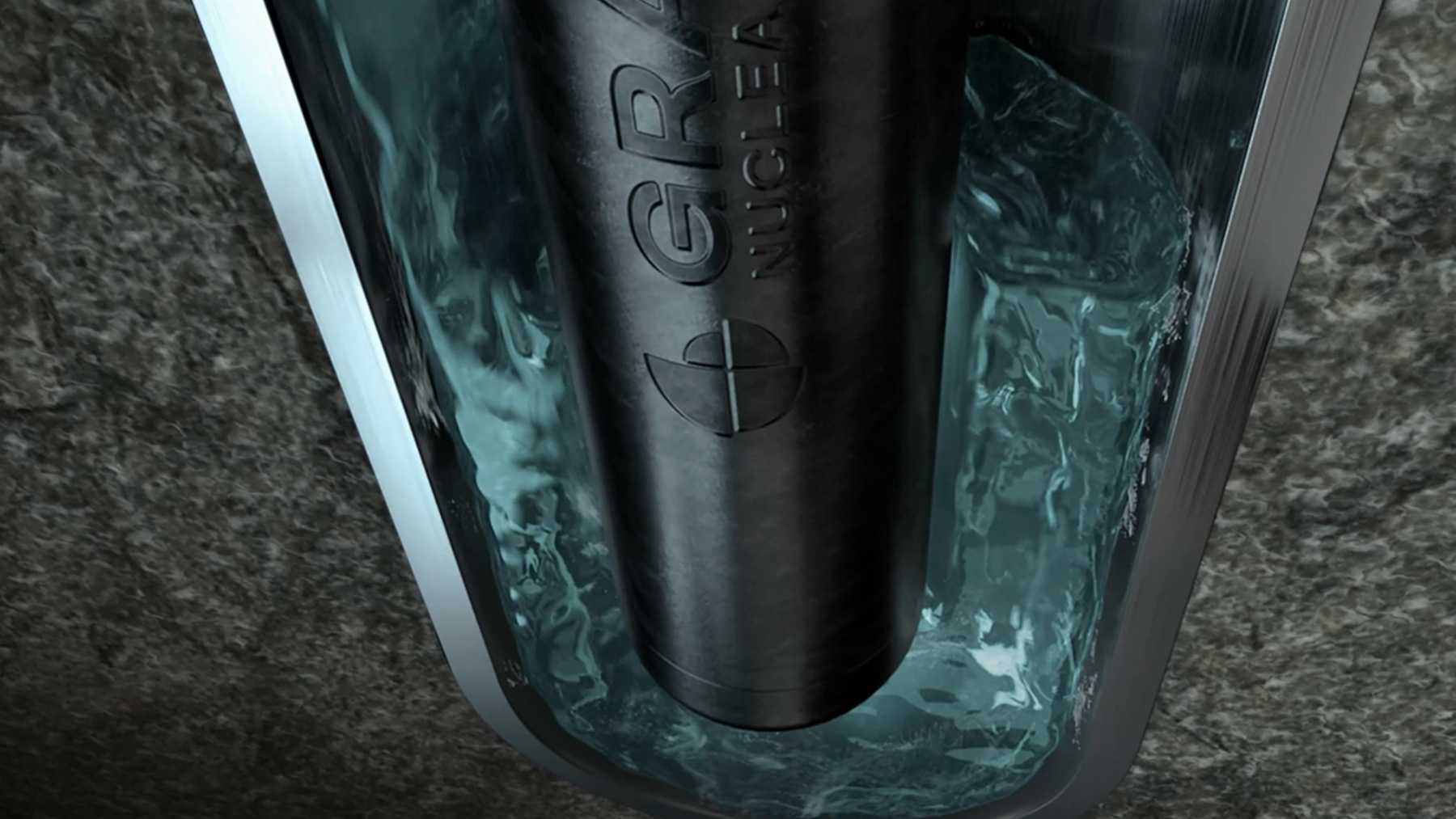

Dropping nuclear material down a very deep hole is not a new idea. The industry has kicked around deep borehole disposal for decades as a way to put spent fuel somewhere the surface will never have to think about again.
Liz and Rich Muller spent years selling exactly that. The father-and-daughter pair founded Deep Isolation in 2016 to lower waste canisters into boreholes drilled with oil-and-gas rigs.
Then in 2023 they founded a second company to send a live reactor down the hole instead.
That company, Deep Fission, spent August 11 in front of investors at Canaccord Genuity’s growth conference in Boston laying out a timeline that would put electrons on the Kansas grid roughly 16 months from now. We covered the concept back in June, when it was mostly renderings and a fresh Nasdaq listing. A few of the numbers have moved since, including one that most coverage is still getting wrong.
The hole is a lot wider than the early filings said
Plenty of write-ups still describe a 30-inch borehole, a figure that traces back to earlier regulatory paperwork. Muller superseded it on stage.
According to the conference transcript published by Investing.com, she said the company is starting at about 40 inches in diameter because that is what it can reliably drill today, and wants to get closer to 60 inches.
That gap is not cosmetic. A 40-inch hole takes four fuel assemblies. A 60-inch hole takes nine, which Muller said delivers much better fuel economics.
Widening a borehole through hard granite is also the entire proof-of-concept program running in Kansas right now. Sixty-inch holes have been drilled before, in Nevada and in some deep-sea wells, but not routinely in the rock Deep Fission is working in.
So when you read that the reactor goes down something the width of a household appliance, mentally upgrade it to something closer to a doorway, and understand that the wider version is still a drilling experiment.
Everything they are not building is the actual pitch
The reactor itself is deliberately unremarkable. It is a pressurized water reactor, the design that has been running commercially since the 1950s, and Muller noted that 64 PWRs currently operating in the US produce roughly 67 gigawatts.
Deep Fission is not trying to prove new physics. It is trying to prove a new address.
A mile of water sitting on top of the reactor supplies the operating pressure, moves the heat to the surface and doubles as emergency cooling. Billions of tons of rock do what a containment dome does above ground.
Strike those out and the shopping list gets short. No reactor pressure vessel, which Muller said runs around $1 billion and comes from a handful of suppliers worldwide. No containment building, no separate pressurizer, no dedicated emergency core cooling system.
Her sharpest comparison was to Vogtle, the newest reactor complex in the country, which parks a large volume of water on a platform above the reactor so gravity can cool it if power is lost. Deep Fission gets the same physics from geology and calls the surface layout “nuclear-assisted geothermal,” because from above the site looks like a geothermal plant.
Fuel is the other bottleneck they sidestepped. The reactor runs on ordinary low-enriched uranium rather than the HALEU or TRISO that several microreactor rivals are still waiting on. Deep Fission signed a supply agreement with Urenco USA in February, sourced from the Eunice, New Mexico enrichment plant.
The 2027 unit is deliberately small, and the timeline already slipped once
Here is the distinction most headlines flatten. The 15-megawatt reactor everyone quotes, the one the company says powers about 12,000 homes, is the 2028 machine.
The 2027 debut is a 5-megawatt unit running below its ceiling. Muller framed the smaller size as a scheduling advantage, since staying at or under 5 MW makes grid interconnection considerably faster. It is the same logic pushing other startups toward small, sited-behind-the-fence machines rather than grid-scale ones.
Worth remembering how the calendar has moved. When Deep Fission went public in September 2025 through a reverse merger with a shell called Surfside Acquisition, at $3.00 a share, the announcement targeted deployment of its first underground reactor in 2026.
That is now end of 2027 for a smaller unit. A year of slip in under a year, before a single hole has been drilled to depth with fuel in it.
The regulatory side has genuinely moved, though. On August 6 the Energy Department signed off on the Gravity reactor’s Nuclear Safety Design Agreement, which sets a safety framework under the Reactor Pilot Program and is not an operating license. Muller said the NRC’s new Part 57 rule is expected in final form by the end of 2026, with a stated review window of six to nine months, and that Deep Fission could be among the first to use it.
Parsons is not sold on any of this
The Great Plains Industrial Park runs to 13,000 acres and used to be an Army ammunition plant, sitting just outside Parsons, Kansas. Deep Fission broke ground on about 100 acres of it in December 2025 and has since drilled a data acquisition well to 6,000 feet.
Zoning is the underrated asset here. Nuclear and industrial uses have been permitted on the land for over two decades, and the park already has roads, rail and a security perimeter. Zoning fights alone have killed projects with every other box ticked.
The town of 9,600 is another matter. Residents were caught off guard by the groundbreaking, and one of them did something about it. Marjorie Reynolds, a pediatric nurse whose family has been in Kansas seven generations, set up a nonprofit under the name Prairie Dog Alliance. Its logo puts a prairie dog inside a radiation trefoil.
Reynolds told KCUR the project is “an experimental project that no one voted for.” Her most specific objection is procedural rather than emotional: the drilling is proceeding under oil-and-gas rules rather than nuclear ones.
Paul Gunter of Beyond Nuclear, which was quoted in a Wall Street Journal piece on the town in July, has pushed back on the idea of proceeding without a peer-reviewed environmental impact statement covering high-level waste under Parsons. DOE has said the administration remains focused on safety and security.
Support is real but thin. A local librarian told The New Republic she reckoned “at most 25 percent” of residents back the project, and Prairie Dog Alliance counts around 15 regular meeting attendees against several hundred followers online. Neither number stops a DOE-authorized pilot, but both guarantee more community meetings through 2027.
The stock says investors have questions
Deep Fission uplisted to Nasdaq on June 18, pricing 2.5 million shares at $16.00, the bottom of a range that had already been cut. It has spent August trading around eight dollars, roughly half the offer price, against a 52-week range that tops out at $19.
The company has no revenue. Its amended registration statement restates the 2023 and 2024 books, citing mistakes in how it valued SAFE instruments and booked share-based pay. The same document flags weaknesses it found in its own financial reporting controls, measured as of the end of March.
That same filing carries the reactor economics: roughly $152 million in capital cost for the initial four-assembly units, falling to about $84 million for the nine-assembly version, against projected revenue of $10 million to $20 million per reactor per year.
What investors are actually underwriting is the 18.5 gigawatts of letters of intent announced in June. Read the release and the company says plainly those are non-binding and commit nobody to buying a megawatt-hour.
Analyst coverage is uniformly positive, which is worth holding at a slight distance. Benchmark started at Buy with a $20 target, Seaport at Buy, and Canaccord at Buy with an $18 target. Canaccord also hosted the conference this article is built on.
What has to go right before late 2027
The near-term work is drilling and choreography, not physics. Deep Fission is testing larger-diameter boreholes and rehearsing how nuclear and drilling crews coordinate before anyone works in a nuclear environment.
Maintenance is the design choice that will draw the most scrutiny. Rather than pulling a reactor up to refuel it, the company plans to swap the entire canister and park the spent one deeper in the same borehole for anywhere from 10 to 50 years.
Which means the waste stays put by design. That is the same argument the Mullers were making at Deep Isolation, except it now arrives attached to a power purchase agreement rather than a disposal contract.
Muller argues the canister has gotten cheap enough that fuel dominates the economics, which makes replacement the rational move. Reynolds’ question about who regulates that, and under which framework, has not been answered in public.
One correction worth making, since it keeps circulating: if this works, it will not be America’s first commercial reactor of the decade. Vogtle Unit 3 entered commercial operation on July 31, 2023, and Unit 4 on April 29, 2024. Deep Fission would be the first commercial reactor put underground, and the first authorized through the DOE pilot route rather than conventional licensing, which is a narrower and more interesting claim anyway.
If the hole gets to 60 inches and the paperwork lands, a rural Kansas industrial park becomes the strangest power plant in the country, and the drilling industry quietly inherits a nuclear business.
If it slips again, the 2028 unit becomes the story, and Deep Fission joins a long tradition of reactors that were always going to be running the year after next.
The Mullers already spent a decade arguing that a borehole is the right place to put nuclear material. They are about to find out whether it matters that this batch is switched on.
 @kevinsmith ROOKIE2 months ago