
- 2 MONTHS AGO · MILITARYAn 8,157-ton nuclear attack submarine needed four tugboats lashed to her sides to get out of the English shipyard that spent 13 years building her, threading two docks and a sharp turn before the open channel, and the fleet she joins hadn’t put one to sea in four months
- 1 MONTH AGO · MILITARYA 145-ton American drone ship built to trail a submarine for three months steered itself more than 2,000 nautical miles from Pearl Harbor to San Diego, and when the Navy ordered 30 drone ships a few weeks later, the company behind it was not one of the three picked
- 3 WEEKS AGO · MILITARYA 6,900-ton nuclear attack submarine lost permission to dive while she waited for an overhaul, was towed three times between Norfolk and a private shipyard and sat in dry dock with less than a quarter of the work done, and the Navy is now sending her shipyard workers to new submarines
- 1 DAY AGO · MILITARYA 97,000-ton nuclear aircraft carrier has now spent 2,022 days at the Virginia shipyard that built her, getting a new mast and work on over 600 tanks, and Navy documents point to one more year of it, with her sister ship already there for a five-year overhaul
- TODAY · THIS ARTICLEA 324-foot covered barge with a roof that slides open was built to hide the giant claw that reached for a sunken Soviet submarine, later hid the Navy’s stealth ship while it was built and tested, and today works as a floating dry dock at a commercial shipyard on San Francisco Bay
The CIA’s giant claw is one of those Cold War stories that keeps coming back around. You’ve probably heard some version of it: a fake deep-sea mining ship, a billionaire lending his name as cover, and a Soviet submarine lying 16,500 feet down on the floor of the Pacific.
Sounds like a James Bond movie… On steroids.
But the ship and the billionaire tend to hog the spotlight. The bit of hardware I find more interesting is the barge that kept the claw out of sight. Mostly because it’s still showing up to work in the San Francisco Bay Area.
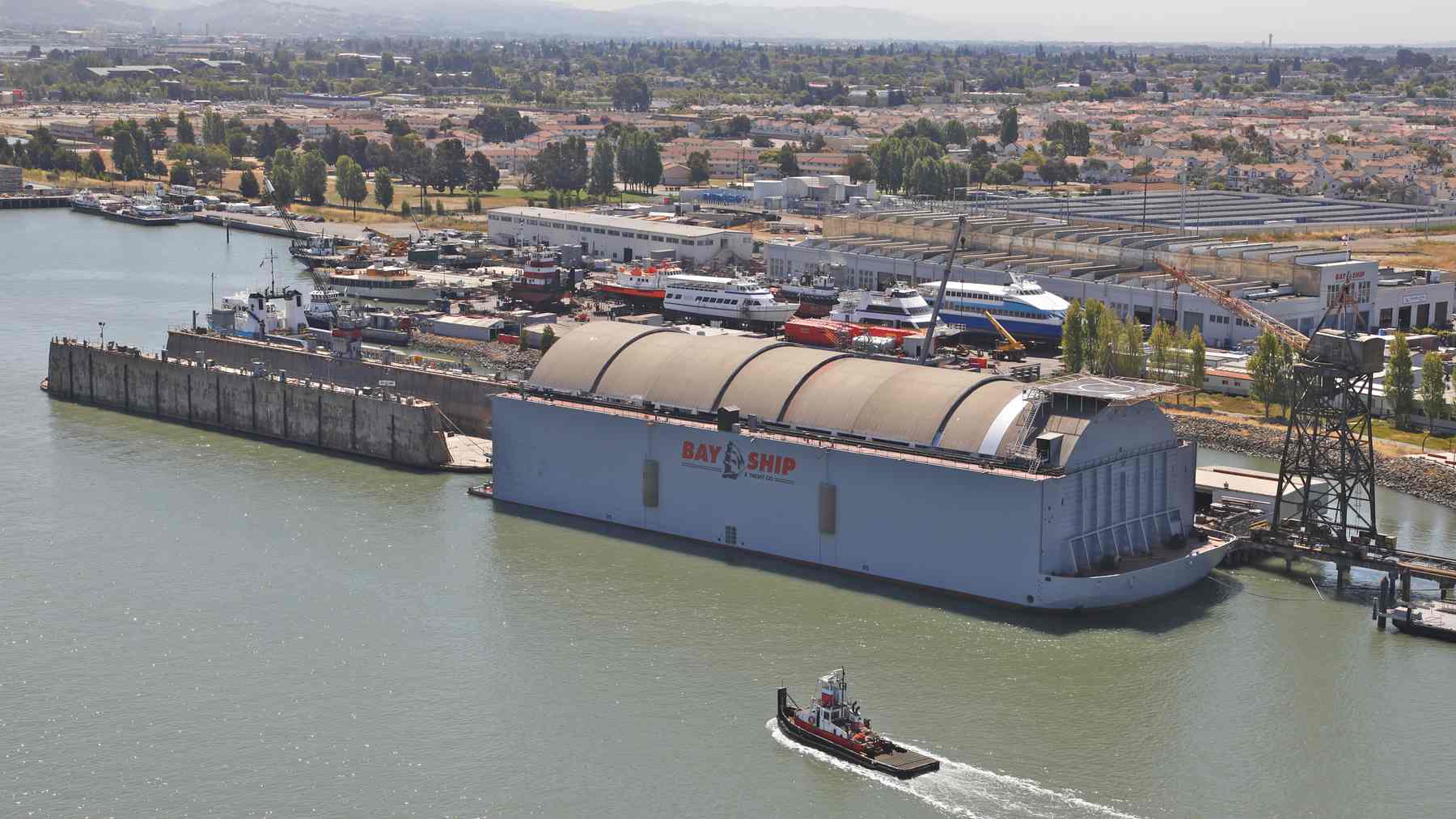
It’s called HMB-1, short for Hughes Mining Barge, and it’s a big, boxy thing. It’s 324 feet long and 106 feet wide, it stands more than 90 feet tall, and it has a roof that slides open. Empty, it displaces 5,800 long tons. Fully loaded, that climbs to 10,875 long tons. It has no engines of its own, so it goes everywhere behind a tug.
If you’re wondering what a long ton is, it’s 2,240 pounds. It’s the old imperial ton that navies still use to weigh ships. So that full-load figure works out to roughly 12,200 of the 2,000-pound tons you’d see on a truck scale.
The barge was launched in 1974 with one job. The claw, which the CIA calls the “capture vehicle,” was built inside it, under that roof, where nobody outside the program could get a look at it.
So how do you hand a claw to a ship in secret?
You sink the box it’s in. That’s pretty much what happened.
HMB-1 was towed, claw and all, to a spot near Catalina Island off Southern California, where piers had already been set into the seafloor. The barge was then flooded until it settled down onto those piers and sat there underwater.
Next, the recovery ship, the Hughes Glomar Explorer, moved into position directly above it. The barge’s roof opened, and the claw was hoisted straight up into the ship’s moon pool.
A moon pool is basically a huge hole through the middle of a ship’s hull, open to the water below. The Glomar Explorer’s was big enough to hold the piece of submarine it was meant to bring up, and it had doors that could open and close its floor, according to the CIA’s own account of Project Azorian.
Apparently, the whole handoff took place within sight of people on the beach. That’s a pretty brazen way to keep a secret. But it worked, because anyone watching from the sand would’ve seen a big ship sitting in the water and, from the looks of things, no barge at all.
The ship arrived over the recovery site on July 4, 1974. Its target was K-129, a Soviet submarine that went down in 1968. The lift didn’t go to plan, though. The CIA says the submarine broke apart about halfway up, and the crew hauled in only the section still held by the claw.
If you’re into this kind of deep-water fishing, the nuclear mini-sub that went after a sunken F-14 and its Phoenix missile is a good companion read.
Then the Navy needed somewhere to hide a stealth ship
After the mission, HMB-1 basically sat around. The Navy mothballed it at a San Francisco shipyard until November 1982, when it towed it down to a Lockheed facility in Redwood City, California.
That’s where it picked up its second secret job. HMB-1 became the floating dry dock where the Navy’s experimental stealth ship, Sea Shadow, was built, and it stayed in that role through the ship’s sea trials, which ran until 1986. So for a few years, the same roof that had hidden a CIA claw hid a ship designed to be hard to spot in the first place.
A floating dry dock, if you haven’t run into one, is essentially a giant tub you can partly sink. You let water into its tanks so it rides low enough for a ship to float in, then you pump that water back out so the dock rises and lifts the ship clear of the sea. Once it’s up, people can get at the hull.
It’s hard to think of a barge with a weirder résumé. Compare it with the 4,300-ton floating crane that spent almost a year moored off West Seattle, which at least got to be bored in public.
The barge doesn’t sink all the way anymore
The General Services Administration eventually put HMB-1 and Sea Shadow up for sale as scrap. In June 2012, an Alameda shipyard called Bay Ship & Yacht bought the pair for $2.5 million.
The catch was that Sea Shadow had to be scrapped under the terms of the sale. The barge got to live. Frankly, $2.5 million sounds like a bargain for a 324-foot floating building, even if you’re required to cut up a stealth ship as part of the deal.
The yard refitted the barge at Treasure Island to serve as a covered dry dock, and swapped its compressed-air system for ballast pumps. Which means HMB-1 can’t fully submerge anymore. It now takes on just enough water for a vessel to float in, then pumps the ballast out until the inside of the dock sits above the waterline.
“Yeah, it’s what was inside that was the secret,” Alan Cameron, the yard’s general manager at the time, told Bay Crossings in 2013. Very Bond-y of him to say.
These days, the roof mostly keeps the weather off. Working under cover lets the yard keep a tighter handle on paint quality, keep messy waste contained and stop losing workdays to rain and wind. It’s a pretty sensible retirement for a piece of spy hardware, if you ask me.
So is it still working?
As far as I can tell, yes. On the shipyard’s facilities page, the yard calls HMB-1 the only covered dry dock on the West Coast and says it takes vessels of up to 6,300 long tons with a beam of up to 76 feet. The yard says it’s also fitted with overhead cranes and full utility service.
What I couldn’t find is a public log of which ships have been through it since the refit, so I can’t tell you exactly how busy it keeps.
Federal paperwork does show it’s still in the rotation, though. In October of last year, the San Francisco District of the US Army Corps of Engineers put out a public notice on the yard’s plan to dredge about 40,000 cubic yards of sediment, and it listed HMB-1 as one of three active berthing areas there. That stretch of water hasn’t been dredged since around 1978, according to the same notice.
The City of Alameda then filed a notice of exemption on April 30 of this year for maintenance dredging at HMB-1 and the yard’s two other berths, under a 10-year dredging permit.
 A 41-foot drone boat ran the Strait of Hormuz with two Coast Guard cutters while an Iranian drone and a Revolutionary Guard attack boat watched it pass, and months later it went through again out in front of a destroyer carrying the region’s top American generalMilitary · 10 hours ago
 A 2,583-ton ship that can be run from a control room on shore went through the Royal Navy’s trials early this year for a net to track Russian submarines between Greenland, Iceland and Britain, and its 8,100-square-foot open deck is rated for 1,050 tonsMilitary · 1 day ago
 A 1,526-ton World War II submarine with no propellers was towed 113 miles back across Lake Michigan in 15 hours by two tugboats and eased into her museum berth by 10 a.m., after a Wisconsin shipyard found only 10% of her hull steel had worn away in her first dry dock in 72 yearsMilitary · 1 day ago