
- 2 MONTHS AGO · ENERGYThe 240-foot steel towers of an idle Wyoming wind farm toppled onto the prairie over two days, 450,000 pounds apiece, cut down with what the county fire chief called an exploding axe, a shaped charge notching the steel the way a logger notches a tree
- 1 MONTH AGO · ENERGYA wind turbine with a 394-foot rotor folded over into a Missouri field on a Wednesday afternoon, the fourth tower to go down at the state’s biggest wind farm in a little over two years, on a 175-turbine site that had only 15 machines running after the last three fell
- 4 WEEKS AGO · ENERGYA 459-foot wind turbine standing on a dike on the German North Sea coast caught fire 276 feet up at half past ten at night, and 60 firefighters drove out to it and stood on the ground watching it burn, because the tallest ladder they own reaches a little past 100 feet
- 3 WEEKS AGO · ENERGYA 499-foot wind turbine folded in half into a Missouri pasture after two loud noises at 4 in the morning, the fifth tower to go down at the state’s biggest wind farm, and photos taken that afternoon show three of its neighbors spinning beside the stump
- TODAY · THIS ARTICLEA 92-turbine wind farm on the South Dakota prairie had more than 20 of its machines wrecked and nearly 300-foot steel towers folded in half by a 131-mph gust in June, and early on an October Monday firefighters drove 10 miles south of Highmore to a turbine burning with nobody inside
Most of us only see a number like 131 mph on a hurricane map. You don’t expect it from a thunderstorm rolling across farmland in the middle of the country, at breakfast time, on a Monday in June.
But that’s what a weather station a mile outside Highmore, South Dakota, logged at 6:25 a.m. CDT on June 29. Another station west of town, near the tiny community of Holabird, had already recorded the same 131 mph ten minutes earlier, according to the National Weather Service office in Aberdeen.
Highmore lost roofs, trees and power lines that morning. A few miles southwest of town, a wind farm lost a whole lot more.
So which wind farm got hit?
If you read about this storm back in June, there’s a decent chance you read that it was South Dakota’s oldest big wind farm, a 27-turbine site from 2003 south of Highmore. It wasn’t. NextEra, which owns that older farm, told National Wind Watch its project was fine, and the group (which campaigns against wind farms) added a correction to the story it had reposted.
That’s a pretty big mix-up when one farm has 27 turbines and the other has 92.
The farm that actually took the beating is Triple H, a 250-megawatt site owned by French utility Engie that’s been running since 2020. In a statement in early July, Engie said more than 20 of the farm’s 92 turbines were damaged and the whole site was out of service, Bloomberg reported. Engie also confirmed damage at North Bend, its newer 200-megawatt farm right next door, according to Renewables Now.
Storm chaser Jakob McMillin got out there early and posted photos on X with the caption “Unbelievable damage to a wind farm near Highmore, South Dakota.” Frankly, that’s about the most restrained way anyone could’ve put it. South Dakota Searchlight, reporting from Highmore that day, described turbine towers bent over at the middle.
Engie hasn’t said, at least anywhere I could find, how many of those turbines have been repaired since or when the site will be fully back up.
These aren’t small machines
I went through the permit application Triple H filed with the South Dakota Public Utilities Commission to get a sense of scale. The farm uses GE’s 2.72-116 turbine, rated at 2.72 megawatts apiece. Each tower is about 295 feet tall to the hub, and the rotor is 382 feet across.
Point one blade straight up and the whole thing tops out at about 487 feet.
The towers are conical steel tubes built from three or four sections, sitting on a concrete foundation that covers roughly 2,700 square feet and goes as deep as 10 feet. The filing doesn’t list what a tower or the generator housing on top weighs, so I can’t give you a number there. The project itself is spread across about 27,250 acres, starting roughly 3 miles southwest of Highmore.
How does wind fold a steel tower?
So how does air bend a steel tube that big? A turbine tower is basically a hollow steel cylinder bolted to a slab, and wind shoving on the rotor at the top works like a long lever, so the bending load piles up farther down the tower. If that load gets bigger than the tube wall can handle, the steel buckles at one spot and everything above it folds over, a bit like stepping on an empty soda can that’s standing upright.
Turbines do have a defense against high wind. The permit filing lists a cut-out speed of roughly 92 mph for three-second gusts. At that point the machine’s supposed to stop, turn its blades out of the wind and wait it out. That’s a pretty sensible system, right up until the wind shows up nearly 40 mph past the point where it’s meant to kick in.
What the filing doesn’t list is the gust speed the turbine’s built to survive while it’s parked. And I couldn’t find anything from Engie on what gave way first at Triple H. If this all sounds familiar, we’ve covered a string of collapses at Missouri’s biggest wind farm, including one where a turbine with a 394-foot rotor folded over into a field.
How rare is a 131-mph thunderstorm gust?
Pretty rare, as far as anyone can tell right now. The NWS calls its figures preliminary and unofficial, but it says the Storm Prediction Center would likely put this one at No. 15 among measured thunderstorm gusts in US records if it holds up.
South Dakota News Watch went a step further in a fact check. If it’s verified, the 131 mph reading would be the second-highest gust ever measured in the state, behind a 142-mph reading in Lantry, in Dewey County, back in 2010. Washington Post meteorologist Matthew Cappucci wrote that you might have to go back to August 1983, and a 149.5-mph reading in Maryland, to find a stronger thunderstorm gust measured directly in the US.
The storm didn’t stay put, either. It formed in Sheridan County, Nebraska, the evening of June 28 and tracked northeast across South Dakota for more than 350 miles, the NWS says. Gov. Larry Rhoden issued an emergency declaration afterward.
Then a turbine caught fire south of Highmore in October
Highmore was back in the news on Monday, October 19. At 7:13 a.m., the Highmore Volunteer Fire Department got called to a wind turbine on fire 10 miles south of town, KELO radio reported. Before firefighters even got there, dispatch confirmed the tower was empty and every worker had been accounted for, according to Dakota News Now. Nobody was hurt.
Fire chief Ken Hoffman told KELOLAND the turbine was a total loss, with one blade burning and the generator up top burned out, and he said he’d never seen a turbine catch fire before. The generator sits in the nacelle, the housing at the top of the tower behind the blades. A volunteer fire department can’t get anywhere near that, so crews kept their distance, dealt with the debris burning in the field below, and then let wind farm staff take it from there.
Reports differ a little on how much ground burned. Dakota News Now says less than an acre, while DRG News put it at about an acre of soybean stubble, with fiberglass scattered across the field.
I’d love to tell you which farm that turbine belongs to. None of the reports name it or its owner, though, and Hyde County has more than one wind farm, so I’m not going to guess. Hoffman said they’re still investigating what started it.
Highmore firefighters handed that site back to wind farm staff after the October 19 fire. Over at Triple H, Engie’s early-July statement put the storm damage at more than 20 of the farm’s 92 turbines.
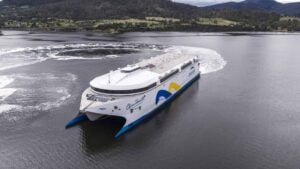 A 427-foot ferry carrying more than 275 tons of batteries just started hauling up to 2,100 passengers and 225 cars nearly 35 miles across the River Plate, on a charge that lasts about 90 minutes and a roughly 40-minute top-up at the dock before it turns around on eight electric waterjetsElectric Vehicles (EVs) · 41 minutes ago
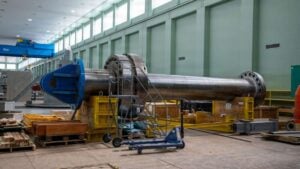 A 400-ton generator at a South Dakota dam was taken apart for the first time in 70 years, its 275-ton rotor lifted out by two cranes working as one, and the first new turbine runner has now rolled into the powerhouse to take each unit up to 52 megawattsEnergy · 3 hours ago
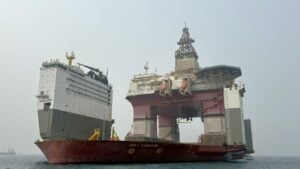 A 45,000-ton semi-submersible drilling rig built to work in 1,640 feet of water and drill as deep as 27,887 feet was floated onto the sunken deck of a 902-foot carrier and now hangs about 28 feet past each side of it on the voyage to a two-year job off NorwayEnergy · 4 hours ago