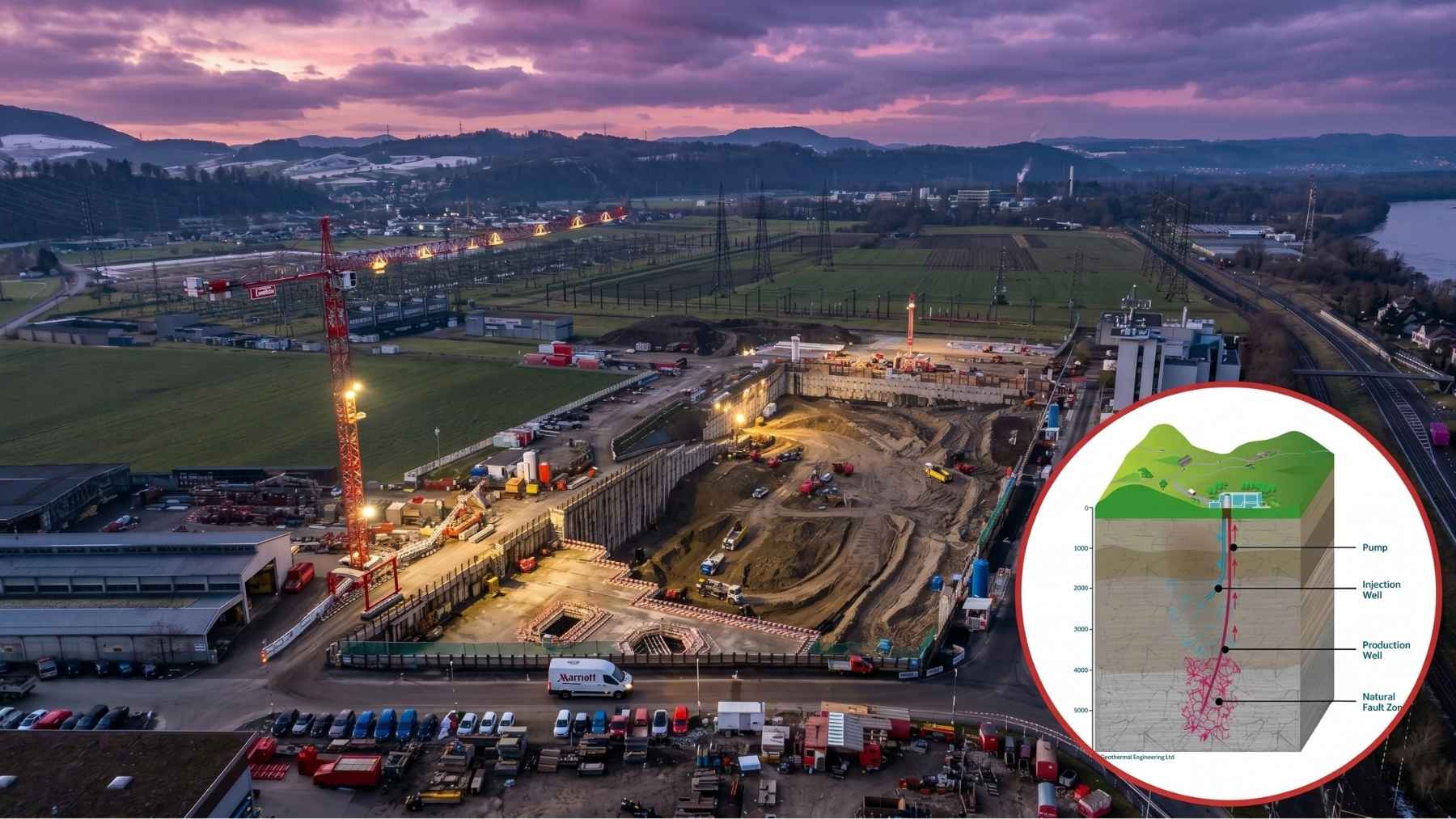

Drilling a really deep hole into the Earth has meant one thing for the better part of a century: somebody thinks there’s oil down there. The rigs, the bits, the directional-drilling tricks, the people who know how to keep a borehole alive at depth, all of it grew up around hydrocarbons. But the deepest hole ever drilled in Britain wasn’t after oil. It drops 5,275 meters (about 3.3 miles) into the granite beneath Cornwall, on England’s southwestern tip, and the prize at the bottom is water hotter than 374°F (190°C), the hottest ever recorded in the UK.
Since February, that water has been spinning a turbine at the United Downs plant near Redruth, run by Geothermal Engineering Ltd (GEL), and feeding the grid around the clock under a deal with Octopus Energy. About 3 MW, enough for roughly 10,000 homes, day and night, windy or not. Then there’s the part nobody designed for: the same water came up carrying some of the most lithium-rich brine ever measured in a well. One hole, two businesses.
Cornwall is sitting on a natural nuclear reactor
The geology is the whole story here. Beneath Cornwall lies a granite body roughly 7 miles (11 km) thick that stretches for hundreds of kilometers, and that granite is shot through with uranium, potassium and thorium. Those elements decay, and decay throws off heat, the same physics that runs a nuclear power station, minus the enrichment, the containment dome and the public inquiries. GEL’s chief executive, Dr Ryan Law, describes it as drilling into a reactor nature already built. “We are just tapping into the heat,” he told Enlit when the plant came online.
GEL, founded in 2008, spent about fifteen years getting two directional wells down to the Porthtowan Fault Zone, an old fracture half a mile west of the site where the granite was smashed up millions of years ago and 374°F water now circulates on its own. The production well bottoms out at 5,275 meters. The injection well, which returns the cooled water underground, stops at 2,393 meters (about 1.5 miles). Total project cost sits around £50 million, call it $70 million, from a mix of private investors, Cornwall Council and EU regional funds.
There’s some history baked into the location, too. United Downs sits on ground the Victorians knew as United Mines, once called the richest square mile on Earth for its tin and copper. People have been pulling valuable things out of this exact patch of Cornwall for 200 years. The product just changed.
Three megawatts doesn’t sound like much, and that’s sort of the point
The power plant itself is an Organic Rankine Cycle unit built by Italy’s Exergy International around its radial outflow turbine. It’s compact, fully closed-loop and emits nothing; every drop of brine goes back underground after giving up its heat. The output, a steady 3 MW under a long-term power purchase agreement, flows to Octopus Energy, whose CEO Greg Jackson called it “a clean, constant energy source right beneath our feet” in the launch announcement.
Britain already uses the ground for warmth, with tens of thousands of ground-source heat pump installations and a handful of mine-water heating schemes, according to the British Geological Survey. What the country had never done before this February was put electricity from deep geothermal onto the grid. The announcement billed it as the first 24/7 geothermal electricity in UK history, and Dr Alan Whitehead, a minister of state at the Department for Energy Security and Net Zero, called it “a groundbreaking moment for UK energy innovation.”
The constancy matters more than the size. Wind and solar are cheap but moody, and grid batteries, like the 12,000-megawatt fleet California just flexed, only shift around electricity somebody already generated. A geothermal plant makes its own, at 2 a.m. in a January storm, without caring. The British Geological Survey reckons onshore geothermal in the UK could yield more than 200 GW of thermal heat hot enough to make power, the equivalent of over 100 nuclear stations. Against that number, 3 MW is a proof of concept. The concept, per the BGS, is enormous.
The water came up carrying a second paycheck
Cornish miners have known there’s lithium dissolved in the county’s hot groundwater since the mid-1800s; GEL’s own project notes say as much. What nobody knew was the concentration. When the company tested its deep fluids during the power work, the readings came back at over 340 parts per million, which GEL says is among the highest found in any well drilled anywhere to date. Law has been upfront that the discovery was luck rather than the plan.
The physics turned out to be almost rude in how neatly it fits together. The brine surfaces at around 347°F (175°C), runs the turbine, and leaves the power block at roughly 131°F (55°C), which happens to be the sweet spot for direct lithium extraction. So GEL bolted a lithium plant onto the back of the power plant, with a process designed by engineering firm Hatch. No open-pit mine, no evaporation ponds, no extra holes in the ground. The facility started at 100 metric tons of battery-grade lithium carbonate a year in February, the first commercial-scale operation of its kind in the UK.
It’s the same realization currently spreading through the oil business, the logic behind Alberta’s oil patch waking up to the lithium in water it used to throw away: brine you treated as a nuisance can be a product. GEL’s targets are aggressive. Roughly 2,000 metric tons a year by 2028 or 2029, then over 18,000 within a decade, enough lithium for around 250,000 EV battery packs annually, or about 65% of every battery-electric car registered in the UK in 2024. From one industrial estate in Cornwall.
The money showed up faster than the megawatts
Switching on did what Law spent fifteen years promising investors it would. In April, the UK government handed GEL a scale-up feasibility grant under DRIVE35, the Department for Business and Trade’s automotive program run with the Advanced Propulsion Centre UK and Innovate UK. Which means the funding stream built for car factories is now paying to expand a lithium operation in Cornwall. An earlier automotive fund, the ATF, had already covered the lithium demonstration plant, and a second geothermal-lithium outfit, Weardale Lithium in County Durham, got DRIVE35 money in the same round.
Then in May, Dutch bank ABN AMRO put up £10 million ($14 million) specifically to grow the lithium side, financing Law described as “a cornerstone” of the company’s wider plans. Those plans run through two more Cornwall sites, already through planning, adding a further 10 MW of baseload power by 2030, and a portfolio of about 25 MW over the next decade. Small numbers by gas-plant standards. But banks don’t usually lend against geology experiments, and now one has.
America is chasing the same heat with oil-patch tools
The US is running its own version of this race with a different toolkit. Fervo Energy, the company building the 500 MW Cape Station in Beaver County, Utah, works with enhanced geothermal systems, where you drill into hot dry rock and engineer the reservoir yourself using drilling techniques that came out of the American oil patch. The first 100 MW is expected online later this year, and the company raised $421 million for the project in an oversubscribed round in March. GEL went the other way: find a natural fracture network where 374°F water already moves, then drill deep enough to reach it.
Different geology, same product: electricity that never blinks. And the customer base for that product is growing teeth. Data centers want firm power in quantities that make 3 MW look quaint; the 9-gigawatt campus planned along I-15 in Utah is the loud example. Every AI build-out, and every EV plugged into a charger at midnight, is a vote for generation that runs around the clock.
The “another kind of oil” framing gets attached to stories like this one, and it’s a stretch in most ways, since you can’t load heat onto a tanker or trade it in Rotterdam. The comparison holds in exactly one respect: the skills transfer. The rigs, the drillers and the reservoir engineers who spent careers chasing hydrocarbons can chase temperature instead, and at United Downs they already have. Whether Britain ends up with one very clever hole in Cornwall or an actual industry is now a money question rather than a geology question. The geology, all 7 miles of warm, mildly radioactive granite, has done its part.



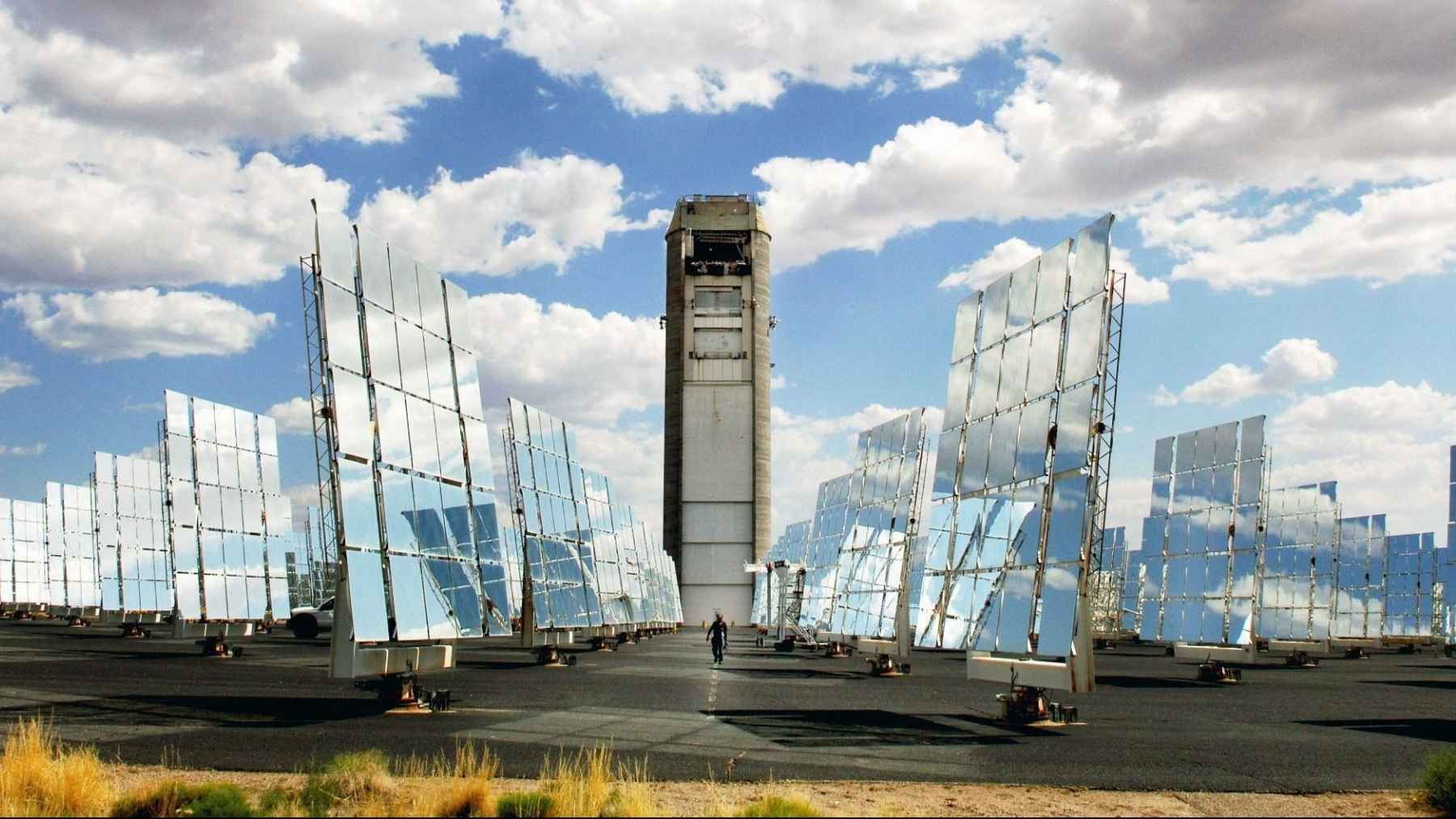
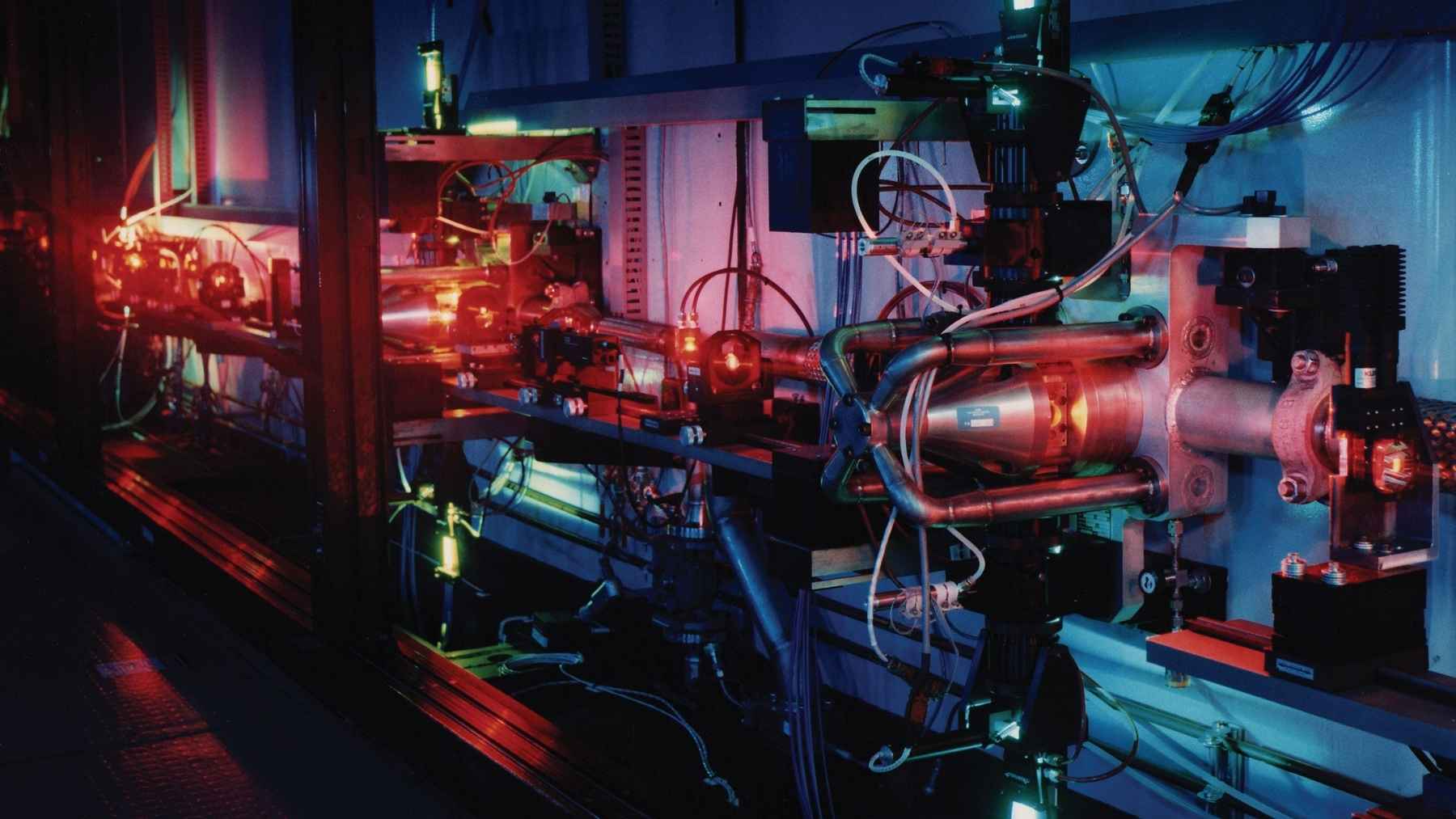
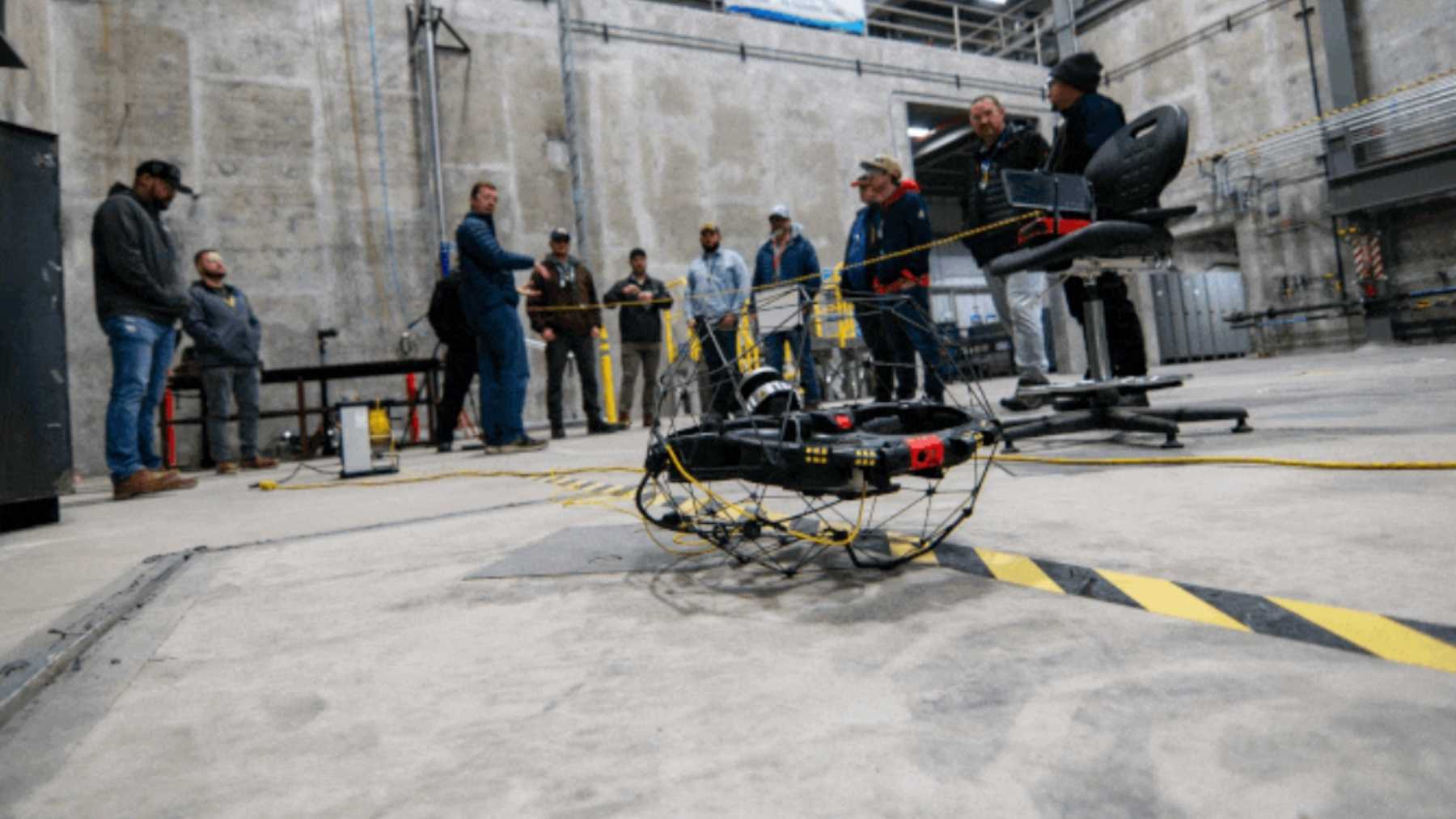












Cornwall's granite contains elevated amounts of naturally occurring radioactive elements such as uranium, thorium, and potassium. As these elements slowly decay over billions of years, they release heat that contributes to the region's geothermal potential.
That process is radioactive decay, not a self-sustaining nuclear chain reaction. The heat is real, but calling it a "natural nuclear reactor" exaggerates what's happening.