
Susan Holt, the premier of New Brunswick, says the Mactaquac Generating Station often gets called “the battery of the Maritimes.” It’s meant as a compliment. But if you’ve ever found an old phone in a drawer with its case bulging open, you might hear that nickname a little differently, because this battery’s been swelling for about 40 years.
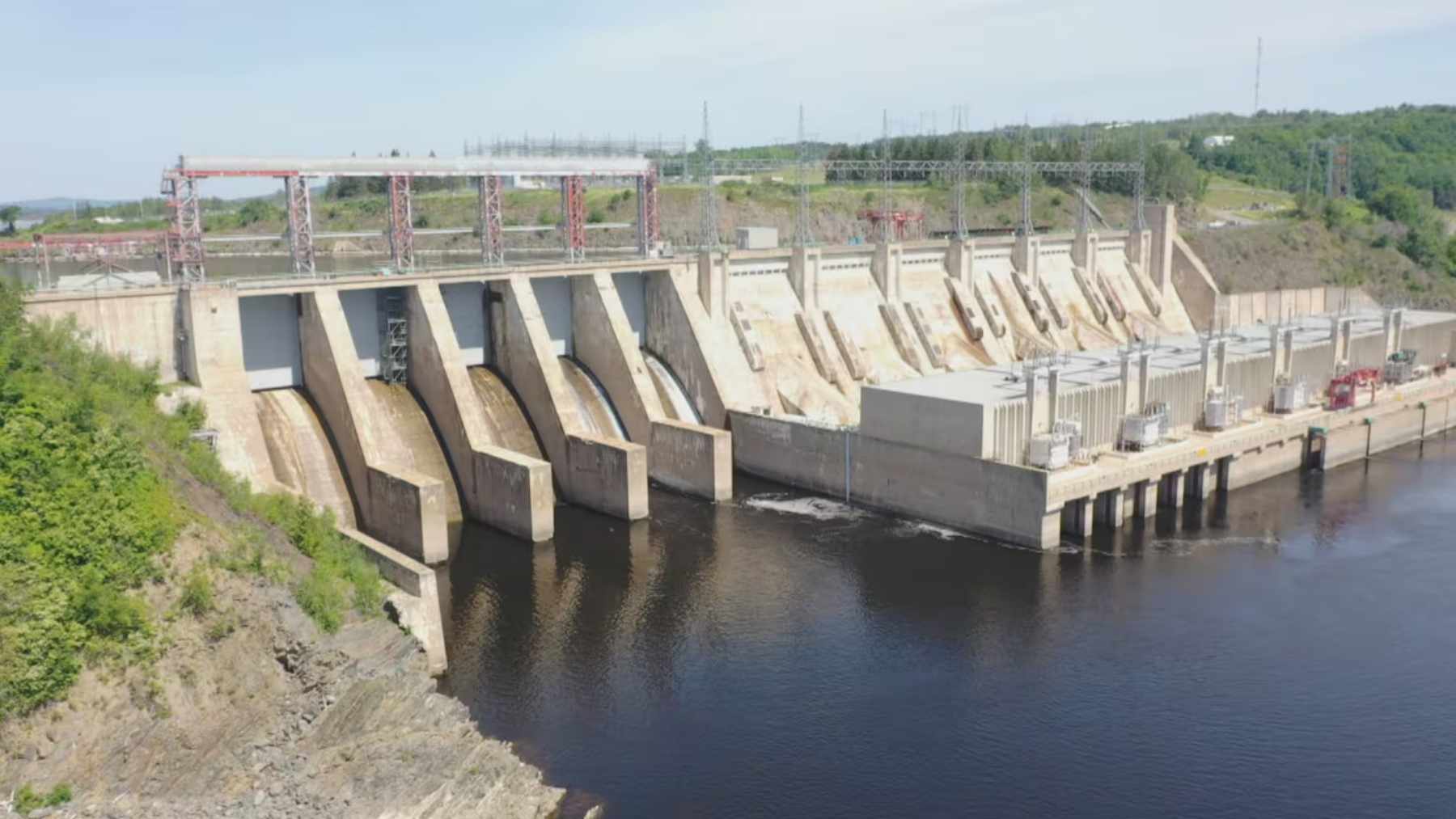
Mactaquac is a 672-megawatt hydro plant on the Saint John River (not to be confused with Florida’s St. Johns River), about 12 miles west of Fredericton, in the Canadian province that borders Maine. Since the 1980s, a chemical reaction has been making its concrete expand from the inside, and NB Power, the province-owned utility that runs it, says the movement can reach about a fifth of an inch a year.
A fifth of an inch doesn’t sound like much, and on your driveway it probably wouldn’t be. The trouble is that this concrete has turbines, generators, pipes and gates cast into it, and when it moves, NB Power says that equipment gets pushed around with it.
On October 13, Canada’s energy minister, Tim Hodgson, held a news conference at the dam to announce a C$219 million loan from the Canada Infrastructure Bank toward the overhaul that’s supposed to keep Mactaquac running until it turns 100. Well, toward planning that overhaul. We’ll get to the difference. (And yes, every dollar figure in this story is Canadian.)
NB Power has some pretty good reasons to keep the place alive. The utility says Mactaquac covers 20% of New Brunswick’s peak electricity needs and 30% of the renewable energy the province is legally required to have. The Canadian Press also reports it’s the largest black-start plant in the region.
Black start is grid-speak for restarting after a total blackout. Most power plants need grid electricity just to run their own equipment, so a hydro plant that can start up with no outside power is a pretty good one to go first. Holt’s own explanation was simpler: it’s renewable power the province can switch on and off when it needs to, for itself and for its neighbors in Nova Scotia and Prince Edward Island.
Why is the concrete growing?
Concrete is basically crushed rock and sand glued together with cement. Certain kinds of rock react with alkaline chemicals in the cement, and the reaction makes a gel that soaks up water and swells, kind of like a sponge that’s been sealed inside a wall. Engineers call it alkali-aggregate reaction, or AAR. It’s slow, which is why Mactaquac had been running for years before anyone pinned it down.
NB Power’s own engineers described the detective work in a piece for the trade publication Hydro Review. The first signs were a joint opening up in the powerhouse and water leaking through joints in the spillway and intake. Then a spillway gate got stuck because the concrete pier beside it had crept about an inch toward the gate opening. Once the utility ruled out the bedrock, it settled on AAR.
NB Power points out that AAR isn’t unique to Mactaquac, and engineers have cut relief slots into several other concrete dams for the same reason. A lot of the dam trouble we write about comes from the water or the ground underneath, like the Kentucky dam sitting on limestone that slowly dissolves. Mactaquac’s problem is the concrete itself.
So why would anyone saw through a dam?
Because the concrete’s going to keep growing no matter what, and it’s better to give it somewhere to go. For more than 30 years, NB Power’s been cutting slots into the affected concrete with a diamond wire saw. If you’ve never seen one, picture a wire cheese slicer, except the wire’s a steel cable studded with industrial diamonds and the cheese is a hydro dam.
A slot gives the swollen concrete room to expand into, so it stops shoving quite so hard on everything around it. The catch is that the concrete keeps growing into the gap, so the slots slowly close back up and they’ve got to be cut again. NB Power doesn’t say how many slots it’s cut over the years or how often each one gets recut, and I couldn’t find a current count anywhere.
Then there’s the drilling and grouting, which is pretty much what it sounds like. Crews drill into cracked concrete and pump grout in to seal it up, partly to keep the reservoir from seeping through. All that sawing, drilling and grouting makes a mess, too. NB Power says the wastewater and sludge get collected and hauled off-site.
Frankly, sawing through your own dam on purpose is about the least intuitive repair I’ve ever come across. So does it work? NB Power calls this work essential to keeping the station’s critical equipment running safely, and from the looks of things, it’s a big reason Mactaquac is still making power.
The turbines get pushed around, too
The dam itself is a 1,700-foot wall of rock fill sealed with clay, with a road running along the top. All the concrete, and all the AAR, is on the north side of the river: two spillways, the intake and the powerhouse. The intake feeds six steel-lined pipes about 29 feet across, and each one carries water to a generating unit rated at 112 megawatts.
Each unit runs on a Kaplan turbine, which looks a lot like a giant boat propeller with blades that can change their angle. Those blades spin inside a steel ring with only a small gap around their tips, and the ring’s set in concrete.
Now picture that concrete growing a little more on one side than the other. NB Power’s engineers wrote that the concrete around the units expands in every direction, and unevenly, depending on how thick it is. They tracked the steel ring around one unit’s blades going out of round, and the long shaft connecting each turbine to its generator had to be re-plumbed, or straightened back to vertical, every few years. It’s a bit like getting your car’s alignment redone after a pothole, except the pothole keeps getting bigger. That’s a different headache from Hoover Dam’s, where most of the turbines can’t run safely once Lake Mead drops below 1,035 feet.
What’s the C$219 million actually for?
Mostly planning and prep work. The Canada Infrastructure Bank calls it a site development loan. It pays for engineering and environmental studies, permitting, early supply work and talks with First Nations and nearby communities, all for what NB Power calls the Mactaquac Life Achievement Project. According to the bank, the loan is there so NB Power and the provincial government can “determine next steps” for Mactaquac, which is a slightly funny thing to say about a plan that’s been in the works for about a decade.
There’s a reason for the cautious wording, though. The overhaul still isn’t fully approved. NB Power’s schedule has a federal Fisheries Act permit coming in March 2027 and a review by its shareholder, the provincial government, that spring. The contractors it signed over the summer are only on design and planning work so far, and NB Power says the civil works deal doesn’t authorize construction. The utility says prep work and testing are already underway on site.
So why not knock it down and build a new one?
NB Power looked at that, and at removing the dam altogether, and decided that fixing up the station it already has was the cheapest and most dependable option. Without major work, the utility says, Mactaquac would likely stop operating by 2030.
I couldn’t find the loan’s interest rate or repayment term in the bank’s announcement or NB Power’s. The bank does say its financing will help soften the impact on ratepayers.
Figures: NB Power, Canada Infrastructure Bank.
The estimate is now close to C$9 billion
NB Power put the price at up to C$3.6 billion when it picked this plan a decade ago, and CEO Lori Clark said on October 13 that the total is now expected to come in close to C$9 billion, The Canadian Press reported. The utility’s project page gives a range of C$7.6 billion to C$9 billion.
To be fair to NB Power, that range counts interest and inflation for as long as the work runs, and I couldn’t tell whether the original figure did. So it’s probably not an apples-to-apples comparison. Hodgson, for his part, wouldn’t promise any more federal money for the dam, since power generation is up to the provinces in Canada, according to The Canadian Press. I’d guess that’s the line New Brunswick power customers will remember from the announcement.
The next big date on NB Power’s schedule is March 2027, when it expects its federal Fisheries Act permit. If the rest of the plan holds, the work wraps up in 2037 or 2038, about 30 years before Mactaquac turns 100.