
The HIMARS is probably the most famous truck in the Army right now. It’s a six-wheel truck with a big box on its back, it fires whatever’s loaded in that box, and then it drives off before anyone can shoot back. If you’ve followed the war in Ukraine at all, you’ve almost certainly seen one.
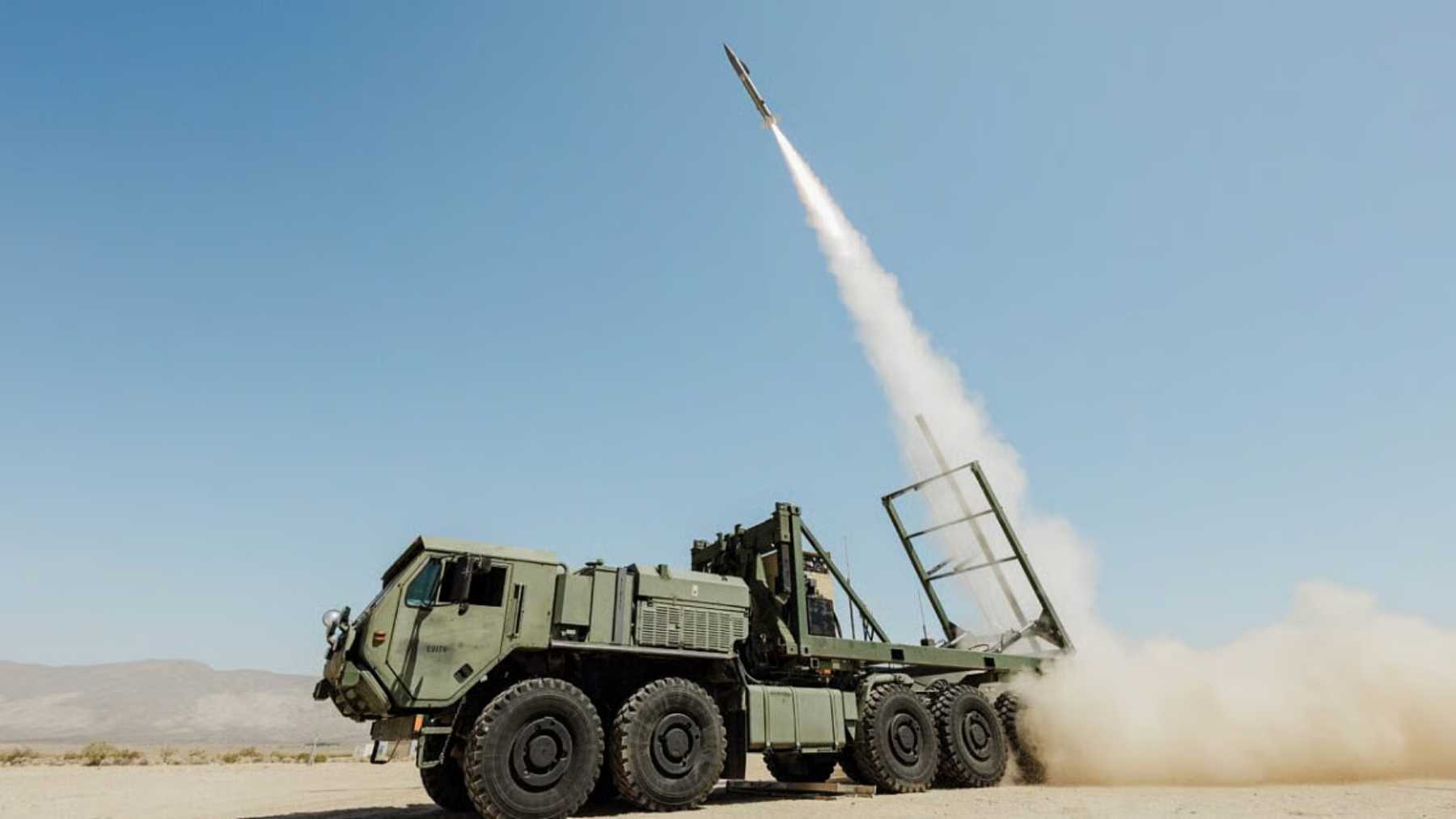
The Army wants to put a hypersonic missile in that kind of box. And on October 8, Castelion, the California startup behind the missile, posted the first photo of the launch setup it’s working on for the Army.
In the picture, a Blackbeard missile is just leaving a closed, container-style launcher on the back of a big military truck. “Container-compatible Blackbeard. Built to move with the fight,” reads Castelion’s post on X.
The truck isn’t a HIMARS, though. The War Zone says it appears to be an Oshkosh MKR18, a Marine Corps cargo hauler that’s shown up with launch hardware on its back in earlier test photos. The company has also talked about turning one of those trucks into a test launcher.
If you’ve never seen one up close, the MKR18 is a lot of truck. It rolls on 10 wheels and weighs 53,700 pounds empty, according to Oshkosh’s spec sheet. It’s basically what the Marines use to haul containers, ammo and bridge sections around. Four of its five axles steer, too, which I’d imagine comes in handy when you’re parking something about 36 feet long.
Castelion didn’t say when or where the photo was taken. It also hasn’t said how many missiles fit in that box, though The War Zone figures there’s room for at least two, and maybe four, based on its size.
The company has warned in the past that its test hardware isn’t necessarily what the finished weapon will look like, so I wouldn’t read too much into the box itself.
So what makes a missile hypersonic?
Speed, mostly. Hypersonic means faster than five times the speed of sound, which works out to roughly 3,800 mph at sea level. Plenty of ballistic missiles hit that on the way down, though. A hypersonic weapon can also steer while it’s going that fast, so defenders can’t just plot a neat arc and wait for it to show up.
Photos give you a rough idea of how Blackbeard does it. They show a two-stage missile, a booster with a smaller section on top that The War Zone says looks consistent with a glide or maneuvering vehicle. The ground version also seems to lose the cross-shaped tail fins the jet-launched one wears.
I went looking for Blackbeard’s length and weight, and as far as I can tell, the company has never published them. There’s no official range, either. The War Zone says Castelion has hinted at just under 500 miles, and a ground launch would probably cut into that, since the missile doesn’t get the head start a jet’s speed and altitude give it.
The Army wants it in the same box as its rockets
So why would the Army want a missile that’s slower and shorter-legged than the one it already has?
Because the one it already has isn’t something you can buy by the truckload. We’ve covered the Army’s first Dark Eagle battery, which carries eight missiles on four big trailers, and those launchers are large, purpose-built rigs. Blackbeard is pretty much the opposite pitch.
According to Army budget documents cited by The War Zone, the service wants roughly 80% of what a planned longer-range version of its Precision Strike Missile should deliver, for a lot less money per round. The Precision Strike Missile, or PrSM, is already in service and fires from HIMARS. The Army has also said in writing that Blackbeard won’t match Dark Eagle’s speed or range and isn’t meant to replace it.
Then there’s the box. The Army’s plan starts with a ground launch from a modified MFOM pod, moves on to Blackbeard GL prototypes with a launcher pod of their own, and ends with a flight test run through the HIMARS fire-control system.
An MFOM pod is basically the Army’s standard ammo box for its rocket launchers. A pod that size holds six guided rockets, one ATACMS or two PrSMs. HIMARS carries one. The older tracked M270 takes the same pods, so anything built to fit can, in theory, ride on either. That’s arguably the smartest part of the whole idea, because a unit that already knows how to load and fire a HIMARS wouldn’t have to learn a whole new machine.
The Navy is already buying the jet version
The ground version is the Army’s project, but the Navy has moved faster. It’s buying an air-launched Blackbeard for the F/A-18E/F Super Hornet, and Navy photos from a September 18 test flight show two of them mounted on one.
The orders have stacked up quickly. In April, about $105 million went to Super Hornet integration and live-fire tests in the Indo-Pacific. In June, the Navy ordered 50 pre-production missiles, plus 50 storage and shipping containers, for $23.4 million.
In August, it added roughly $90 million to support those 50 and turn Blackbeard into a program of record, which is military-speak for a weapon with its own line in the budget.
On September 14, Castelion said it had landed a production order worth up to $200 million, and the Navy put out its own release the next day. The company’s announcement doesn’t say how many missiles that buys. I haven’t seen an official price per missile from the Navy or the company, either.
If you divide that June order by 50, you get about $468,000 a missile. That money also covered the containers, though, so I wouldn’t treat it as a sticker price. Frankly, that’s a pretty quick string of orders for a missile program, at least by Pentagon standards.
And that’s before you get to the plan to fire one off a 180-foot drone ship in 2027.
Figures: Oshkosh Defense, U.S. Navy, Department of War, Castelion, The War Zone.
How many does the Pentagon want?
A lot, if testing goes well. On May 13, the Pentagon, which also goes by the Department of War these days, said that once Castelion finishes testing and validation, it’ll award a two-year multiyear contract for at least 500 Blackbeards a year, with options to stretch it to five years.
A multiyear contract basically commits the government to several years of buying at once. That’s the kind of promise that gives a company a reason to build a bigger factory.
You may have seen a bigger number. The first version of that announcement, as quoted by Reuters and The War Zone, said the Pentagon was seeking the go-ahead and the money from Congress to buy more than 12,000 Blackbeards over five years.
The release on the Pentagon’s website now talks about “thousands of additional hypersonic missiles,” with no figure attached. I’d go with “thousands” as the official number until someone in Washington says otherwise.
The Army version’s next big test is already on paper. The service’s fiscal 2027 budget documents list a live fire of a production-representative missile from its own launcher pod, which basically means hardware built the way the real thing will be built. The Army’s fiscal 2027 began on October 1 and runs through September 30, 2027, so that launch is on this year’s schedule.