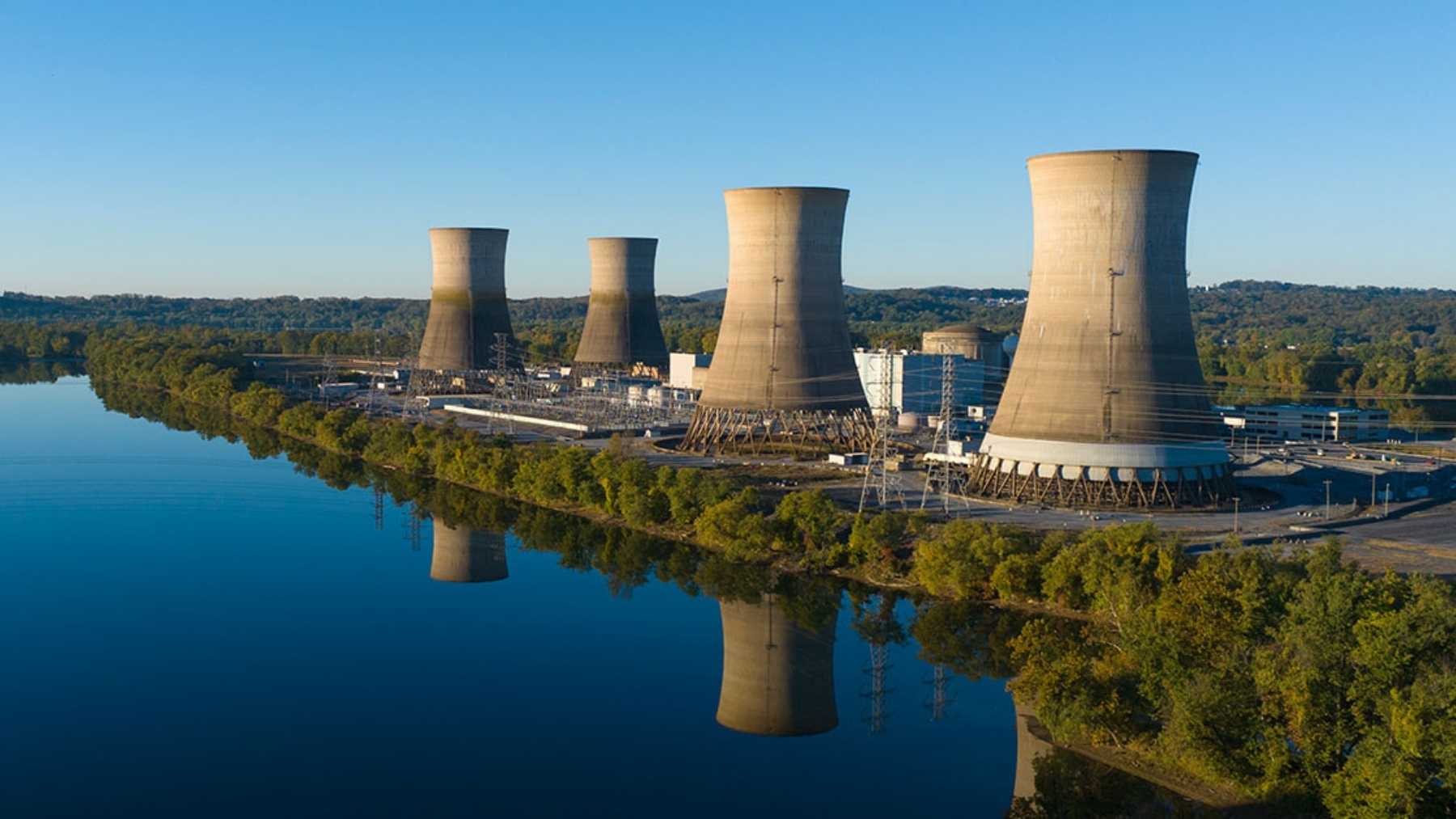

Three Mile Island is the rare place that makes energy news for two opposite reasons at the same time. One half of the island is a comeback story: Microsoft has bought every future watt, and on September 25 federal regulators published the final environmental sign-off that moves the healthy reactor toward a 2027 restart. The other half is the reason you know the name in the first place.
That half still has homework. Unit 2, the reactor that partly melted down on March 28, 1979, holds up to 2,480 pounds (1,125 kilograms) of fuel debris in its cooling system and around its reactor vessel, according to the Nuclear Regulatory Commission. That’s roughly 1 percent of the original core, and it’s been sitting in the plumbing for 47 years.
So why is any of it still there?
The last 1 percent isn’t something you can pick up
The cleanup crews of the 1980s did the heavy lifting. They pulled about 99 percent of the fuel and damaged core out of the reactor and shipped it west, and it’s stored today at the Department of Energy’s Idaho National Laboratory, where the federal government holds title to it. That’s the part of the story most people vaguely remember, if they remember any of it.
What’s left behind is the stubborn tail. The NRC describes it as fine sediment, hardened melt fused onto components, and thin films coating the insides of pipes, tanks and other equipment. Forget fuel rods sitting in a rack, waiting for a crane. This is crud, either stuck fast to the metal or lodged in spots the defueling tools of the era couldn’t reach.
If you want a sense of how well that 99 percent figure holds up against the competition, Japan’s wrecked Fukushima Daiichi reactors still hold an estimated 880 tons of melted fuel, and after two robotic sampling runs the total amount brought out is under a gram. TMI-2 has the opposite problem. The bulk left decades ago, and what remains is roughly a ton of leftovers bonded to the building’s insides.
Since 1993, when that initial cleanup wrapped, the plant has sat in what the industry calls post-defueling monitored storage, under a license that lets the owner possess the reactor but never run it. The NRC calls the condition “safe, inherently stable,” which is regulator-speak for a building you can walk away from and check on. It stayed that way for nearly three decades.
So who gets it out, and by when?
A company called TMI-2 Solutions, part of the Utah decommissioning firm EnergySolutions, became the owner and licensee on December 18, 2020, and its job splits into two phases. Phase 1 is the strange part: engineering work plus pulling the remaining fuel debris out of the systems and sealing it in the same style of heavy canister the industry uses for ordinary spent fuel. Phase 2 is the normal part, tearing the plant down the way you’d tear down any retired reactor. The company’s stated goal for Phase 1 is to get the radiological mess down to what you’d find at a plant that simply got old, rather than one that melted.
One thing I didn’t expect: the debris won’t leave the island. Per the TMI-2 Solutions FAQ, the canisters go onto the existing spent fuel storage pad at Three Mile Island and stay there until the Department of Energy comes to collect them, because the federal government still hasn’t licensed a central storage site for this kind of material. So the last of the 1979 core moves maybe a few hundred yards and then waits some more.
The company puts the price at $1.06 billion in 2019 dollars and says decommissioning finishes by 2038. The NRC’s file on the site lists 2052 as the estimated date for closure. I’ll be honest, I can’t reconcile those two for you; they sit 14 years apart on two official pages, so you’re getting both. Neither page pins a start date on the debris pull itself either, which is frankly the date I went looking for.
There’s also a wrinkle you don’t get on most demolition jobs. Pennsylvania’s historic preservation office deemed some of the TMI-2 buildings eligible for the National Register of Historic Places, so in 2023 the company filed a license amendment request just to clear the way for eventually knocking them down. The most infamous reactor complex in America is, on paper, historic architecture.
Meanwhile, the healthy twin is almost back
The reactor next door never had an accident of its own. Unit 1 ran until 2019, shut down because cheap natural gas made it a money loser, and Constellation is now restarting it as the Crane Clean Energy Center, with Microsoft signed up for all 835 megawatts for 20 years and a restart targeted for the second half of 2027.
On September 25, 2026, the NRC and the Department of Energy published the final environmental assessment for that restart in the Federal Register, along with a finding that firing it back up won’t significantly affect the surrounding environment. So you get one island in the Susquehanna where one reactor is being scrubbed and inspected toward a restart while the machine beside it still hasn’t given up the last of its 1979 core.
Is that a comfortable arrangement? I’d argue it’s a pretty honest one. The two units have spent 47 years demonstrating the entire range of what can happen to a reactor, from quietly profitable to famously not, and now both ends of that range sit on the same island with work crews on them.
The paperwork tells you which one is moving faster. Constellation’s reactor cleared its final environmental review on September 25, 2026. The melted one is still waiting on its own: TMI-2 Solutions filed an amended decommissioning plan with the NRC on October 27, 2025, and the agency’s page, last updated September 14, 2026, lists that review as still open.