
There’s an old line about nuclear power being a very expensive way to boil water. It’s a little unfair, but it’s basically accurate. A reactor makes heat, the heat turns water into steam, and the steam spins a turbine hooked up to a generator.
Terrestrial Energy, a North Carolina company developing molten salt reactors, would like the steam-and-electricity half of its plant treated like a regular industrial project. On October 8, the company said it had asked the Nuclear Regulatory Commission to confirm that building that half isn’t nuclear construction.
If the NRC agrees, the company says that half could go up first and start selling power and heat with an auxiliary heat source like natural gas. That could all happen before the reactors have a construction permit or an operating license.
The plant comes in two pieces
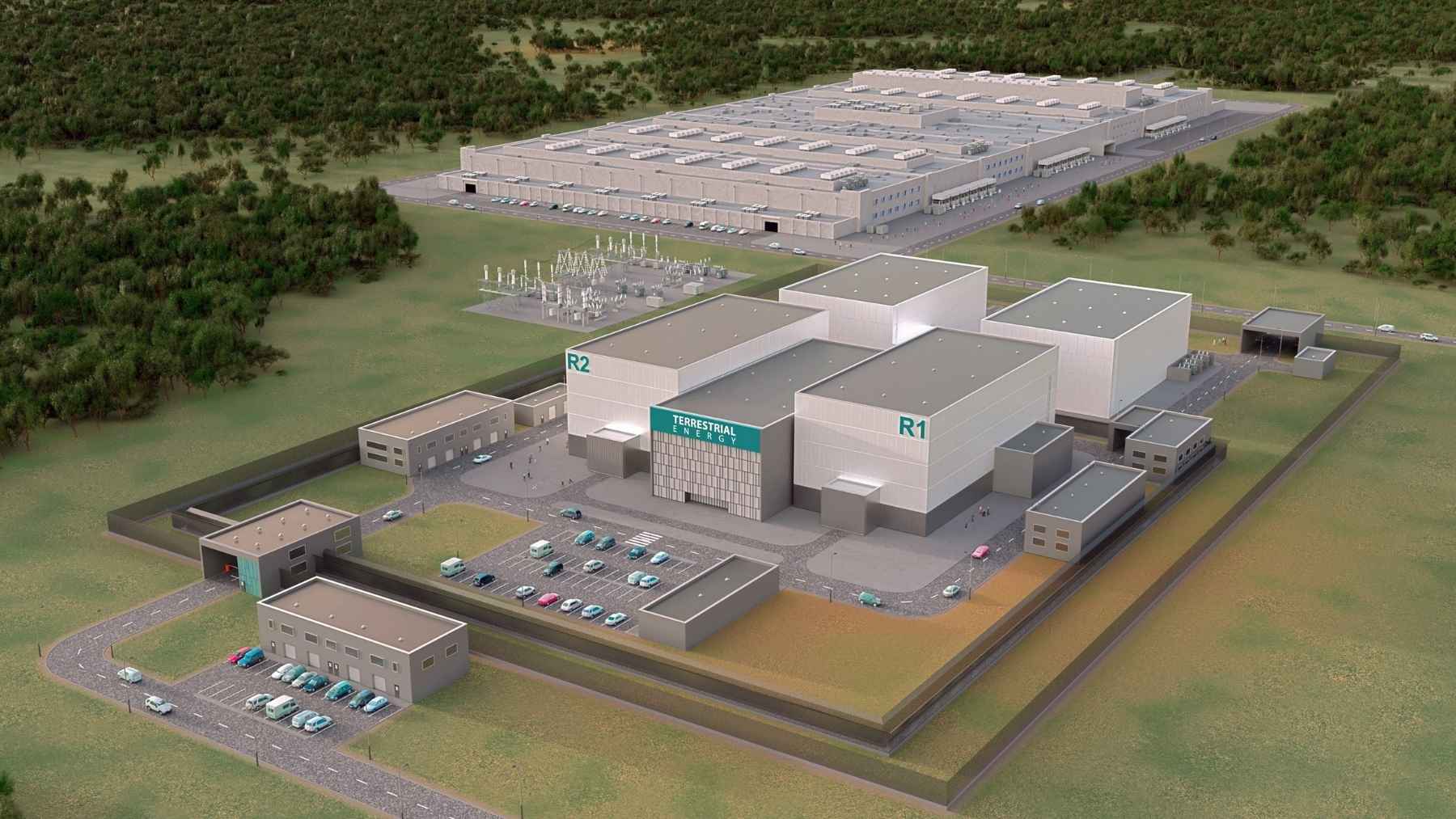
The design is called the Integral Molten Salt Reactor, or IMSR, and every plant is split into two parts. The Nuclear Facility holds the standardized, modular reactor systems. The Thermal and Electric Facility, or TEF, holds the turbines, the generators and the steam systems, which is pretty much the kind of gear you’d find at a coal or gas plant.
The filing itself is a topical report. If that term’s new to you, it’s basically a piece of a future license application that a company asks the NRC to review on its own, ahead of time. Once it’s approved, the company can point to it in later applications, and the NRC doesn’t have to go back over that part.
One IMSR Plant is rated at 390 megawatts of electricity from two reactors. Those reactors are built as replaceable core-units, and the company plans to swap them out every seven years.
The molten salt part means the IMSR’s fuel is dissolved in the salt that also carries the heat away, so there aren’t any solid fuel rods. We’ve covered how that works with a liquid-fuel research reactor going into a science building in Abilene, and the short version is that it runs hot at low pressure. The IMSR also uses standard low-enriched uranium, under 5% U-235, which is the same kind of fuel the existing US fleet uses.
So what counts as nuclear construction?
Less than you’d think. The NRC’s definition lives in a section of the federal rulebook called 10 CFR 50.10, and it doesn’t treat every bulldozer on a reactor site as nuclear work. Clearing and digging the site, putting up fences and warehouses, and building roads, parking lots and transmission lines are all on its list of things that don’t count.
The rule saves the word for driving piles, pouring foundations and installing equipment for the parts of a plant that matter for safety. It spells those out. They include safety-related equipment, anything the plant relies on to handle accidents, and anything whose failure could trip the reactor or keep safety systems from doing their job. Security, fire protection and onsite emergency facilities are on the list too. If a contractor’s working on any of that, it’s construction, and it needs the NRC’s permission first.
That reactor-trip clause matters here. At a lot of conventional plants, a turbine trip can automatically shut the reactor down too. According to the report, a failure that starts on the turbine side of an IMSR Plant stays isolated from the reactors, and the reactors don’t depend on the TEF to stay safe.
The report also leans on the company’s method for analyzing postulated initiating events, which the NRC has already approved. That’s regulator-speak for the things that could go wrong in a plant and kick off an accident.
If you’ve been following TerraPower’s Natrium project in Wyoming, some of this might sound familiar. TerraPower needed an NRC exemption to start driving piles and pouring foundations for the plant’s non-nuclear “energy island” in Kemmerer while its construction permit was still under review, and the NRC approved that permit in March.
Terrestrial’s CEO, Simon Irish, is pitching the TEF report as something more permanent. He called it “a fleet-wide advantage, not a one-off exemption,” since the same pathway would cover every IMSR Plant once the NRC signs off.
The gas is supposed to be a bridge
So why would a reactor developer want to burn natural gas?
Money, mostly. Licensing a reactor can take years, and a turbine side that’s already up and running can bring in revenue while you wait. In Irish’s telling, customers would get electricity and heat sooner, and the banks financing a plant would get a construction phase they can actually lend against, since only the reactor side would be stuck on the nuclear licensing clock.
Frankly, I think that’s a pretty smart way to sell a first-of-a-kind reactor to customers and lenders who’d otherwise be nervous about one. If the nuclear side runs late, whoever owns the site still has a working power plant, and that seems like a much easier conversation to have with a bank.
There’s a fair bit we don’t know yet. The company hasn’t said what the gas setup would look like, how big it’d be, or how long a plant could run on it before the reactors take over. Since every TEF is supposed to be customized for its site, I’d guess those answers change from project to project. The NRC hasn’t posted a review schedule for the report either, at least not one I could find.
And yes, burning gas at a plant built around nuclear reactors is arguably going to sound a little backwards to some of nuclear power’s biggest fans. The gas is described as a stopgap until the nuclear side is ready, so presumably it gets turned off once the reactors come online.
An Army project in Maryland starts with gas
The filing doesn’t name a specific site. But on September 18, the Army conditionally picked Ameresco, a Massachusetts energy company, to develop a power project at Aberdeen Proving Ground in Maryland, with Terrestrial lined up as the nuclear supplier.
The deal announcement describes a phased project combining natural gas and nuclear generation. Ameresco told POWER magazine that the gas comes first, and that the IMSR would be a potential second phase that won’t be available before 2030 and still depends on lease negotiations with the Army.
Neither company has connected Aberdeen to the TEF report. Still, a project that starts on gas and adds a reactor later sounds like a pretty natural fit for what the filing wants the NRC to sign off on, and I’d be a little surprised if that hadn’t crossed anyone’s mind in Charlotte. The Army, for its part, says nothing gets built until the environmental and regulatory reviews are done, and that development at its sites could start as early as 2027.
Terrestrial also has a plant planned for Texas A&M’s RELLIS campus in Bryan, Texas, where Last Energy has its own pilot reactor.
The NRC has already approved two of Terrestrial’s earlier topical reports. The TEF report, filed October 8, is the company’s third submission of 2026, and it’s still aiming to have its first IMSR plants running at multiple US sites in the early 2030s.