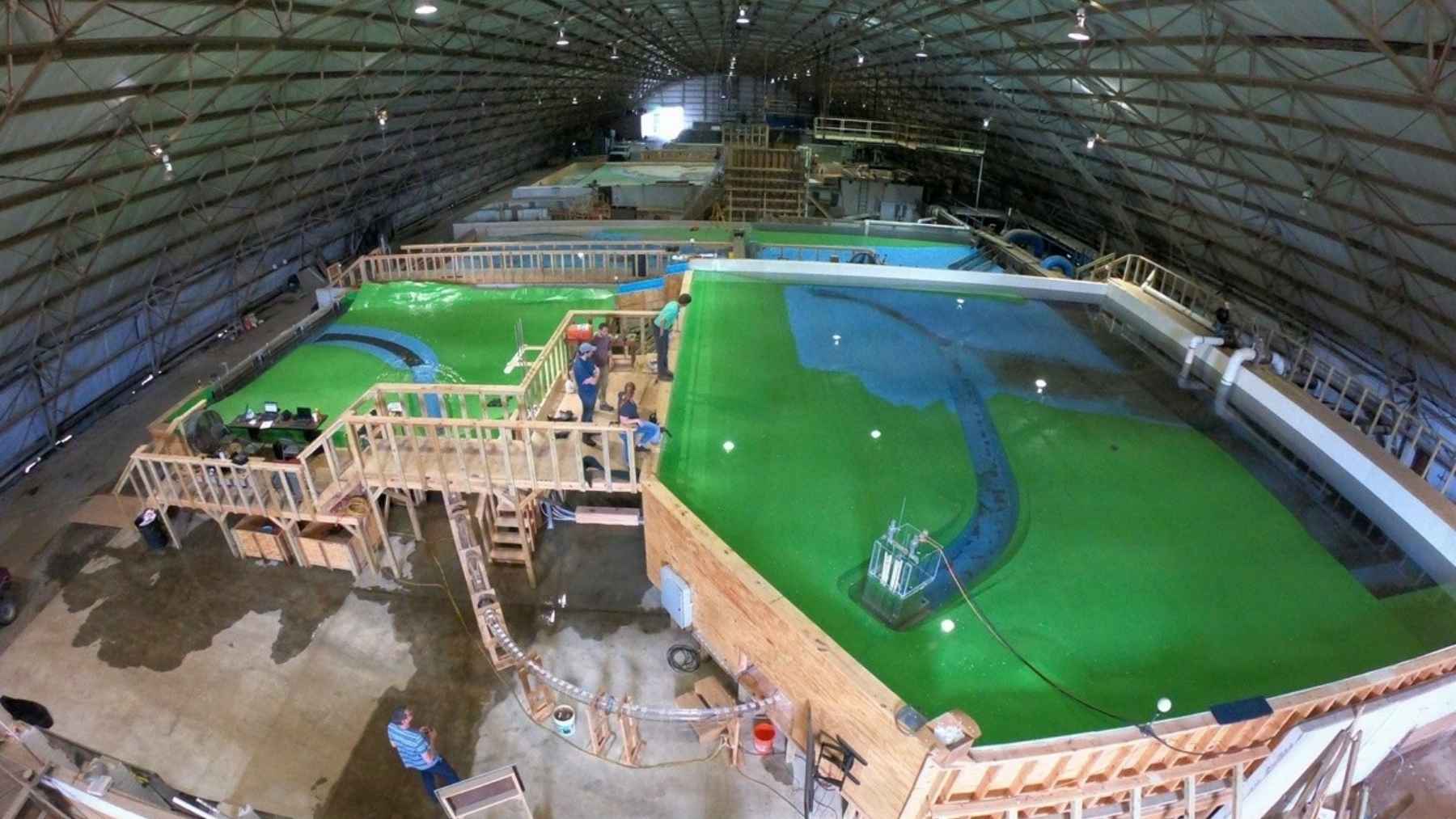

“Measure twice, cut once” is solid advice for a bookshelf. The U.S. Army Corps of Engineers just applied it to an entire dam. Before turning heavy equipment loose on the real thing in Kentucky, the Corps rebuilt it at reduced scale in a Mississippi lab and ran water through the model more than 200 times to see how the new plumbing would behave.
The real thing is Rough River Dam, a 1,590-foot wall of compacted earth in west-central Kentucky, near a community named, helpfully, Falls of Rough. It holds back a 5,100-acre lake that pulls in boaters and anglers from as far away as Louisville, and it’s got a problem you can’t see from the water: the rock underneath it.
So what’s actually wrong with it?
The dam sits on karst. That’s limestone that slowly dissolves in water, the same geology that gives Kentucky its famous caves. Give water a few decades of pressure from a lake and it finds paths through that rock, widens them, and can eventually start dragging the dam’s own soil along for the ride. Engineers call that internal erosion, and it’s the same failure family behind the seeping dike we covered in South Carolina. A safety report flagged Rough River’s foundation back in 2012, and monitoring since then showed the deterioration hadn’t stopped. The Corps says the dam is safe under current conditions, and the Army’s civil works chief has called it one of the government’s most monitored dams, but no one in Louisville was going to sit on that forever.
Why build a whole new outlet before touching the leak?
The cure is a concrete cutoff wall. Crews will dig from the crest of the dam down through the embankment and into bedrock, filling the slot with concrete as they go. Depending on where you stand along the dam, that wall runs anywhere from 75 to 180 feet deep. Think of it as a buried curtain the water can’t get around.
The catch is that the wall’s path crosses the dam’s drain. Every dam needs a drain, which engineers call an outlet works. It’s basically a tower with gates on the lake side feeding a passage under the dam, and whoever runs those gates decides how much river comes out the other end. Rough River’s version is a 548-foot passage under the right end of the dam, doing that job since the dam was finished in 1959.
The wall has to slice straight through it. The Corps studied reinforcing the old conduit so it could take the load, and found the fix would shrink the passage so much the dam couldn’t release enough water anymore. So the plan flips the order: build an entirely new outlet at the opposite end of the dam first, with a new control tower, a tunnel through the hillside, and a stilling basin, which is a concrete pool that takes the fight out of the water before it rejoins the river. Once the new side is running, crews seal the old tower and conduit with grout and concrete. Only after that does the wall go down.
Frankly, it’s the only order that makes sense. You can’t leave a lake without a working drain for years, and you can’t run a wall through a passage that’s still carrying the river.
The dry run happened in a Mississippi lab
That’s where the model comes in. At the U.S. Army Engineer Research and Development Center in Vicksburg, Mississippi, engineers built the dam and its future outlet at 57 feet wide and 100 feet long. Then they put the design through more than 200 test runs, from routine releases to the rare monster floods the structure has to survive. Jake Allgeier, the project’s lead hydraulic engineer, put it plainly in the Corps’ September 21 write-up: even in the age of supercomputers, “a physical scale model remains an irreplaceable tool for hydraulic engineering.”
Water in a tunnel does something sneaky, and that’s what they were chasing. At low flows it moves through like a creek, with air above it. Open the gates far enough and the tunnel fills completely and pressurizes, and at that moment the forces working on the concrete change character. That’s exactly where you don’t want surprises. You’ll want to find that transition point on a model in a lab, not on the real thing with a lake behind it.
Allgeier also mentioned something I found more surprising than the model itself: this one’s the Louisville District’s first new outlet works design since Taylorsville Lake in the 1970s. America built most of its big dams in the 1950s and 1960s, and the engineers who designed that generation of hardware from scratch? They’re long retired. So part of this project is a district relearning a craft, with a very expensive final exam at the end.
Where the job stands now
The ceremony came months into the job. Crews began clearing trees in March 2026, with grading and excavation following in April, a sequence the Corps laid out at a public meeting that February. The officials with shovels showed up July 21, when the Assistant Secretary of the Army for Civil Works joined the U.S. Army Corps of Engineers Louisville District for the Phase 2 groundbreaking. The construction contract went to Thalle-Bauer LLC of Hillsborough, North Carolina, in December 2025.
Phase 1 already happened, mostly out of sight: exploratory drilling and grouting across the dam’s centerline, wrapped up in 2017, plus moving the road that used to run across the crest. That road’s a decent progress marker, because Kentucky State Highway 79 crossed the top of the dam for decades, and the very last task of the whole job is putting it back up there. When the highway returns to the crest, the job’s done. You won’t see that for years yet.
In the meantime, the Corps has held the lake below its normal summer level since 2023 as an interim safety measure, and those restrictions stay through construction. If you’re wondering whether the dam still earns its keep while under the knife, it does. During the historic Kentucky floods of spring 2025 it ran exactly as designed, and Col. L. Reyn Mann, the Louisville District commander, says it prevented more than $70 million in flood damages over the past year alone. The dam and the surgery run at the same time, which is a big part of why the job takes six to eight years. It’s the same slow-motion logic behind the Colorado dam that grew for four years while a court argued about the water.
One date the Corps hasn’t published, and I couldn’t find anywhere else, is the switchover, the day the new tower takes the river and the old one retires. For now the official line is simply that nothing moves at the old conduit until the new outlet’s fully up and running.
The Corps published its look inside the model program on September 21, 2026, and the schedule it has repeated all year still stands: six to eight years of construction from the March 2026 start. That puts the finish in the first half of the 2030s, with Kentucky State Highway 79 rolling back over the crest of Rough River Dam as the closing act.