
Tunnel boring machines tend to get a name before they start digging, and it’s usually a woman’s name. The tradition goes back to Saint Barbara, the patron saint of miners and tunnel workers. It’s why you get machines like Mary, grinding away under Adelaide, and Roberta, now starting a new run under Paris.
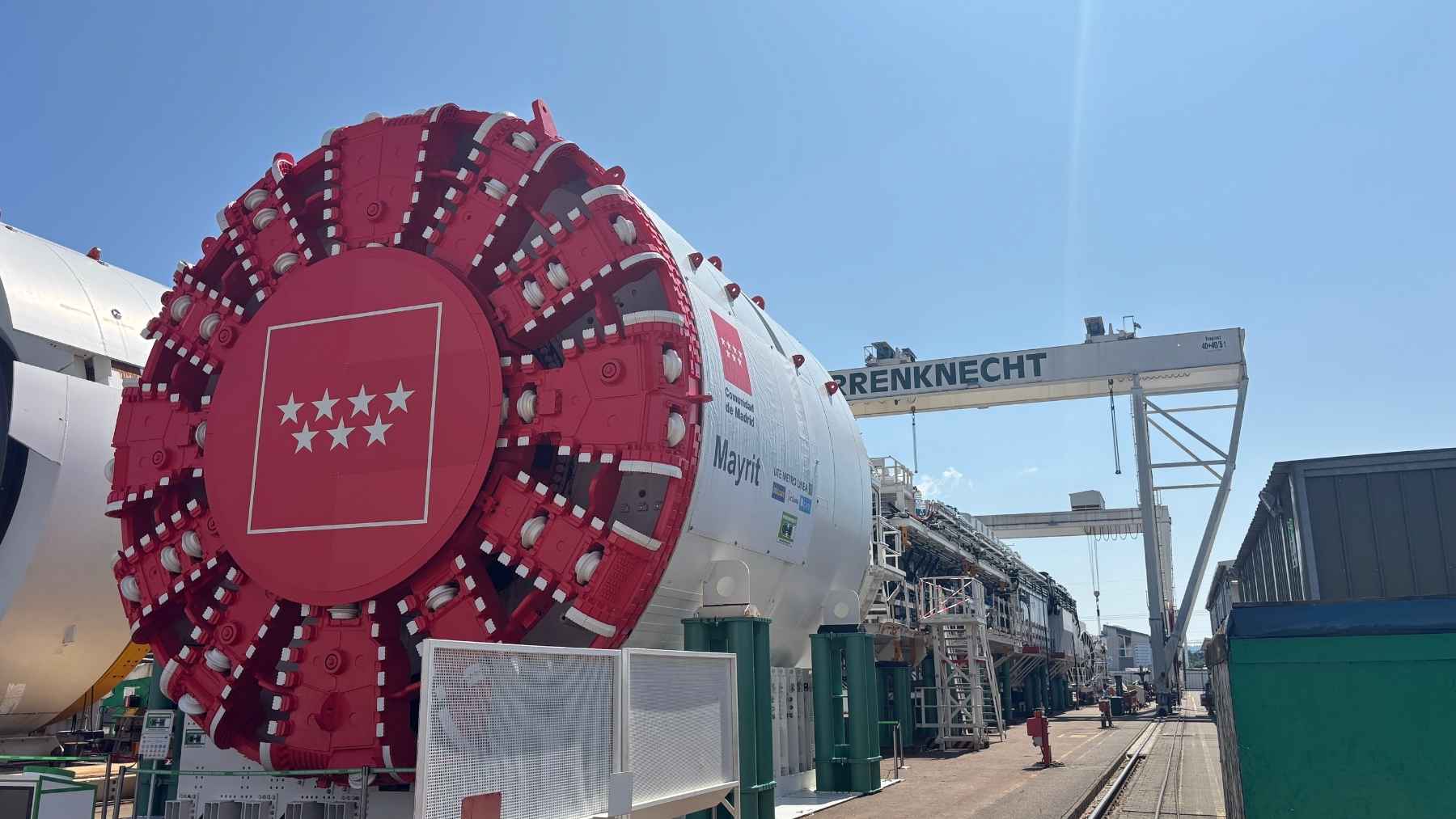
Madrid’s newest one is called Mayrit, and that’s not a woman’s name. It’s the Arabic name the city went by more than a thousand years ago, and the most common explanation ties it to the water running under the ground there. Which is a slightly unnerving thing to call a machine whose first big job was going under a river.
Mayrit’s spent most of this year chewing her way under the south side of the city, stretching Metro Line 11 toward Atocha, Madrid’s big rail hub. On September 4, she broke through into the future Palos de la Frontera station after 1.7 miles of tunnel, according to the Community of Madrid, the regional government that owns the Metro. And on September 28, after nearly three weeks of maintenance, she started digging again.
So what exactly is Mayrit?
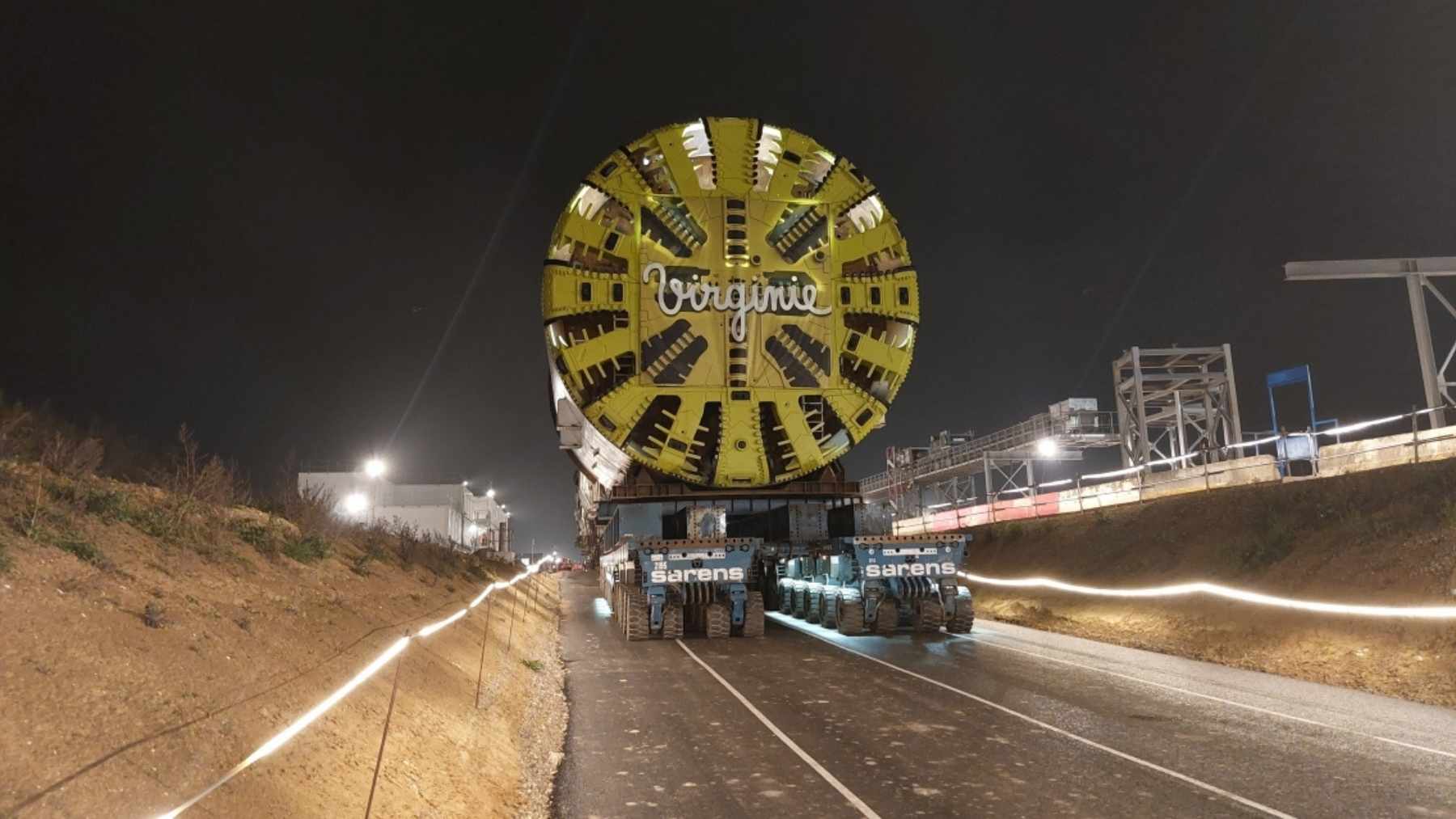
She’s an earth pressure balance machine, or EPB, built in Germany by Herrenknecht. She weighs about 1,653 tons and runs about 322 feet long once you count all the equipment she drags along behind the cutting wheel. The wheel itself is about 31 feet across. She got to Madrid in pieces, as you’d expect: down the Rhine to Rotterdam, by ship to Santander on Spain’s north coast, and then by road, mostly at night.
Earth pressure balance is what lets her dig through soft ground without that ground falling in on her. She keeps the dirt she’s just cut packed into a sealed chamber behind the wheel and pushes it back against the face at roughly the same pressure as the earth pushing in, so the soil around the tunnel stays where it is.
She also builds the tunnel as she goes. After every few feet of digging, she stops, bolts a ring of curved concrete segments into place behind the wheel, and then shoves off that ring to keep moving. Mayrit had set 1,606 rings by the time she reached Palos de la Frontera, which works out to one roughly every 5 1/2 feet. Those rings leave a tube about 27 feet wide on the inside, with concrete walls a little over a foot thick.
And all that digging makes a lot of dirt. She hauled out about 246,600 cubic yards of it on the way to Palos de la Frontera. The region likes to measure this stuff in Olympic swimming pools, and by its yardstick, that’s somewhere around 75 of them.
First, she had to get under a river
The first leg ran about 3,660 feet, from Comillas, where she started, to the future Madrid Río station. It’s also the stretch that probably cost the engineers the most sleep. To get there, Mayrit had to pass under the Manzanares, the river that runs through Madrid, and under the M-30, the city’s ring freeway, which runs through tunnels along the riverbanks there.
So, yes, Mayrit dug a subway tunnel under a river and under a freeway that’s already underground. I don’t get to write that very often. If you read about the borer that ground its way under two runways at Paris’s main airport, this’ll sound familiar, just with water on top instead of jets.
So how do you take a 1,653-ton machine under a river without the river following her in?
Mostly with that pressurized chamber up front, which keeps the wet ground, and the water in it, pushed back where it belongs while the rings go in behind her. Spanish press reports put her descent at about a 3.5% grade, which they described as the maximum allowed for rail infrastructure, before she leveled out and climbed back up to the station. I couldn’t find that figure in any of the regional government’s own releases, so take it as reported.
If 3.5% doesn’t sound steep, you’ve probably driven past those 6% grade signs that warn truckers on mountain interstates. Trains are a lot fussier about hills than trucks are. Steel wheels on steel rails don’t get anywhere near the grip a rubber tire gets on asphalt, so rail lines stay about as flat as engineers can make them.
Mayrit reached Madrid Río on June 9. Xataka, a Spanish tech site, reported that was 11 days ahead of schedule, although the regional government’s announcement didn’t mention a schedule at all. I also haven’t been able to find an official figure for how deep she went under the river.
She’s beating her own spec sheet
When Mayrit’s parts arrived in Spain, the region said she’d manage up to about 49 feet a day. By June, she was averaging about that, and her best days were hitting around 98 feet. Then she found another gear. On the second leg, a little over a mile from Madrid Río to Palos de la Frontera, she averaged nearly 75 feet a day, up from about 49 on the first.
Miguel Núñez, the region’s director general of infrastructure, gave most of the credit to the ground. In comments to Spanish media in June, he said Mayrit’s cutting through a soft local clay called peñuela, and that it behaves very well under the machine’s pressure. Clay turns into a thick paste in that pressurized chamber up front, and a thick paste is pretty much ideal for holding the face steady.
She’s already back underground
Mayrit spent nearly three weeks parked at Palos de la Frontera after the breakthrough, according to Madrid Actual, a local news site. The team used the stop for maintenance and to move her from the wall she’d come through to the one facing Atocha. And she apparently didn’t need much. “We’ve had hardly any wear,” Iván de la Rosa, who heads projects and construction at the regional government’s transit infrastructure office, said in a video shared on social media. The only parts that needed swapping were the gauge cutters.
Gauge cutters sit on the outer rim of the cutting wheel, and they’re the ones that set the exact width of the tunnel. They travel farther than any other cutter on every turn of the wheel, so they’re usually the first to wear out. After 1.7 miles under Madrid, that’s frankly about as clean a report card as a tunnel boring machine gets.
After Atocha comes Conde de Casal, where this extension of Line 11 ends. The whole stretch, from Plaza Elíptica, the line’s current last stop, to Conde de Casal, runs about 4.1 miles with five stations. Acciona, which leads the consortium building it, expects to finish in 2027.
It isn’t all machine work, either. A separate section of about 2,230 feet is being dug with what the region’s own release calls the traditional Madrid method, better known as pick and shovel. I’m guessing there’s a bit more equipment down there than that phrase suggests, but I’m glad it made it into an official press release. The region said in early September that section would wrap up within days, putting the extension close to 60% dug.
Line 11’s supposed to keep going after that, too. The long-term plan is roughly 20 miles of line with 20 stations, cutting diagonally across Madrid from Cuatro Vientos in the southwest to Valdebebas in the northeast.
Mayrit’s next job is Atocha, though. She started on that leg on Monday, September 28, and it’s about 2,300 feet of digging under Paseo de las Delicias, Ronda de Atocha and Paseo de Santa Isabel.