
There’s an old saying you’ll hear from soldiers, engineers and just about anyone whose job involves planning for the worst: two is one, and one is none. Basically, if you’ve only got one of something important, you should assume that someday you’ll have zero.
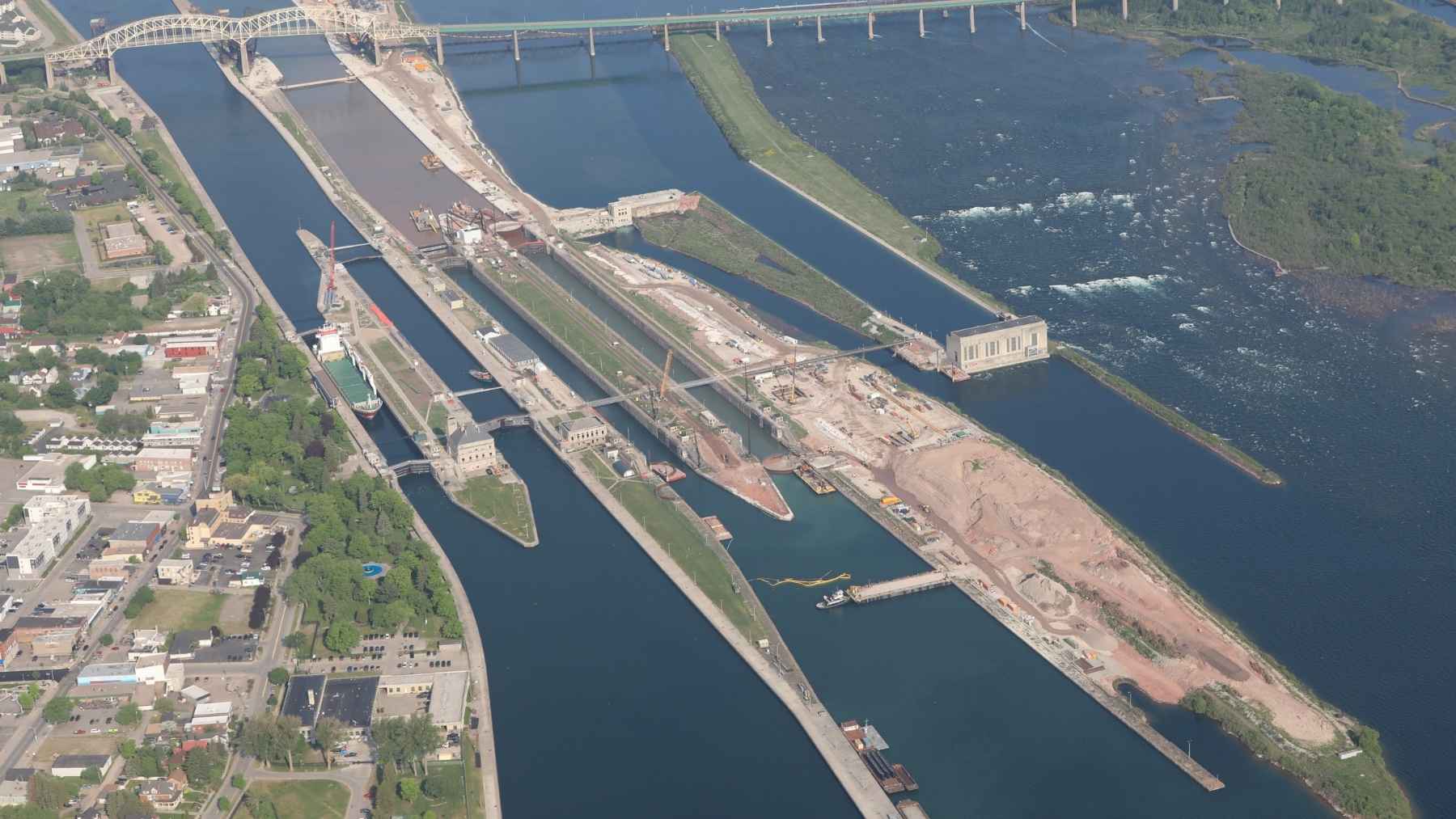
Great Lakes shipping has been running on one for about as long as there have been 1,000-foot freighters. Every one of those ships sailing in or out of Lake Superior has to pass through the Poe Lock in Sault Ste. Marie, Michigan, because it’s the only one of the Soo Locks they fit in.
So the Army Corps of Engineers is building it a twin. On September 29, the Corps said work on the New Lock at the Soo, a $3.219 billion project, was halfway through its last and biggest phase.
So what does half a lock look like?
It’s mostly a very big hole with concrete growing out of it. The new lock is going into the footprint of the Sabin Lock, a long-retired chamber at the north end of the complex, and it’ll be the Poe’s exact twin: 1,200 feet from end to end, 110 feet across and 32 feet deep. The first two phases, which deepened the channel ships use to approach from upstream and rebuilt the walls they tie up to while they wait, are already done.
The Corps says the new lock gets built from 84 concrete monoliths and a whole lot of rebar. A monolith, in this case, is one massive block of concrete cast in place, and a lock wall is really just a row of them standing shoulder to shoulder. The two chamber walls take 21 apiece, each one about 70 feet tall and 44 feet wide.
Crews pour them 5 feet at a time from a batch plant on the site. It’s the same build-it-in-layers idea we saw when Denver Water topped out Gross Dam, just with concrete forms instead of steamrollers. And it’s a very different job from Singapore’s giant hollow concrete boxes, which were cast on land and sunk into the sea. The Soo’s monoliths go up in the dry, behind cofferdams that hold the river back at both ends of the site.
The Army Corps planned the whole job so the Soo stays open to shipping while it happens. I’d argue that’s the most impressive thing about it, since the Poe keeps working right next door the entire time.
The whole lock needs roughly 400,000 cubic yards, by the Corps’ count, and 140,198 of them were in place as of late September. Mick Awbrey, who heads the Corps’ project office for the new lock, says you could pour a regular neighborhood sidewalk with that much concrete and run it all the way from Sault Ste. Marie down to Orlando, Florida. I’d love to see the permit paperwork for that sidewalk.
If you’re keeping score at home, that’s about 35% of the concrete. So the Corps has to be counting the demolition and the rock excavation in its halfway mark as well as the pours. It also says the contractor, a joint venture called Kokosing Alberici Traylor, has finished $975 million worth of work, with more than 600 people on the job.
The Corps didn’t say how many of those monoliths are finished, and I couldn’t find a count in any of the updates I went through. I couldn’t find a weight for the new miter gates either. Those are the giant swinging doors that seal each end of the chamber, and building and installing them is part of this phase, along with the mechanical and electrical systems and a hands-free mooring system the Corps calls innovative.
The Poe does pretty much all the heavy lifting
Here’s a quick refresher on what a lock actually does. Lake Superior sits 21 feet higher than Lake Huron, and the St. Marys River drops between them through rapids no freighter could ever climb. A lock is basically an elevator for ships. A boat sails into a long concrete box, gates close behind it, and the water inside rises or falls until it matches the lake on the other side.
The American side of the Soo has two working locks. Besides the Poe, there’s the MacArthur, which can’t take ships longer than about 730 feet because of the way its walls line up. Anything bigger goes through the Poe, and according to the Corps, ships restricted to the Poe by their size carry 88% of all the cargo tonnage that crosses the Soo.
The Corps says as much as 80 million tons a year moves through, with coal, iron ore, limestone and wheat among the most common loads. By its math, a single 1,000-footer carries as much cargo as 3,000 big trucks. Those ships are 105 feet wide, and the Poe is 110. That leaves roughly 2.5 feet on each side.
I don’t envy whoever’s at the controls.
It doesn’t take much to knock the Poe out, either. Back in April, a 1,000-foot freighter called the American Century let its anchor go by accident as it was pulling into the lock. It had to back out. The Corps kept the Poe closed while the Coast Guard looked into it, and it reopened about five hours later with no major damage found. Thirteen vessels were delayed.
That’s the mild version. The Department of Homeland Security once gamed out a much worse one, in a study the Corps has cited in its own releases about the new lock. It found that even a short, unplanned shutdown of the Poe during the shipping season could idle about 75% of U.S. steel output in two to six weeks. If the shutdown stretched to six months, the study put the job losses at close to 11 million, with automakers and mining companies among the hardest hit. That seems like a strong argument for having two.
So why didn’t anyone build a second one sooner?
It mostly came down to money. Congress signed off on a second Poe-sized lock back when Reagan was in the White House, and then the project sat. One federal study even concluded a second lock wasn’t needed, figuring the cargo could move by rail if the Poe ever went down. Construction didn’t start until about six years ago. That’s a pretty long time to leave something sitting in your online cart.
Does the Soo get two big locks in 2030?
It’ll get there, eventually. The current schedule has the new lock finished in 2030, assuming the funding keeps flowing and the weather cooperates. But the Corps has also said that once the new lock is commissioned, the Poe will be shut down for a major rehab that’s expected to take several years.
Which means if you were picturing two big locks running side by side in 2030, you’ll have to wait a few more years. The Soo will just swap one for the other while the Poe, which is pushing 60, gets fixed up. I think that’s a sensible trade, if a slightly anticlimactic one.
The Soo gets a lot more flexible after that. When it has all three locks in service, the Corps says it’ll be able to pull one out when the weather’s friendlier without stopping traffic. Right now, most heavy work on the Poe has to wait for the annual winter shutdown, which runs from mid-January to late March. I’d guess nobody on those maintenance crews will miss doing concrete repairs in a Michigan winter.
The new lock doesn’t even have a name yet. Congress gets to pick one, probably after it’s finished, so I’d expect “the New Lock” to stick around for a while.
The Poe, meanwhile, is set to stay open for this season through January 15, according to the Corps’ current notice to shipping. Then it goes into its usual winter break, and the Corps is still aiming to have the New Lock at the Soo open in 2030.