
If you’ve ever had a plumber out to clear a clogged drain, there’s a decent chance you’ve seen a snake. It’s basically a long, bendy cable that gets fed down the pipe by hand until it reaches whatever’s stuck, and the fancier setups put a camera on the end so the plumber can see what they’re dealing with.
A group of University of Nottingham engineers has spent the last couple of years doing something pretty similar. Except their drain is a sealed room inside Dounreay, an old nuclear research site on Scotland’s far northern coast, and their snake carries radiation sensors along with the camera.
So what’s new?
Two things, and both happened in the last few weeks. On September 21, the team published a paper in the journal Robotica that lays out the design in detail. Then, at the end of September, the university announced that the snake had won Best Cross Sector Technology from Game Changers, a nuclear tech program that Sellafield Ltd sponsors.
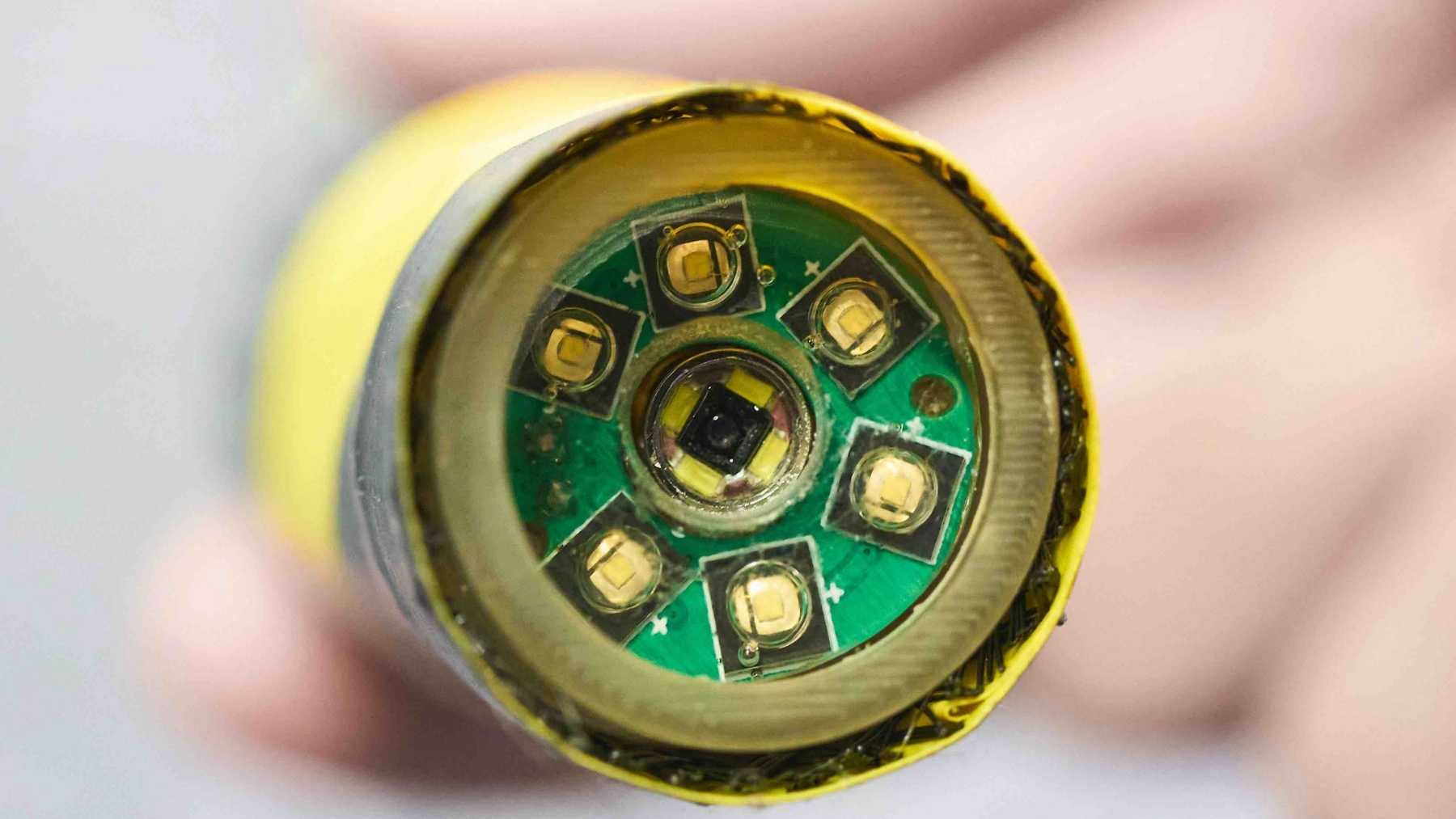
The paper has the hardware details. It describes two prototypes that are about 27 feet long and a little under an inch across, which makes them roughly as wide as a quarter. According to the paper, they went into a Dounreay hot cell carrying a radiation sensor that weighs about 2.5 ounces and a borescope camera, the same kind of skinny inspection camera a mechanic might slide into a spark plug hole to look inside an engine.
Dounreay is run by Nuclear Restoration Services (NRS), the government-owned company that’s taking the site apart. If the name sounds familiar, it’s also home to the 135-foot steel ball that’s getting its rust spots painted over before demolition.
So what’s a hot cell?
A hot cell is basically a sealed room with very thick walls, built so people can work with highly radioactive material without being in the room with it. Workers stay outside and handle things through the wall with mechanical arms, usually watching through heavily shielded windows. We recently covered an Oak Ridge crew that used one broken arm to fix the other, if you want to see how finicky that gets.
Even with arms and windows, a hot cell can have spots nobody can reach or see. According to NRS, the snake’s first Dounreay job was getting a look under a turntable in a lab that’s no longer in use.
Game Changers said the spot it was after sat about 20 feet in from the access point and a little over 3 feet off the floor. Nobody had seen inside that cell for more than 40 years.
Jason Simpson, NRS’s Dounreay project manager, said the survey would help plan how the lab gets decommissioned. I couldn’t find anywhere that NRS has published what the camera actually saw under that turntable, though, which is a bit of a letdown if you were hoping for a big reveal.
How do you steer a 27-foot robot from the back?
Most of the robot arms you’d see in a car factory have a motor in every joint. This one’s got the machinery that does the steering at the back, in what Game Changers calls an actuation pack, and it runs cables down the body toward the head. Pull on the right cables and the front end bends or lifts.
Xin Dong, the associate professor who leads the Nottingham team, says the snakes are “controlled like a puppet on wires,” and honestly, I can’t think of a better way to describe it.
The caged drone that mapped Idaho’s radioactive waste vaults at least got to fly. This snake has to be pushed. In the version Game Changers described, operators feed it in by hand and pull it back out the same way.
That’s also where the new paper comes in. You’ve probably heard the old line about how you can’t push a rope, and a robot that’s 27 feet long and about as wide as a quarter has a milder version of the same problem. Shove one end without anything along the sides to brace it, and the body can bow out and fold, which engineers call buckling. The paper lays out a way to estimate how much margin there is before that happens, so a crew can plan the insertion ahead of time. That beats finding out the hard way halfway into a hot cell.
The newer design’s also got a trick for when it gets there. The first snake lifted its head with cables attached to a joint. The prototypes in the paper add two balloons that inflate independently of each other to prop the robot up and hold it steady at the target.
Frankly, that’s a pretty clever fix. A long, skinny robot steered from 27 feet away isn’t exactly a stable platform, and you’d want the camera and the radiation sensor holding still while they work.
It’s built to be thrown away
Anything that goes into a hot cell can come back out contaminated, and you can’t exactly hose a robot down in the parking lot afterward. So the team made it cheap, which I’d argue is the smartest call in the whole design. The paper describes a low-cost, disposable design that cuts down on decontamination, and it says the modular build makes the robot easier to ship and to repair out in the field.
RAICo, a UK nuclear robotics partnership that supported the project, has described the snake as modular segments built with flexible tubing and 3D-printed guide disks. That’s a pretty humble parts list for something that’s been inside a nuclear hot cell, and I mean that as a compliment.
The university says it builds these snakes in a range of sizes. At Dounreay, it says one was modified to squeeze through a 1.2-inch gap and get into a shielded containment cell, while the prototypes in the paper measure a little under an inch across. The announcement doesn’t say whether the snake that went through that gap was one of them.
Four have been deployed so far
According to the university, four of the snakes have been deployed, and it credits them with helping save the nuclear industry an estimated £5 million (roughly $6.6 million) in the last two years. I couldn’t find a breakdown of how that estimate was worked out.
The University of Nottingham announced the Game Changers award on September 30, and it says the snake’s now in testing at other UK nuclear sites.