
Tunnel boring machines are a one-way bet. You dig a hole for the machine to start in, you dig a hole for it to finish in, and it grinds from one to the other, because the thing can’t exactly turn around and drive home. So when a sewer tunnel under a New Jersey bay stalled partway across, the recovery plan asked a boring machine to do two things these machines basically never do: steer through a deliberate curve, and then leave through the same hole it started from.
The stalled tunnel belongs to the Two Rivers Water Reclamation Authority (TRWRA), which moves sewage from Oceanport under Pleasure Bay to its treatment plant in Monmouth Beach. Today that job runs through a concrete line that’s more than 50 years old, feeding a pump station that took damage during Hurricane Sandy, so the authority’s been building a replacement: a 3,250-foot tunnel, 8 feet across, running straight under the bay. Crews had roughly 70% of it dug when ground started pushing into the tunnel faster than anyone could deal with. The ground had other ideas. Construction stopped.
That tunnel was a rib and lagging dig, which is about as traditional as tunneling gets: steel ribs set one after another with boards spanning between them, mining-style, with people working inside the whole way. Once the ground starts coming in on a dig like that, sending anyone back in to finish the last 30% isn’t a serious option anymore. Machines and tunnels get stuck in this business more often than you’d think, and the classic fix isn’t pretty: sink a rescue shaft straight down from the surface and dig the problem out by hand.
So how do you finish a tunnel you can’t get back into?
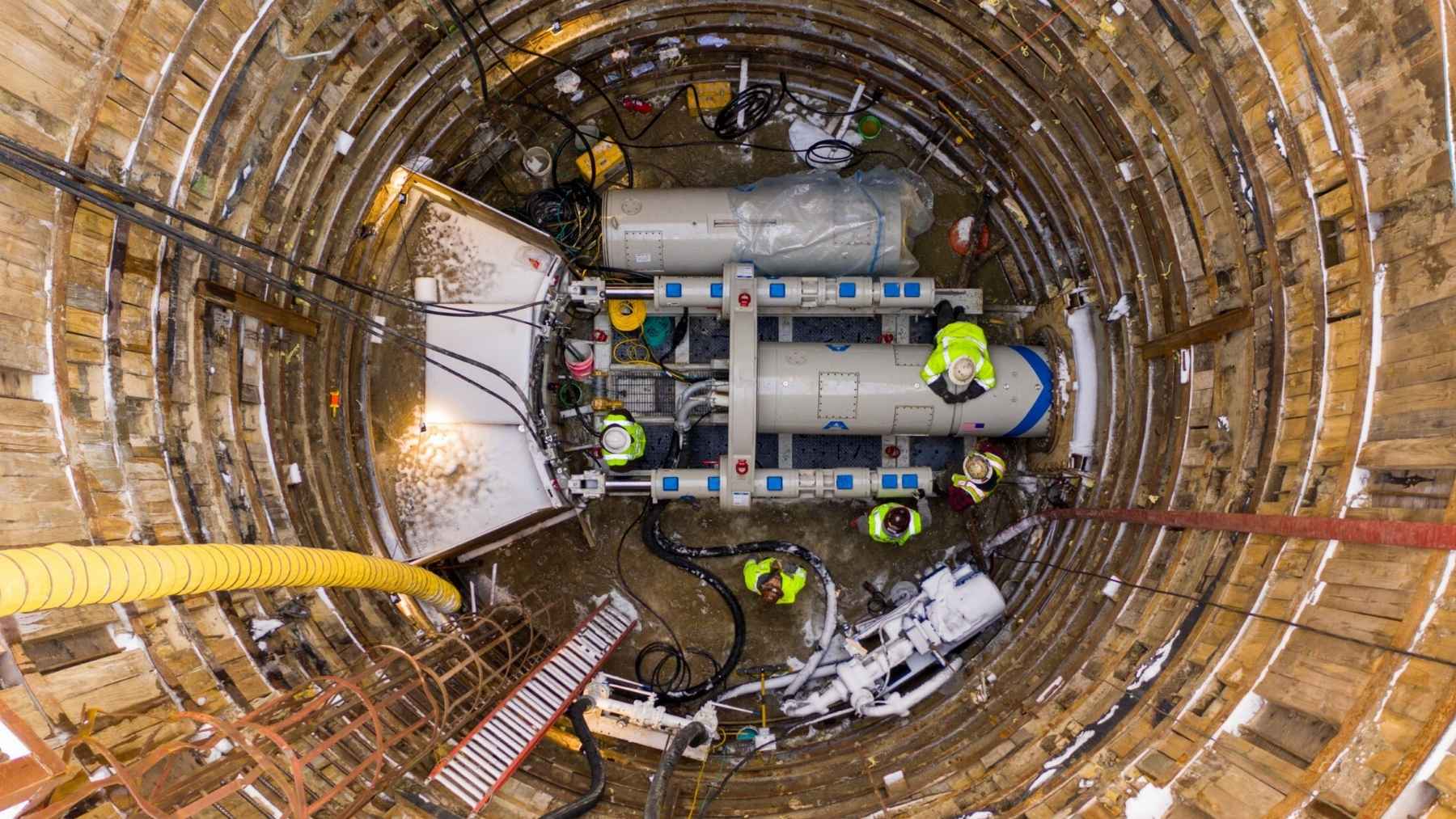
You hit it from the other end, with a machine that doesn’t need anyone inside it. TRWRA and its engineer, Hazen and Sawyer, worked out a bypass: launch a microtunnel from the shaft at the far end of the route (a 96-foot-deep pit in Oceanport, originally built as the straight tunnel’s exit) and curve it 1,290 feet through the ground until it strikes the stalled tunnel in the side at a shallow angle. Microtunneling, if you haven’t run into the term, is remote-controlled tunneling: the machine chews at the front while hydraulic jacks in the shaft shove a growing string of pipe in behind it, and an operator steers everything from the surface. Nobody rides inside. It’s the same family of work as the boring machines that went under a Nebraska creek.
Reusing the Oceanport shaft was frankly a clever bit of recycling, and also an awkward one. The pit wasn’t built to launch anything, so contractor Northeast Remsco had to retrofit it with a concrete thrust wall to take the jacking loads, plus a slab for the jacking frame to sit on. And the shaft is only 25 feet across on the inside, which is why the steel pipe came in 10-foot sticks instead of the longer lengths crews would normally jack. Shorter pipes fit down the hole, and they also articulate better around a curve.
Steel casing pipe isn’t supposed to bend
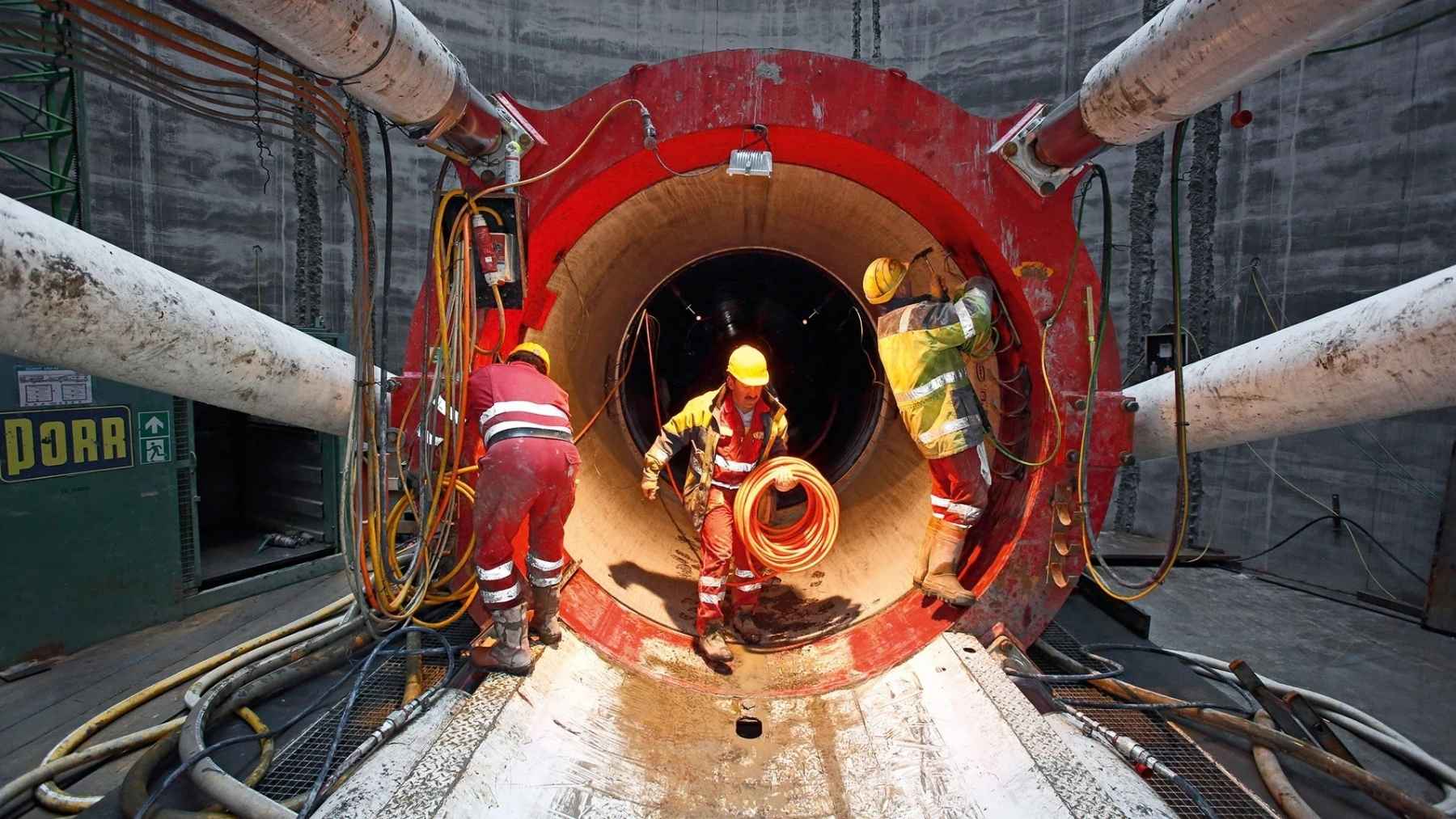
Steel microtunnel drives have historically run dead straight, because the press-fit joints holding the casing sections together don’t flex, and that’s the whole problem a curved rescue runs into. For this job, pipe maker Northwest Pipe built a new connection called the Permalok Radial Bending Joint, a press-fit joint with enough play in it to follow an arc, and Pleasure Bay was the first place anywhere it went into the ground. The drive followed a 5,500-foot-radius curve, a sweep so gentle you’d struggle to see it standing inside the pipe, but far more than a straight joint could ever take.
Those joints push together under jacking force, with no field welding at all. Joseph Petriello, Northeast Remsco’s vice president of trenchless operations, says a 72-inch field weld takes two workers around five hours, against roughly 15 minutes for a press-fit connection: “There’s a huge time savings using Permalok versus welded steel pipe.” On an emergency schedule, that gap adds up fast. His crews needed about 20 minutes for each of the early joints and got quicker from there, running day and night in two nine-person shifts.
By the end, 129 sections of steel pipe sat pressed together in a continuous curved tube under the bay, and the welding rigs never came off the truck.
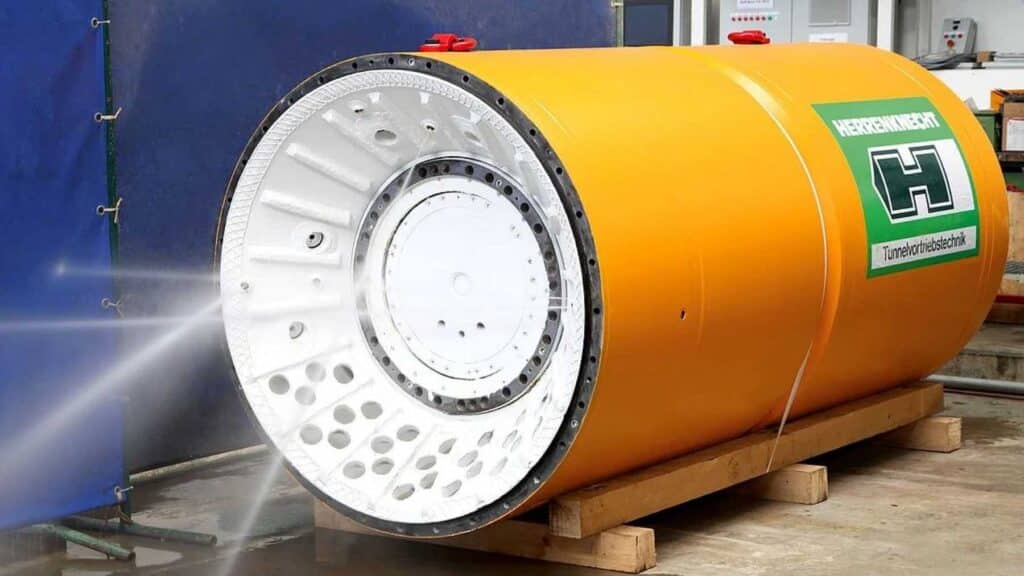
The machine doing the cutting was a Herrenknecht AVN 1200 wearing a steel skin that brings it out to 72 inches, so it bores a hole the same size as the pipe following it. Guidance came from a total station system Northeast Remsco already uses on its long straight drives. Northeast Remsco hadn’t run this particular type of machine before, which strikes me as a fairly bold thing to find out about on an emergency job under a bay.
It worked.
So how did the machine get out?
Backward, and I’d argue this was the harder trick. A normal drive ends with the machine punching into a receiving pit, where a crane plucks it out. This drive ends in the side of another tunnel, with no pit anywhere near it. So the AVN 1200 carried a retractable cutterhead: once the bore was done, the head pulled in, and the machine reversed back through the 1,290 feet of pipe it had just installed, all the way to the launch shaft, where it was lifted out. TRWRA hasn’t published the exact day the machine came up, and I couldn’t find it anywhere else either, but Northwest Pipe’s project case from July 22 confirms the machine was reversed out through the casing and removed through the shaft.
The meeting point needed preparation of its own, because a boring machine grinding into a tunnel full of structural steel would be a bad afternoon. Before the borer arrived, crews cut away sections of the old tunnel’s steel ribs and replaced them with 15 fiberglass ribs and 14 fiberglass plank sections, then grouted roughly 70 feet of the interception zone with a mix specified at 500 psi. The fiberglass gave the cutterhead something it could chew through cleanly, and the grout held the ground around the junction steady while it happened.
There’s still a sewer to build inside it
The steel tube is just the casing, basically a protective sleeve, and the actual sewer is a 54-inch fiberglass-reinforced pipe running through both the original tunnel and the new curved section, replacing that 50-year-old concrete line. TRWRA’s project updates had the carrier pipe going in over the summer, with the tunneling contractor wrapping up and leaving the Oceanport site in September. New Jersey’s having quite a stretch underground, by the way: a 1,680-ton boring machine just turned its cutterhead for the first time on the Hudson rail tunnel.
TRWRA expects the full replacement, new pump station included, to be substantially complete in early 2028, with final restoration of the parks and the ballfield above the work finished by summer 2028.