
Pump up a bike tire in a hurry and you’ll notice the bottom of the pump getting warm. Some of that heat comes from friction, but a lot of it’s coming from the air inside, since squeezing a gas into a smaller space heats it up. That’s just what gases do.
General Fusion, a Canadian company based in British Columbia, has been trying for more than 20 years to build a power plant on that bit of physics. In its version, a plasma stands in for the air and a collapsing metal wall does the pumping. On October 8, it said its LM26 machine had squeezed a plasma hard enough to push the electrons inside it past 1 keV. That’s the first of three big milestones it set for the machine.
The company measured the result with help from the UK Atomic Energy Authority (UKAEA), Britain’s national fusion lab. A laser-based instrument read the electrons at 1.09 keV just before the squeeze peaked, and that’s about 22.7 million degrees Fahrenheit. When we covered LM26 in June, it’d only gotten as far as about 0.72 keV.
So what’s a keV, and why does anyone care about getting to one?
A keV, or kiloelectronvolt, is basically how fusion people write temperature, since numbers in degrees get unwieldy once you’re into the millions. One keV works out to a bit under 21 million degrees Fahrenheit, and NASA puts the center of the Sun at about 27 million. The Sun can get away with that because its gravity keeps an enormous amount of fuel crushed together for billions of years. Machines on Earth can’t keep their fuel squeezed together for anywhere near that long, so they’ve got to make up the difference with a lot more heat.
Dennis Whyte, UKAEA’s chief executive, said in UKAEA’s own release that “achieving hot electrons is a necessary step for proving fusion confinement concepts.” More than 50 years ago, British scientists brought this exact laser method to a Soviet tokamak and clocked its electrons at 1 keV, Whyte points out, so the number by itself isn’t a record.
So that “world first” is narrower than you’d think. According to both General Fusion and UKAEA, LM26’s the first machine to reach 1 keV with slow compression, meaning a squeeze that takes milliseconds instead of the microseconds or nanoseconds other compression approaches need. That faster group includes the 44-ton British machine we covered earlier this month, which does its crushing in millionths of a second.
That’s a pretty specific kind of first, so I went through the two technical papers posted alongside the announcement.
So how do you squeeze a plasma with a metal wall?
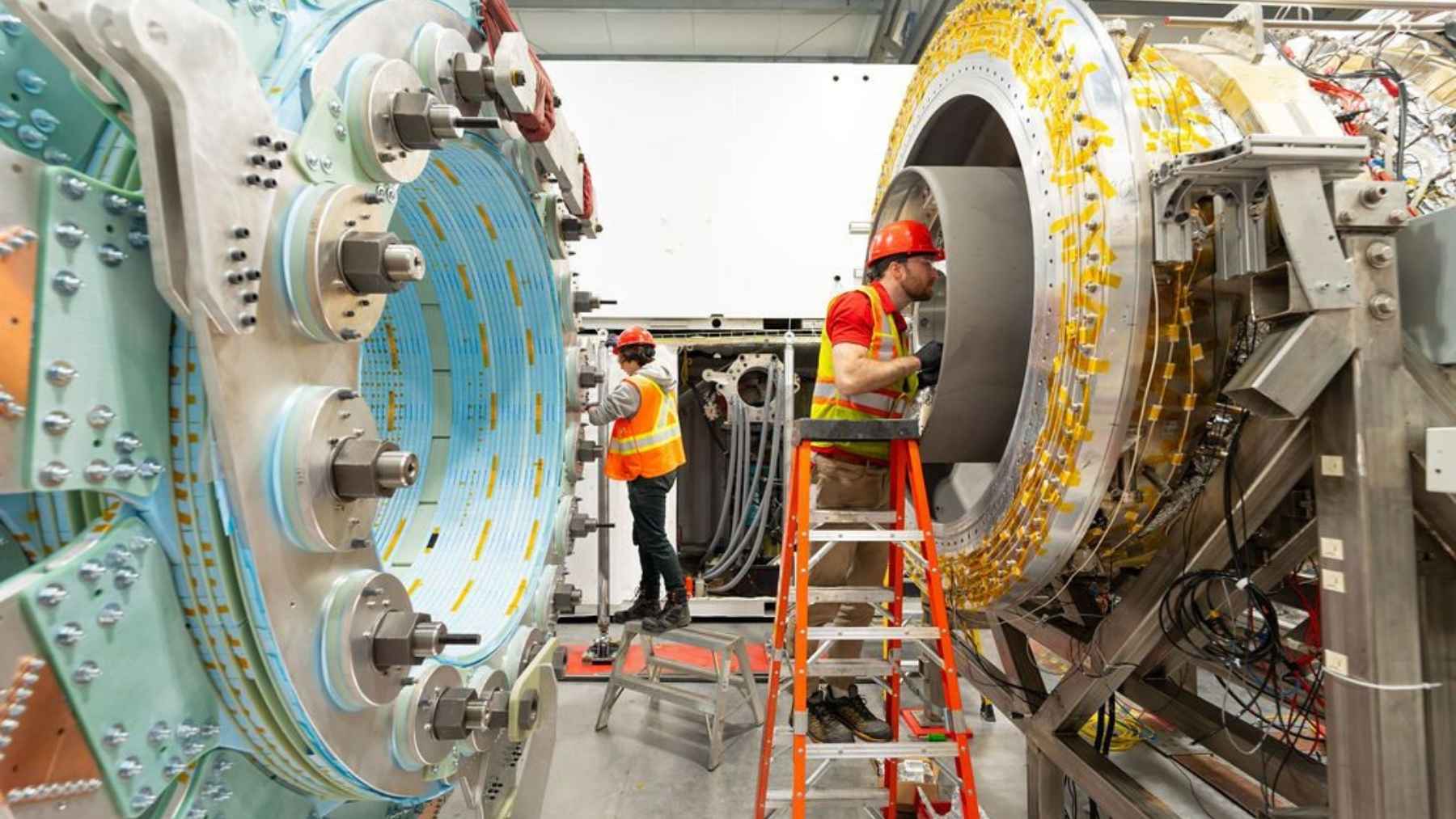
In LM26, the wall’s a solid lithium cylinder about 5.8 feet across and roughly 2.8 inches thick, sitting inside a chamber with a big coil wrapped around the outside. The plasma gets shot into the middle and settles for a few milliseconds. Then a pulse of current through the coil hits the lithium with a magnetic field that’s strong enough to cave it in. According to General Fusion’s paper on the shot, the lithium hit nearly 600 mph on its way in. It took about 3 milliseconds to get from the start of the squeeze to the hottest moment, and by then the wall had closed to a bit more than a third of its starting width. The electrons got more than five times hotter along the way.
Each of those big shots wrecks the liner, by the way. Afterward, crews pull the spent lithium and the aluminum shaft that runs up the middle of the machine out through an access plate, then slide new ones in under argon so nothing gets contaminated.
That’s fine for a test machine, but it’s arguably one of the bigger gaps between LM26 and an actual power plant. The company’s plant design swaps the solid lithium for a liquid lithium wall, which it says would also soak up neutrons and breed fuel while it does the squeezing.
General Fusion hasn’t published how big or heavy LM26 is as a whole, so that 5.8-foot liner’s the best sense of scale I can give you. Neither paper says what day the shot happened, either.
So which number should you believe?
Both, sort of. The 1.09 keV reading comes from Thomson scattering, which basically means shooting a laser beam into the plasma and studying the light that bounces off the electrons. Hotter electrons move faster and smear that light across a wider range of colors, so the spread tells you the temperature.
UKAEA designed and built a key piece of that setup, the polychromator that sorts the scattered light by color, at a diagnostics center it recently opened on its Culham Campus in England. One of its scientists also co-wrote the paper on the measurement. Getting a laser into LM26 is a real challenge, too, since the plasma’s sitting inside a metal can that’s closing in on it.
The team fired eight laser pulses during the squeeze. It timed the seventh to get through about a tenth of a millisecond before the wall cut across the laser’s path, and let the eighth hit the lithium, partly to see how much glare that’d kick up. Quite a lot, it turns out.
The higher 1.18 keV reading comes from a set of filtered sensors that pick up the X-rays the plasma gives off. Those can keep watching after the laser loses its view, but they’ve got wider error bars, and the Thomson paper says that system can lean on the laser readings to calibrate itself.
So I’d go with the 1.09 keV laser reading, and treat the 1.18 as a fairly good sign that the plasma kept heating up after the laser lost sight of it.
The fuel itself got to about 0.46 keV
There’s one more catch. Electrons are the light, fast-moving particles in a plasma. The ions are the heavy part, deuterium nuclei in this case, and they’re what actually has to collide and fuse.
LM26’s ions reached about 0.46 keV, which the company worked out from the neutrons the plasma gave off rather than measuring directly. Its modeling suggests that’s up to double where they started, and those neutrons mean some of the deuterium did fuse in there. No one’s claiming LM26 made more energy than it used, though.
The heat didn’t stick around, either. Right after the peak, the paper says, the temperature dropped sharply as the plasma’s electrical resistance climbed and the current running through it started to fizzle out. Greg Twinney, the company’s CEO, acknowledged in a blog post that “there is still hard work ahead.”
Next up is 10 keV
LM26’s next target is 10 keV, and that’s more than 180 million degrees Fahrenheit. Getting from 1.09 keV to 10 keV looks like a much bigger climb than getting from June’s 0.72 keV to 1.09, if you ask me.
To get there, the company says it’s rebuilding LM26 with a cone-shaped compression setup, so the wall can squeeze the plasma harder in about the same amount of time. It’s also upgrading the power supplies, doubling the valves that feed in the gas the plasma’s made from, and adding new instruments. General Atomics, the company that runs the Energy Department’s DIII-D fusion facility in San Diego, is advising on those.
Figures: General Fusion, UKAEA. Fahrenheit conversions by AutoNotion.
There’s no date yet for LM26’s first shot at 10 keV. After that comes the Lawson criterion, and that’s basically the point where a plasma’s hot enough, dense enough and hangs onto its energy long enough to put out more fusion energy than it loses. General Fusion is targeting that by the end of 2028, and it plans to show those conditions on LM26 with hydrogen fuel rather than the deuterium-tritium mix a power plant would burn. It’s aiming to have a first power plant running around 2035.
If you’d like to check General Fusion’s homework yourself, both papers have been on its website since October 8, and they’ve been submitted for peer review. UKAEA’s Whyte says he’s looking forward to seeing the Thomson one published in Review of Scientific Instruments.