
“Building the plane while you’re flying it” gets said a lot in office meetings, usually about a software rollout that’s going sideways. It’s rarely meant literally.
But Deutsche Bahn (DB), Germany’s national railroad, has spent the last couple of years doing something pretty close to the literal version. The job is the Cramberg tunnel, a 2,402-foot bore on the Lahn Valley line between the villages of Balduinstein and Laurenburg, and it’s been carrying trains for more than 160 years. It needed to get wider, and DB didn’t want to stop the trains while that happened.
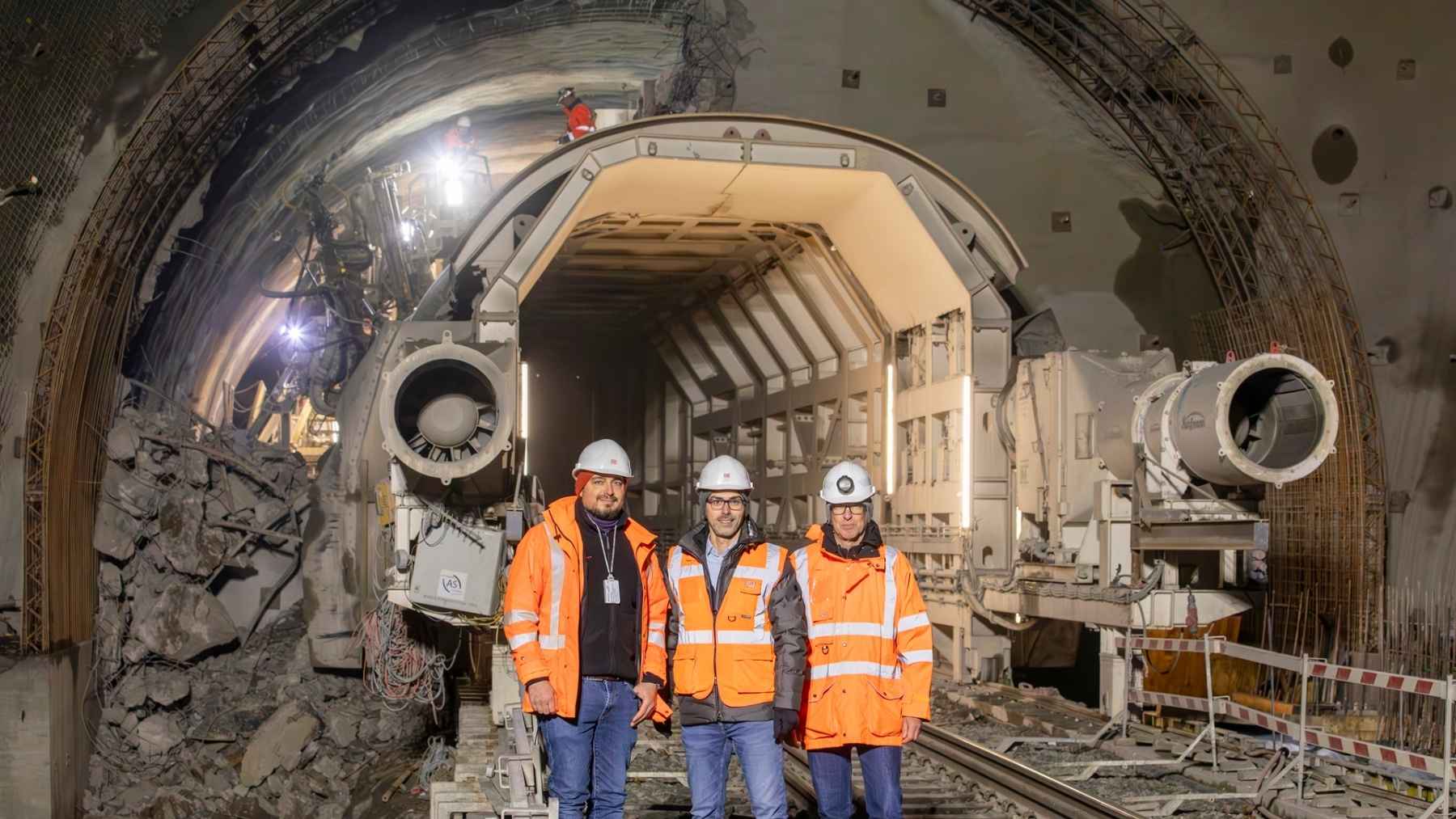
So DB’s contractors brought in a machine called Tilly von Cramberg. Herrenknecht built it, it weighs about 298 tons, and it’s 151 feet long. For most of its time underground, trains ran straight through the middle of it while it widened the tunnel around them. DB says Tilly’s short for Mathilda, which it translates from Old High German as “pure strength.”
Tilly’s done digging now. PORR, one of the three companies in the joint venture doing the work, said in a September 14 update that the machine broke through at the far end of the tunnel in early 2026 and has since been pulled back and lifted out. PORR didn’t say exactly when it came out, and I haven’t been able to pin down a date anywhere else.
According to that same post, the crews have moved on to building foundations for the tunnel’s new lining, putting in drainage, and prepping the areas around both entrances.
So why does an old tunnel need to be wider?
Railroads build to something called a clearance gauge. Basically, it’s an invisible outline of the space a train needs around it, roof and sides included, and nothing’s allowed to poke into it.
A tunnel dug for steam engines doesn’t fit the outline DB uses today, so Tilly widened the Cramberg bore by roughly 6.6 feet all the way around. PORR says that extra room will let the two tracks sit about 13 feet apart and leave space for escape walkways along the sides. The company also says that after 160-plus years in service, the tunnel was badly damaged anyway.
So where do the trains go?
Right through the machine. Before Tilly went in, a single track was laid down the center of the tunnel, and the machine ran on its own pair of rails, mounted on precast foundations on either side of that track.
DB calls this approach “tunnel-in-tunnel.” Tilly was essentially a steel tube that covered the track for its full length, so a passing train was riding through a smaller tunnel while the old one got torn apart and rebuilt around it.
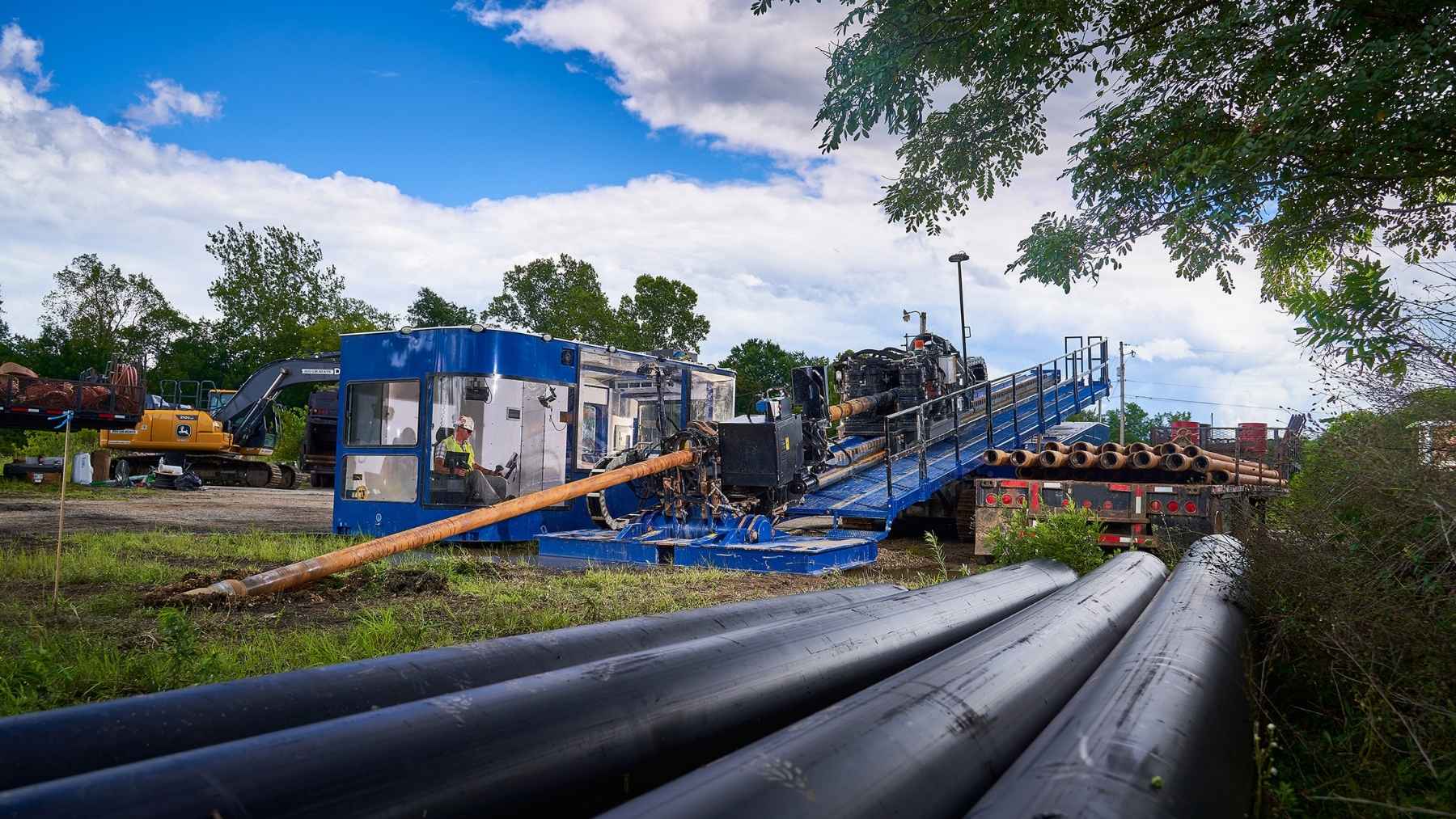
We’ve already seen a London utility drill a duct under a live railroad without lifting the track. Doing the work inside the tunnel means the trains roll right through the middle of the job site.
Tilly came in three sections. The front one shielded the track from rock that might come loose as the old tunnel got opened up. The middle one was where the work happened, with drill rigs on telescoping arms on either side, a hydraulic hammer on a central arm, and a rig that sprayed concrete onto the freshly exposed rock from a ring running around the shell. The back section carried hydraulic power units, compressors, ventilation and dust extraction, electrical gear and a stock of materials. DB says three people ran the whole thing. That’s a pretty small crew for something that weighs about as much as two fully loaded freight cars.
That sprayed concrete’s known as shotcrete, if you haven’t run into the term. It’s basically concrete fired out of a nozzle at high speed, so it sticks to the rock and holds it in place until a permanent lining goes in.
So why not just dig a new tunnel next to the old one?
A new tunnel would usually mean a new route, and in Germany that’s likely to mean new land and a long approval process. Tilly’s maker pitches the in-place approach as a way to keep the line exactly where it’s always been and keep that paperwork to a minimum. If you’ve ever followed a rail project through permitting in the US, you’ll know how long that can take.
Did the trains really keep running the whole time?
Mostly. The plan was to chisel most of the rock away with that hammer, but the crews also used explosives, including what DB calls loosening blasts. They’re small charges meant to crack the rock rather than throw it, so the machinery can finish the job.
Blasting meant stopping the trains, though. When Tilly was christened, the municipality of Balduinstein said traffic would be halted for blasts twice a day, plus overnight. DB has also closed the line outright for some phases of the work, and its project page lists some early-morning and late-evening trains being swapped for buses through the end of 2026.
So this wasn’t a zero-disruption job. Still, compared with closing the line for the whole project, it’s arguably a pretty good deal if you ride it.
Tilly took about twice as long as planned
DB originally expected Tilly to grind through the mountain in about 12 months of round-the-clock work, and it ended up taking roughly two years. A sister machine called Nora handled the shorter Fachingen tunnel nearby, and DB wrapped that one up in May.
DB InfraGO, the railroad’s infrastructure arm, has told rail operators that extensive delays in the tunneling pushed the rebuilt tunnel’s opening from April 16, 2026, to November 15, 2027. Herrenknecht’s own project page points to a complex geology with cavities in the rock. Cavities are pretty much the last thing you want to run into while you’re widening a tunnel with trains inside it. I haven’t found a more detailed explanation from DB than that.
At least the contractors have been putting out numbers on what’s come out of the mountain. Feldhaus, another member of the joint venture, said in February that about 58,900 cubic yards of rock and old masonry had been removed. In August, it said about 28,800 cubic yards of rock had been loosened mechanically, without explosives, which is a bit under half of that 58,900 total.
The hammer worked the top of the tunnel, while two tunnel loaders handled the lower part on either side of the track and scooped up the debris as they went. Feldhaus hasn’t said how the rest splits between blasting and tearing out the old lining, though.
Once Tilly broke through, it was pulled back through the tunnel and lifted out. Italy has a similar trip planned. Over there, a 2,000-ton boring machine is due to be taken apart and hauled back through its own tunnel so it can dig a second one.
So when is the Cramberg tunnel done?
With Tilly gone, the big job that’s left is the permanent lining, which gets cast in place inside the widened tunnel. I’d argue pouring concrete is a lot less exciting than running trains through a 298-ton machine, but the lining’s what’ll be holding the rock up long after Tilly’s gone.
Deutsche Bahn’s project page says the Cramberg work will be finished by the end of 2027. If the schedule holds this time, DB InfraGO has the rebuilt tunnel going into service on November 15, 2027, about 19 months after the April 16, 2026, date it was originally aiming for.