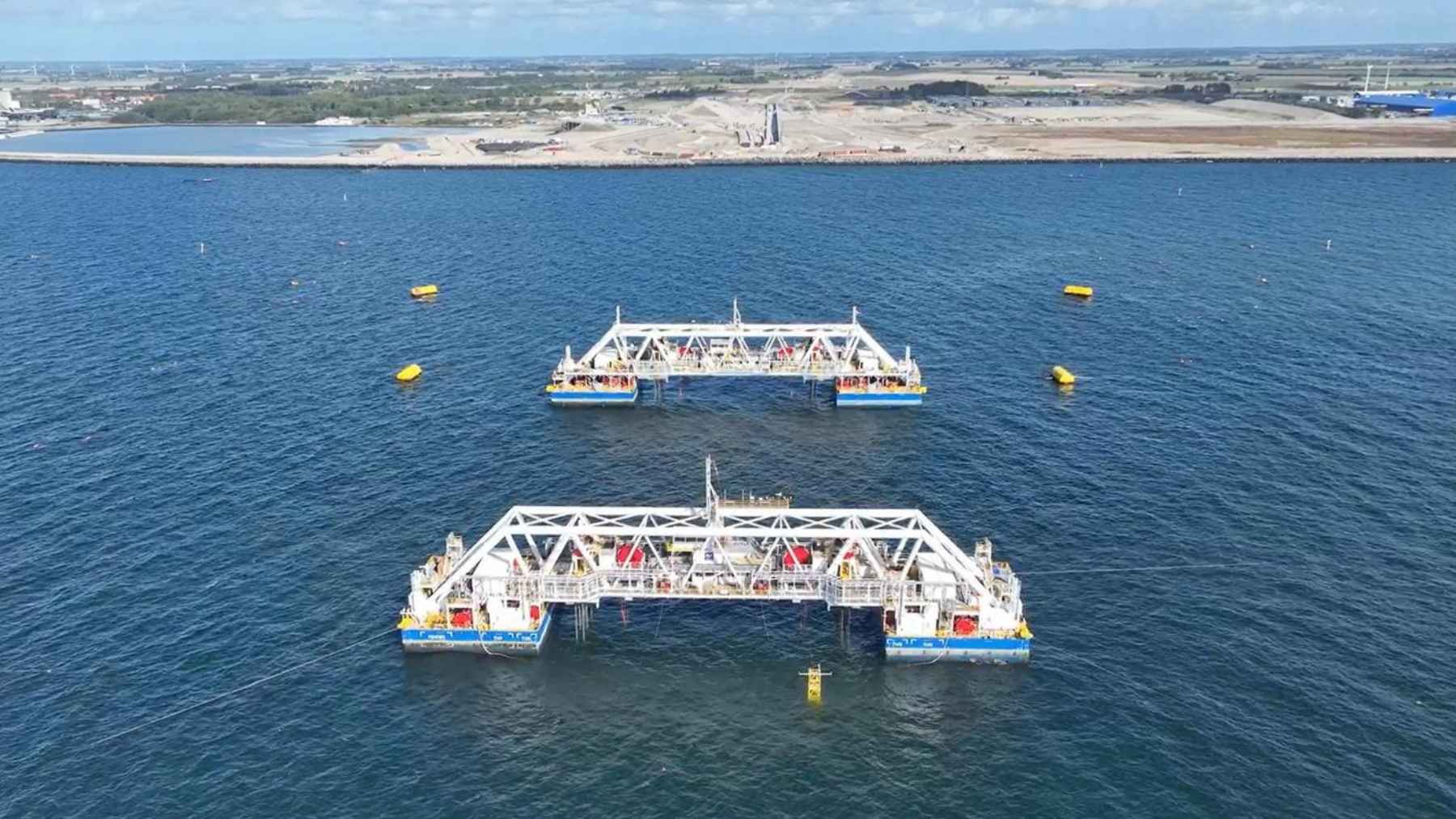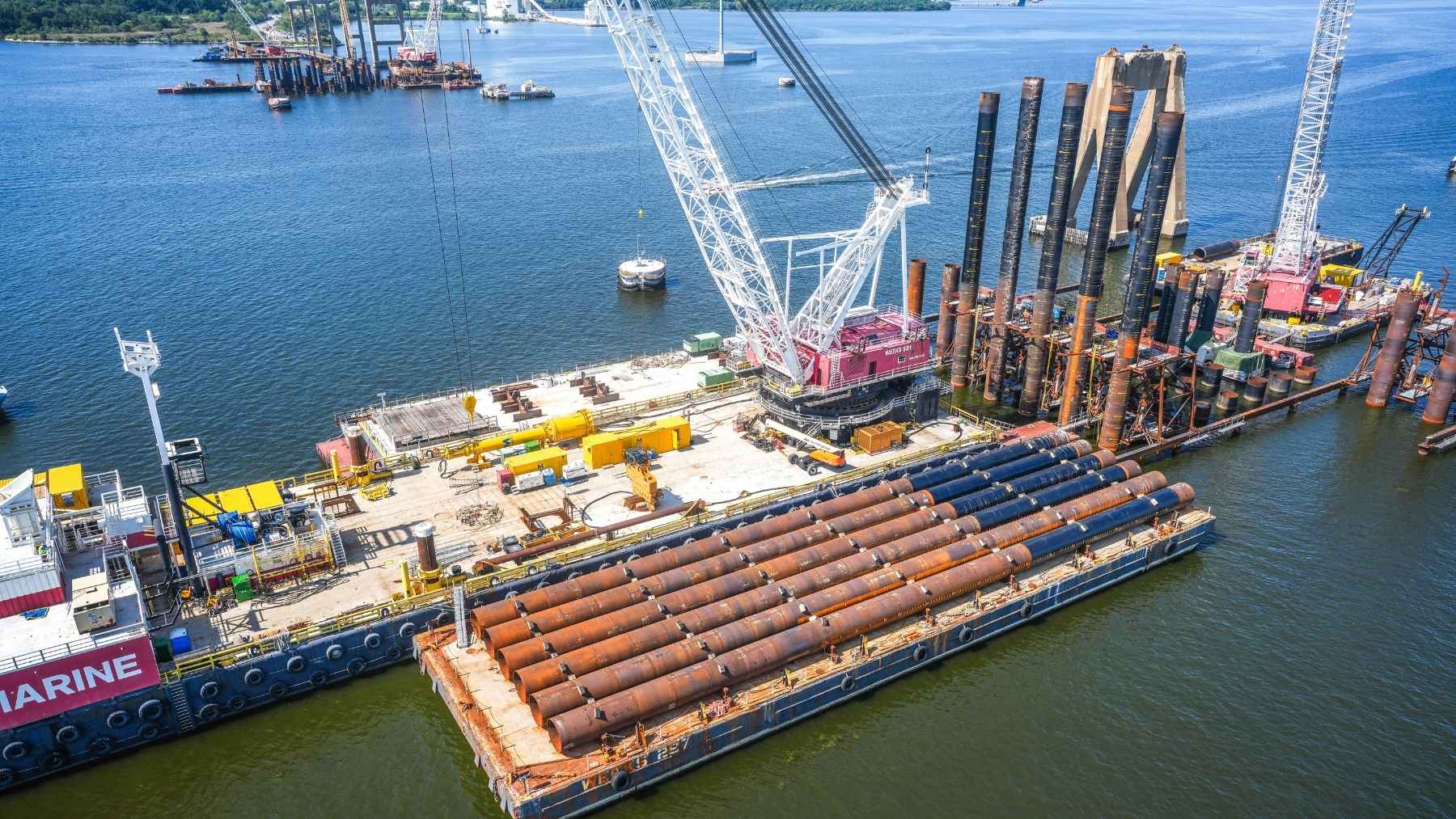

Some Marylanders have been grumbling that nothing much seems to be happening where the Key Bridge used to be. I get it. Look out from the shore and you’ll mostly see cranes, barges and two long work platforms stretching over the Patapsco River from Hawkins Point and Sollers Point, and not much that looks like a new bridge yet.
That’s because most of the work so far has happened out on the water, and a lot of it below the surface. So the state’s built a way to check on it from your couch. Gov. Wes Moore launched a public progress dashboard for the Key Bridge rebuild on October 1, and the Maryland Transportation Authority (MDTA) updated its numbers on October 13.
According to the dashboard, the permanent steel piles for the new bridge’s south tower are 55% done. The north tower’s are at 26%. And both work platforms, which MDTA calls trestles, are now finished.
The trestles are basically temporary roads on stilts. They let trucks, cranes and crews drive straight out to where the towers will stand, and the north one alone runs 2,200 feet on 126 steel piles of its own.
It’s a pretty simple page, and I’d argue it’s more useful than another round of glossy renderings. It tracks the stuff that has to go in before anything gets built on top.
So what is a pile, exactly?
A pile is essentially a giant steel leg. You drive it down through the soft stuff until it reaches ground firm enough to carry the load, and whatever you’re building sits on a cluster of them.
The ones going in here are on the big side. MDTA describes them as hollow steel pipes, 8 feet across and longer than 200 feet, and its September project newsletter says each one weighs more than 170 tons and is made of American steel.
Eight feet across is wide enough for an adult to stand up inside one, and the newsletter even has a photo of one of the agency’s summer interns doing exactly that. The Baltimore Banner reported in August that the piles run up to 230 feet, and that when 230 isn’t enough, crews weld on a few dozen more feet of steel. They come up from Texas on barges and sit at Sparrows Point until it’s their turn, according to the Banner.
The riverbed is basically oatmeal
So why not just build the bridge on the bottom of the river?
Because the bottom isn’t much of a bottom. MDTA’s engineers bored into the riverbed before designing the foundations, and they found that the top 60 to 70 feet couldn’t come close to carrying a cable-stayed bridge. Brian Wolfe, the agency’s director of project development, described that layer as “soupy” to Maryland Matters. Below it sits a much harder layer, and that’s where the piles need to end up.
The Banner compared it to oatmeal in August. Frankly, that’s about the least reassuring thing you can say about the ground under a bridge. It does make the first part of the job easier, though. A crane lowers each pile through the water and slides it over 50 feet down into the mud before the hammer ever gets involved.
That’s when the hammer takes over. Back when the test piles went in last fall, Wolfe told Maryland Matters that its blows would reach about 10 million pounds of force during testing. The hammer itself weighed 145 tons, according to the Banner, or about 27 times as much as the 10,580-pound pneumatic hammer we covered beating steel casings under Interstate 15.
The crane it hangs from, the Weeks 533, has a pretty good résumé, too. It’s the same rig that set the space shuttle Enterprise down at its museum home in New York and pulled the Miracle on the Hudson plane out of the water.
For all that muscle, the hammer doesn’t start at full power. MDTA says crews begin each pile with what’s called a soft start: a few light taps, with pauses in between, before the hammer ramps up. Think of it as a courtesy knock for the fish, giving anything swimming nearby a chance to clear out before the real pounding begins.
Then there’s the bubble curtain. Crews pump compressed air through three rings set around the pile, which wraps it in a wall of rising bubbles. Sound carries a long way underwater, and the bubbles muffle some of the racket before it spreads.
Those test piles were the dress rehearsal. Crews drove six at each of the two tower sites, which flank the shipping channel, then used a load frame and jacks to push on them the way the finished bridge will. Both the vertical and sideways tests passed, and the first permanent pile went in last December.
Most of the piles are there to protect the towers
MDTA’s newsletter breaks down the total, and the split surprised me a little. The two towers get 246 piles between them. Only 90 are foundation piles that’ll actually carry the towers, while the other 156 go to pier protection.
So why sink 156 of these things into the river for something that doesn’t hold the bridge up?
Because of how the last bridge came down. The container ship Dali took out the old Key Bridge by slamming into one of its piers. Pier protection is a heavy barrier around the base of each new tower, meant to take the hit from a ship that’s lost control so the tower doesn’t have to. The state’s paperwork for the main span contract calls it a “vessel collision protection system.” I’d argue it’s the last place on this whole project anyone should try to save money.
The two sides aren’t moving at the same speed. As of August, MDTA counted more than 50 piles in at the south tower and more than 35 at the north one. Crews keep the piles upright and in exactly the right spot with a frame called a template, and the north side’s template stands five piles at once, against two at the south.
I can’t tell you exactly how many piles that 26% at the north tower works out to. The dashboard only shows percentages, and the newsletter doesn’t break the 246 down by tower. MDTA hasn’t said why the north side is behind, either, but it expects to finish driving piles at both towers in the spring of 2027.
The towers will be somebody else’s job
The company driving these piles won’t be the one putting the towers on top of them. The state originally picked Kiewit to design and build the whole thing, and Kiewit is still finishing the first phase of the work, which includes the piles and the trestles. But in April, MDTA said it wouldn’t keep Kiewit for the construction phase because its price came in far above the state’s own independent estimates. The Banner reported that Kiewit’s numbers ran billions of dollars over the roughly $5 billion the state expects to spend.
So the state split the rest of the job into four contracts. The biggest covers the cable-stayed main span, which MDTA’s request for qualifications sets at 1,665 feet between two concrete towers. The agency’s dashboard puts those towers at more than 600 feet tall.
If you haven’t seen one up close, a cable-stayed bridge hangs its road deck from straight cables that run down from the towers. It’s the same basic design as the Gordie Howe International Bridge between Detroit and Windsor, which has taller towers and a longer span.
Putting in the foundation before you’ve even hired the people building the towers might sound backward. Mike Baker, who’s with AECOM and working under contract for the state, called the piles the step that has to come first when he talked to the Banner. “If you’re building your new house, you don’t start with a deck,” he said. Fair enough.
The target for opening is still the end of 2030, though the Banner pointed out that the state’s request for builders now asks for completion as close to that date as practicable. That’s a little looser than the firm deadline the state set the first time it went shopping for a contractor, and I’d treat 2030 as a goal more than a promise.
MDTA plans to name its shortlist of main span teams this fall, and as of the dashboard’s October 13 update, the winner is due to start work in the summer of 2027.