
If you’ve ever flown a camera drone a little too far, you know the moment. The video on your phone breaks up into blocky mush, the controller starts beeping, and you spend the next few seconds hoping the thing remembers its way home.
That’s a weak radio signal. A jammer does the same thing on purpose. It basically shouts noise over the frequencies a drone and its controller use until they can’t hear each other anymore.
Drone pilots on both sides of the war in Ukraine have a pretty low-tech answer to that. They fly FPV drones that pay out a thin fiber-optic line from a spool as they go, so the video coming back and the commands going out travel down glass instead of through the air. FPV stands for first-person view. The pilot wears goggles that show whatever the drone’s nose camera sees, so flying one feels a lot like sitting in it.
So what happens when you put that on a boat with nobody aboard?
BlackSea Technologies, the Baltimore company behind the GARC drone boats the Navy already runs, has a 53-second video of exactly that. It calls the setup Marionette, and I’ve been through the clip frame by frame.
So what’s in the video?
The clip opens on a camera at the back of the GARC, looking forward over the deck. Four black hard cases sit there in two rows, and the front-left one already has its lid up with a small drone sitting inside on a pair of rails.
About two seconds in, the video cuts to the drone’s own camera. You’re looking up out of the open case at the boat’s sensor mast, and roughly a second later you’re out over open water, flying low. The drone keeps going for about 40 seconds by the timer in its own video feed, and the last shot from its camera has it coming up behind a white boat. That boat isn’t the GARC, which wears gray camouflage. Then the BlackSea logo fills the screen.
So that’s one drone out of one case. As far as I can find, the company hasn’t shown all four going in a row. It also hasn’t said where or when it filmed this, and the clip’s YouTube description is blank.
The cases are the clever bit
From the looks of things, they’re ordinary hard-shell equipment cases, the kind you’d haul camera gear around in, except these open their own lids when someone tells them to. The company’s Marionette page says the cases are there to protect the drones while the boat carries them, and that they open by remote.
So why not just strap the drone to the deck? Salt water, mostly. A GARC can spend hours at sea getting soaked in spray, and the small FPV drones that would ride in those cases generally aren’t built to sit out in that. A hard case with a lid that pops open on command is a pretty sensible answer.
The system works with 5-, 7- and 10-inch FPV drones, according to its maker. Those numbers refer to propeller size. Bigger props generally mean a bigger drone that can lift more, so the 10-inch option is presumably the one you’d pick if the drone had to carry more than a camera.
The GARC is already a Navy regular
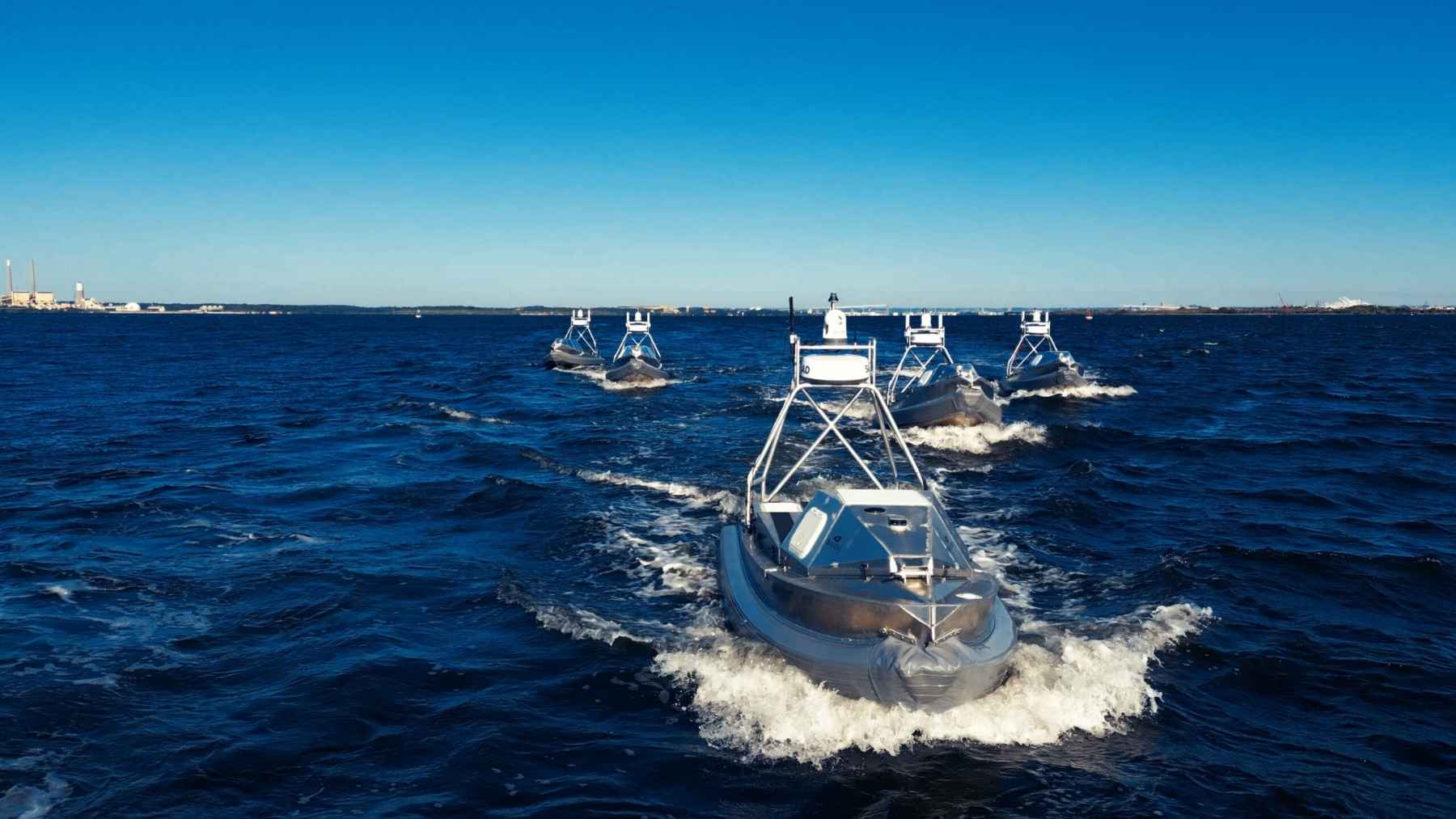
If the boat sounds familiar, there’s a good reason. GARC is short for Global Autonomous Reconnaissance Craft, and the Navy’s Unmanned Surface Vessel Division 32 says it’s the boat the unit trains with most. The division sent GARCs out as a mock enemy against allied ships during NATO’s BALTOPS exercise this summer, and in July one of them blew a hole in the retired USS Peleliu during a sinking exercise off Hawaii.
The GARC’s spec sheet lists it at 15 feet 8 inches long and 5 feet 8 inches wide, and it displaces 4,800 pounds fully loaded. The company usually rounds the length up to 16 feet. It’s rated for 1,000 pounds of payload and runs a 200-hp diesel, cruising at about 25 mph with a sprint of about 46.
The boat can go on fiber too
Here’s where it gets a little more interesting. The drone’s fiber only runs back to the boat, and the boat still has to talk to whoever’s running the show. Normally that’s a radio link, which puts you right back at the jamming problem.
The company’s fix is a second system called FOCUS, which it says it built with L3Harris. It strings a fiber-optic line between a base station on shore and a converter on the boat, using swappable fiber packs picked for each mission, and its listed maximum control range is just under 50 miles.
So on paper, you could have glass running from an operator on shore to the boat, and more glass running from the boat to the drone. From the clip alone, you can’t tell whether the GARC in the video was on FOCUS that day. I’d argue the boat’s link is the more interesting half of all this anyway. A drone boat whose line to shore doesn’t travel through the air is a lot harder to cut off than one talking over radio, and that’s worth more than any single drone in those cases.
Fiber has its limits
Fiber doesn’t make the setup invincible, though. A fiber-controlled drone can only fly as far as the line on its spool reaches, that line can snag or snap, and the spool is weight the drone has to haul instead of something more useful. BlackSea doesn’t list how much fiber Marionette’s drones carry, so I can’t tell you how far the one in the video could have gone.
The video also doesn’t show the drone coming home. The product page talks about carrying, protecting and launching drones, and recovery doesn’t come up. That’s a real difference from the German box we covered in July, which tosses its drone up and catches it again on a moving deck.
Ukraine has been doing its own version for a while. According to Russian accounts, its Sea Baby drone boats now hide between six and eight FPV drones behind hatches along their sides that pop open mid-mission, and some of those drones fly on fiber. The version in this video puts the same idea on an American hull the Navy already knows how to run, with the drones riding in cases on deck instead of inside the boat.
BlackSea put the clip on its YouTube channel on August 4. If you watch it, I’d suggest slowing the playback down, because the drone goes from sitting in its case to flying over open water in about a second. It had 211 views as of October 14.