
If you’ve ever done the Las Vegas to Grand Canyon drive, you’ve probably stopped at Hoover Dam and taken the same photo as everyone else: the giant white band of rock ringing Lake Mead, marking where the water used to be. That ring gets a little taller every week now. And if the federal government’s own forecast is right, sometime around Thanksgiving the lake behind that ring drops past the point where most of the dam’s power plant has to shut down.
Lake Mead sat at just over 1,038 feet above sea level on September 23, according to Bureau of Reclamation data. The line everyone at Reclamation is watching is 1,035 feet. Below that elevation, 12 of Hoover Dam’s 17 turbines start taking severe cavitation damage and can’t safely run. The lake’s about 3 feet away, it first broke its lowest-ever mark back in early August, and it hasn’t really stopped setting new ones since.
Twelve out of 17, just so we’re clear, is most of the power plant.
So what actually breaks at 1,035 feet?
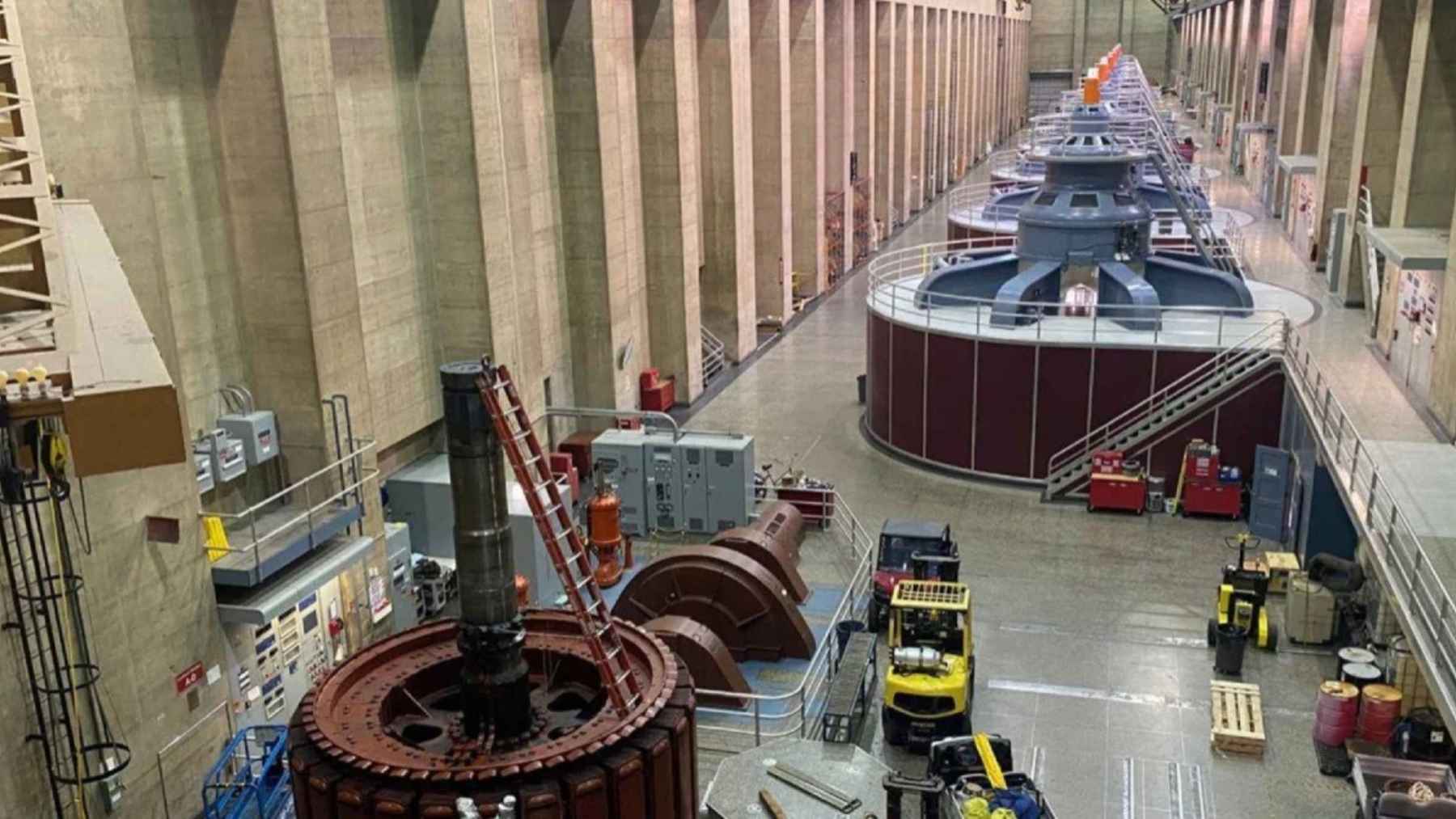
Cavitation, mostly. When the reservoir gets low enough, the pressure of the water flowing through a turbine drops far enough that vapor bubbles start forming, and those bubbles collapse against the steel hard enough to chew pits into the blades. Run a unit like that for long and you’re basically sandblasting your own machinery from the inside. Hoover’s 12 older turbines weren’t designed for the conditions you get at these elevations, so below 1,035 feet they have to sit out.
Reclamation used to figure the dam could still deliver about 1,302 megawatts at that level; its updated assessment from May puts the real number at 382 megawatts. The plant’s historical capacity is 2,074 megawatts, enough electricity for roughly 1.3 million people across Nevada, Arizona and California, so the dam would be running at less than a fifth of what it was built to do. Circle of Blue, which has covered this about as closely as anyone, puts the cut at 70 percent of generating capacity the day the lake crosses the line.
Nobody involved is pretending the crossing won’t happen, either. “We’re going to go to 1,035. There’s no question that’s going to happen,” Tom Buschatzke, director of the Arizona Department of Water Resources, said at a meeting back in May, as reported by Circle of Blue.
Reclamation’s own forecast crosses the line in November
Every month, Reclamation publishes a rolling two-year forecast for the Colorado River system called the 24-Month Study. The September edition models a 6 million acre-foot release from Lake Powell next year. An acre-foot, if you’ve never had a reason to care, is exactly what it sounds like: enough water to cover one acre, one foot deep.
That study has Lake Mead ending October at 1,035.16 feet. By the end of November it sits at 1,034.88, under the turbine line for the first time. From there the projection keeps sliding to 1,007.38 feet next July and bottoms out at 996.96 feet in July 2028. The model shows a partial rebound in between, but at no point in the next two years does the lake climb back above 1,035.
I went through the Hoover table in that same study, and it’s frankly the bleakest page in the document. Reclamation lists the dam’s effective generating capacity month by month: 1,191.6 megawatts this September with 91 percent of units available, then a cliff. By April 2027 the study shows 24 percent of units available and about 316 megawatts. From the looks of things, that’s the low-water turbines and not much else.
You should keep two caveats in mind here. The lake level changes daily, so that 3-foot cushion is a late-September reading, not a promise. And the 6 million acre-foot scenario is the study’s most probable case, not its only one. Next month’s edition will move the numbers. It’s pretty hard to see it moving them 3 feet in the right direction, though.
Five turbines were built for exactly this
Hoover isn’t completely defenseless. Five of its 17 turbines are wide-head units, designed to keep spinning at low water pressure, and Reclamation says they can operate down to elevations near 950 feet without excessive damage. In May the agency approved $52 million to replace up to three of the older turbines with wide-head designs as well, a swap it expects to restore at least 160 megawatts of capacity.
The money comes from a fund collected from power customers decades ago to cover retirement benefits for Hoover employees, who then ended up getting their pensions through the regular federal system instead. So the dam’s drought insurance is being paid for with leftover pension money nobody could legally hand back. Government accounting is a strange world.
I can’t tell you when those three new turbines actually go in, because Reclamation hasn’t said. The May announcement carries no timeline, and when Circle of Blue asked about installation dates, the agency’s press office didn’t answer before publication. Once the new units are running, the capacity cut at 1,035 feet shrinks from roughly 70 percent to 58 percent. Better, but you’re still losing more than half the plant.
The water is being held back upstream on purpose
Part of the reason Mead is falling this fast is that water it would normally receive is being parked upstream. In April, Reclamation cut this year’s releases from Lake Powell from 7.48 million acre-feet to 6 million to protect Glen Canyon Dam’s own turbines and outlet plumbing, and it’s moving as much as 1 million acre-feet out of Flaming Gorge Reservoir in Wyoming to keep Powell propped up. We’ve covered Lake Powell‘s side of this before.
Mead is basically last in line. Both reservoirs hit their lowest levels on record in August, which Reclamation attributes to a record-low winter snowpack across the basin, and the agency says their combined storage is now lower than at any point since Lake Powell began filling in 1963. Mead itself sits at about a quarter of capacity, and it’s still the biggest reservoir in the country, the same one we reach for as a yardstick when something enormous gets built somewhere else.
Grid analysts don’t expect the lights to go out over this. Nathalie Voisin of Pacific Northwest National Laboratory told Circle of Blue that other resources will cover what Hoover stops providing, just at a higher cost, and Jordy Fuentes, executive director of the Arizona Power Authority, said the hydropower rate could triple. The dam itself, though, is now on a schedule. Reclamation ran the model for its September study on September 8, and the output has Lake Mead finishing October at 1,035.16 feet and finishing November at 1,034.88.