
A solar developer and an olive grower want exactly the same piece of ground: flat, full sun, a substation within reach. In Jaén province that overlap has turned into a five-year argument running through grower platforms, the regional government and at least one courtroom. An olive oil bottler in the town of Vilches has spent this year building the version of that argument where nobody digs a tree up.
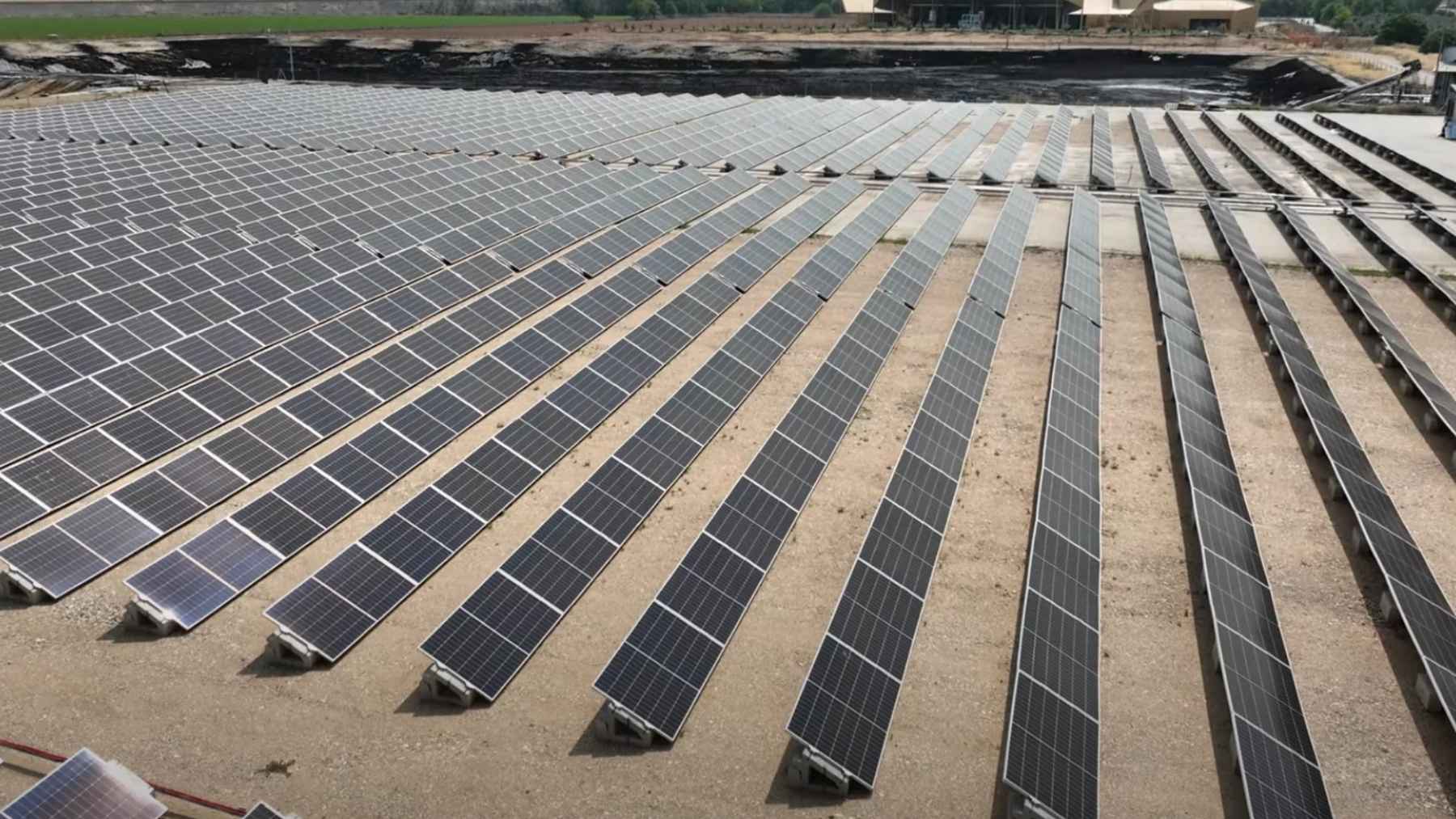
Greening, the Granada energy firm doing the engineering, put the count in writing on August 3: more than 5,150 photovoltaic modules on steel structures standing more than 13 feet (over four meters) above a grove still in production. Installed capacity of 3.65 MWp. A 3-megawatt-hour battery next to it.
Every tree stayed in the ground.
The harvester decides how high the steel goes
Traditional olive trees in this part of Andalusia top out around 6.5 feet (two meters). The machine that matters is taller than the crop by a wide margin: a straddle harvester that drives over a row, clamps the trunk and shakes the fruit into a catching frame stands up to about 11.5 feet (3.5 meters) at full height.
So the glass has to clear 11.5 feet, not 6.5. That’s the whole design constraint, and it explains a 13-foot canopy sitting over 6.5-foot trees.
Researchers at the University of Jaén worked the geometry out and published it in Applied Energy, in a paper on agrivoltaics in Mediterranean olive groves. Their layout puts the module canopy 13 feet above trees averaging 6.5, tilts the glass 30 degrees to the south, and leaves 5.6 feet between module rows so the panels don’t shade each other. The stated reason for the 13-foot figure was letting the harvesting machine “pass over the olive trees.” That same university is now attached to the Vilches build, with Pedro Pérez, professor of electronic technology at Jaén, named as an adviser on the project.
Clearance for farm machinery keeps showing up as the design driver in this category. A German array at Tützpatz was built tall enough for a combine to work underneath it, on flat arable ground where the crop never gets anywhere near the panels.
The building at the end of the grove bottles oil, it doesn’t press it
The electricity isn’t going to a mill. Acesur runs a packing plant at Vilches, one of its main production sites, filling bottles under the Coosur and La Española labels. The array went onto olive parcels next to that industrial site, and the company has said the plant will cover about 95% of its own electricity demand from it.
Acesur started a decarbonization plan in 2021 with a total spend of €9 million (about $10.4 million) running to 2028. The first phase swapped more than 30,000 MWh of fuel oil for biomass made from olive-grove residue, and put solar on four of its production centers, covering about 7.4 acres split roughly 75% ground-mount and the rest on roofs across Vilches and Jabalquinto in Jaén and Dos Hermanas and La Roda de Andalucía in Seville. Those four sites generate 3,654.70 MWh a year by the company’s own count. Site emissions at Vilches went from 25,400 metric tons of CO2 equivalent (about 28,000 US tons) in 2021 to 8,700 metric tons in 2024. Spain’s energy diversification institute, the IDAE, has put €5.2 million (about $6 million) into the agrivoltaic array and a molten-salt steam system called ThermalBox, of which €2.8 million (about $3.2 million) went to the array.
Construction started in April, and as of October 15 neither company has announced the array energized. Acesur has scheduled both projects for completion in 2028.
A fifth of the ground stays bare on purpose
The array covers a 12.4-acre parcel of traditional grove, and pv magazine España reported in April that more than 20% of the plot is being left uncovered as a control zone.
That control zone is what turns a self-consumption plant into an experiment. The University of Jaén will run the site as a living laboratory, measuring agricultural productivity, water stress, soil temperature and how the two activities interfere with each other. Shaded trees and unshaded trees, same soil, same year, same rain. Without the bare fifth, any yield figure that comes out of Vilches would be a number with nothing to compare it against.
The design targets a second-phase output of more than 5,000 MWh a year for self-consumption.
In the west of the same province, the trees do come out
Vilches sits in the northeast of Jaén. Roughly the other end of the province, around Lopera, Arjona and Marmolejo, growers have spent two years fighting a set of photovoltaic projects promoted by the Galician company Greenalia that require clearing olive trees outright.
The numbers there are contested. Campaign groups circulated a figure of 100,000 trees; the Spanish fact-checking outlet Maldita.es traced that back to a platform estimate built from installed capacity and local planting density, and found that official documentation puts the seven Greenalia plants at 1,369 acres. Greenalia has called the 100,000 figure radically false, put the real affectation at 36,022 trees across its six parks, and says 87% of the land is under voluntary agreement. The La Loperana cooperative counted 42,600 trees over 1,053 acres in Lopera alone.
A judge at the Andújar court issued a ruling on January 26 provisionally dismissing the criminal case over how the permits were handled, finding insufficient criminal intent for a prevarication charge. The same ruling flagged indications of artificial fragmentation, projects each kept under 50 MW so the approval stays regional rather than national, the same defect that led Andalusia’s high court to annul a comparable plant at Bujalance and Montoro in Córdoba last year. Greenalia has argued that its authorizations were public, went through the statutory consultation windows, and were not challenged at the time.
That fight is still live. The groups SOS Rural and Ecología y Libertad filed appeals on January 16 at Andalusia’s high court against the regional authorizations, and a separate one at the Jaén administrative court against a January 20 decree by the Lopera council lifting its freeze on building permits. As of mid-October neither court has ruled, and in March the Campiña Norte platform said no tree had yet been removed inside Lopera’s municipal limits.
Which is the context an elevated array in Vilches lands in. Acesur and Greening aren’t making an argument about anybody else’s project, and no party has alleged that any of the Jaén plants is operating unlawfully. But a company that buys olives for a living has an obvious commercial reason not to be seen paving over the crop it depends on, and it built the expensive version of the structure to avoid it.
The Germans already found the failure mode
Putting glass over a crop has a known way of going wrong, and a Bavarian hop grower has the receipts. Josef Wimmer mounted panels on the poles already holding up his hops, 23 feet over the field, and the first build generated well while cutting his cone yield. The bines climbed the full 23 feet, hit the panels, went bushy at the top and set fewer cones. Weihenstephan-Triesdorf measured the hit at 10% to 20%. Wimmer rebuilt the array at 45 degrees to get the crop back.
Olive trees don’t climb. A tree that stops at 6.5 feet will never touch a canopy at 13, which removes the specific mechanism that cost Wimmer his cones, and leaves the ordinary one: shade.
Shade under panels cuts both ways depending on the crop and the year. French vine growers near Cognac put panels over vines partly for hail and heat protection rather than for the electricity, and German trials over apple orchards have been tracking what partial shade does to ripening. The Jaén team’s own modeling found the panels need to be partly transparent, in the range of 57% to 71% depending on location, to keep olive yield intact.
Nobody has published a Vilches olive yield number yet, and the trees haven’t been under the array through a full harvest. Jaén’s next one is weeks away: on September 29 the Andalusian government forecast about 575,000 metric tons of oil from the province for the 2026-27 season, 45.6% of the regional total.
Greening chief executive Pablo Otín framed the project on August 3 around energy management rather than generation, arguing the value sits in combining renewable output, storage and flexibility for industrial customers. Acesur environment director Nicolás Tejada put it in terms of the crop, saying the design lets the company cut its carbon footprint while protecting the grove its oils come from. Both companies have set completion of the agrivoltaic array and the ThermalBox steam system for 2028, at which point Acesur expects the Vilches site to be emitting around 3,000 metric tons of CO2 equivalent a year, against 25,400 in 2021.
 @dallasadams ROOKIE1 month ago