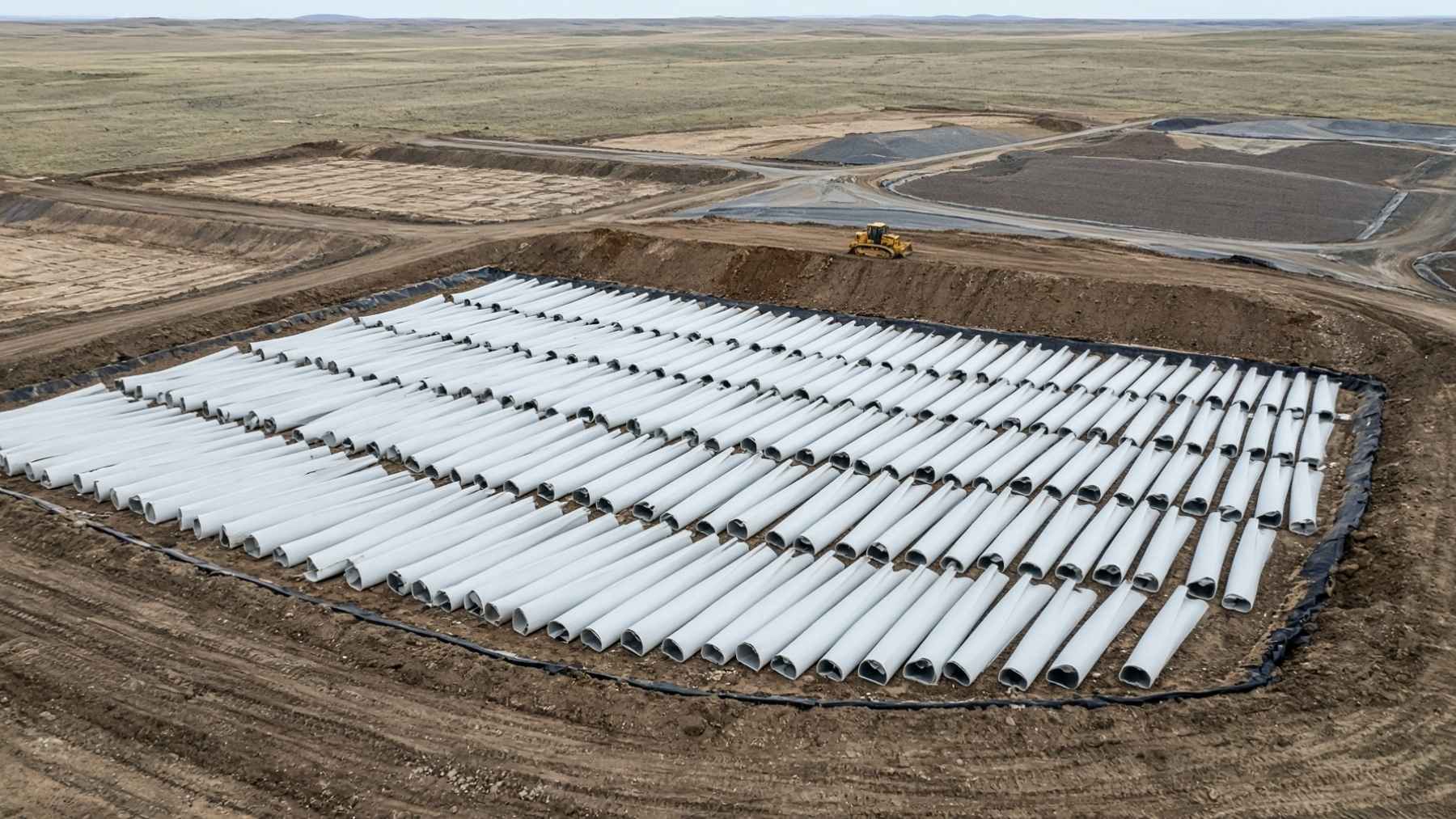

If you caught our piece last month on the idle wind farm outside Casper, Wyoming, the one Chevron built back in 2009 and barely ever ran, you might’ve wondered how you actually get rid of an 11-turbine farm once the blades come off. Well, now we know. Dynamite.
Over two days in late August, demolition crews dropped the farm’s 240-foot steel towers, each one weighing 450,000 pounds, onto the prairie off Cole Creek Road. Your Wyoming Link reported the work ran through Wednesday and Thursday, August 26 and 27, and Chevron’s own decommissioning site declared the explosive phase finished on the 27th. There’s video, courtesy of a county commissioner, and it’s about as satisfying as you’d hope.
Natrona County Commissioner Dallas Laird, who shared that video, told the station the towers toppled “just like a huge redwood tree.” He’s also not the only county official who’s been itching to see them gone.
So how do you knock over a 450,000-pound tower?
Pretty much the same way you drop a tree, it turns out. Howard Oden, the Natrona County fire chief, described the method to Cowboy State Daily as an “exploding axe.” When a logger fells a tree, he cuts a notch on the side he wants it to fall toward, then makes a second cut behind it, and gravity handles the rest. The crews here made the same two cuts, in steel, with explosives.
The contractor, a demolition outfit called Destructable, paired linear shaped charges with dynamite. A linear shaped charge is basically an explosive packaged to slice in one direction instead of blasting out every which way, so it can cut through most of a tower’s base without wrecking anything around it. Chevron said the charges sat above ground, and equipment on site tracked overpressure and vibration. Frankly, it’s a tidier operation than “blowing up a wind farm” sounds like it should be.
Per Oden, no one planned to blow up an entire tower, or even an entire base. The charges take out most of the bottom, the tower tips, and gravity finishes the job for free.
Not every tower went down with a bang, though. Your Wyoming Link reported the first nine came down by explosives and the last three were picked apart by crane, so their components could come off intact. I’ll point out that nine plus three makes twelve towers on an 11-turbine farm, so at least one of those counts is off. Chevron’s decommissioning page keeps it simpler: the “energetic felling” is complete, and crane disassembly continues.
The farm never really earned its keep
Chevron put up the Casper Wind Farm in 2009 on the site of an old Texaco refinery, 11 turbines rated at 16.5 megawatts between them. The company told Your Wyoming Link the turbines had struggled to run at full capacity since 2018 because of congestion on the regional grid, that they last operated in December 2023, and that no one has bought the site’s output since.
So why tear the towers down now instead of letting them rust in peace?
Because the county permit has a clock in it. Chevron’s conditional use permit with Natrona County gave the company 20 months to restart after a partial shutdown, or 18 months once the site stopped sending out electricity entirely. Once those windows closed, decommissioning wasn’t optional anymore, which is arguably the most productive thing that permit ever did. We dug into the farm’s history, and into the genuinely weird question of what America does with dead turbine blades, in the August piece, so I won’t rehash all that here.
What’s left goes to salvage, mostly
Chevron says a third-party contractor called Wind Decom is managing the materials, and that a good chunk of the hardware may wind up as spare parts for other wind farms, with the metal going through the usual salvage and recycling channels. Anything that can’t be reused heads to permitted disposal or recycling facilities.
The schedule, per Chevron spokesperson Christine Dobbyn: the turbines and the company’s share of the electrical substation should be gone by the end of 2026, weather and contractor coordination permitting. Site reclamation is slated for 2027, and monitoring, agricultural mitigation and erosion control run through 2029. Which means the paperwork will outlive the towers by about three years.
If the eagle side of Wyoming wind is more your thing, we’ve also covered the camera towers another Wyoming wind farm uses to spot birds and shut turbines down. This site won’t need any of that.
What happens to the land is still an open call. Chevron told Cowboy State Daily it hasn’t made decisions about the property’s future and it’ll keep working with regulators on planning, while its environmental unit keeps handling remediation at the old refinery site. The company’s last public update landed on August 27, 2026, the day the felling wrapped: explosives done, cranes still working, and everything above ground supposed to be gone before the year is out.