
- 3 MONTHS AGO · ENERGYA French startup has spent six years on a nuclear reactor with no turbine, no generator and no grid connection, a 131-foot box running helium at 1,382 degrees to sell steam to the sugar mill next door, and the mill has never agreed to buy any of it
- 2 MONTHS AGO · ENERGYSeven emergency diesel generators kept six shut-down reactors cool when Europe’s largest nuclear plant lost its last power line, but crews ended up running just two of them to stretch the fuel over 18 days, and they’ve burned through almost all of it
- 1 MONTH AGO · ENERGYA 1,600-megawatt reactor on the French coast shut down at three minutes to midnight for a year of work, 20,000 separate tasks that include trading its steel lid for a new 109-ton one that reached the plant by river barge, cargo ship and road convoy
- 1 MONTH AGO · ENERGYTwo 105-ton machines, each 52 feet tall, were set in place at a 300-megawatt reactor that will be the world’s first power plant cooled by molten lead instead of water, to pull droplets out of its steam before they can erode the turbine blades
- TODAY · THIS ARTICLEThree 365-ton steam generators, each as tall as a six-story building, crossed the world by ship and rode a river barge and a special trailer into a French nuclear plant, where they’ll sit in storage until the reactor shuts down for an eight-month overhaul
Turning 40 is a big deal. We usually view it as the end of youth, the beginning of a new chapter. Maybe time to schedule a colonoscopy. Or buy a Corvette. Well, 40 is a big birthday for a French nuclear reactor as well.
It’s roughly when each one goes through its fourth ten-year inspection, a shutdown that runs for months while EDF, which operates every nuclear plant in France, works to keep the reactor going safely past that age. Think of it as a state car inspection, if the car had to sit in the shop for most of a year and came back with a few upgrades.
Unit 2 at Cruas-Meysse, a four-reactor plant on the Rhône in southeastern France, has its turn coming up. Its shutdown starts in February, and the heaviest job on the list (I mean that literally) is replacing all three of its steam generators. And the new ones? They’re already on site.
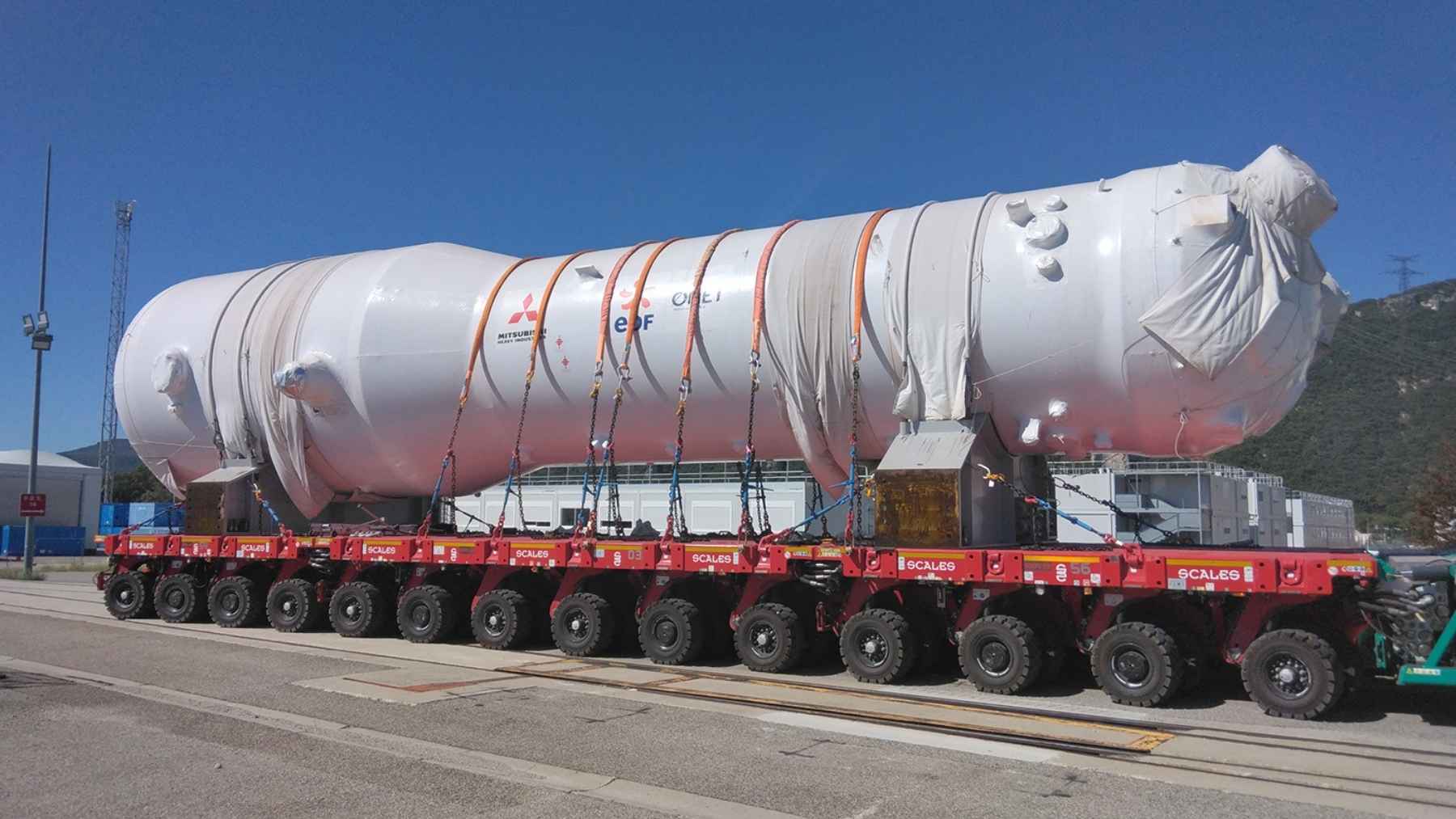
EDF announced their arrival on September 28, and Mitsubishi Heavy Industries, which built them in Japan, confirmed on October 15 that the delivery is complete. They’re not small, either. Each one’s about 69 feet tall, which EDF compares to a six-story building. EDF’s weight figure works out to roughly 365 tons apiece. That’s about 730,000 pounds.
So what does a steam generator do?
It’s a lot like the radiator in your car. Hot coolant from the engine runs through a bunch of thin tubes; air flows over the outside, and heat moves from one to the other, but the coolant and the air never mix.
A steam generator does the same job with water on both sides. Water that’s been through the reactor core flows through the tubes, and a separate supply of water around the outside picks up that heat and boils. The steam goes off to spin the turbine. Or, as the NRC puts it, “The water inside the tubes heats non-radioactive water on the outside.” The reactor side runs much hotter than the 212°F at which water boils in your kitchen, and it only stays liquid because it’s kept under very high pressure.
MHI says each of the new ones holds roughly 4,500 tubes. The NRC says steam generators in this country hold anywhere from 3,000 to 16,000, so these are toward the low end of that range. Cruas puts three steam generators on each reactor, though, so that’s still a lot of tubing.
Those thin tube walls are frankly some of the most important plumbing in the building. The NRC counts them among the layers that keep a reactor’s fuel sealed off from the environment. When a tube wears or cracks past a set limit, it usually gets plugged so nothing can flow through it, and then you’ve got one fewer tube carrying heat.
The new tubes are made of TT690, an alloy of nickel, chromium, and iron that’s been heat-treated to hold up better against corrosion, according to MHI. That’s a pretty good bet, going by the NRC’s experience. The agency says stress and corrosion working together have cracked some older tubes, most of them made of a related alloy called Alloy 600, while thermally treated Alloy 690 (that’s what the TT stands for) hasn’t cracked that way so far.
So why replace them now?
Age, mostly. EDF says the three coming out have been in service for nearly 40 years, and its stated goal for this inspection is to keep Unit 2 running past 40 with safety close to the level of EDF’s newest reactor design, the EPR. If you want a sense of how big a deal these swaps can get, we covered an Ohio plant that had to cut a hole through its containment building to get a new pair inside.
Figures: EDF, Mitsubishi Heavy Industries.
They’ll wait in storage until the shutdown
EDF says the three came by ship from Japan to Fos-sur-Mer, a port near Marseille, and from there to the river port at Cruas. A special trailer then carried each one the last stretch to the plant. France’s public radio network reported that the convoy didn’t go unnoticed, which I’d say is putting it mildly. EDF hasn’t said exactly when each of them rolled in or how long the whole trip took.
They’ve been finished for a while, too. MHI says it completed all three at its Kobe works more than two and a half years ago, and France’s nuclear safety regulator signed off on them at the end of February, after which they shipped. That’s a pretty long time for three finished steam generators to sit around. I couldn’t find an explanation for the gap, but EDF has had this swap penciled in for 2027 for a while now, so I’m not sure anyone was in a hurry.
Over the next few weeks, they’ll go through what EDF calls preparation work. After that, they’ll wait in dedicated on-site buildings until it’s time to enter the reactor building.
You’re probably wondering why a French plant would buy steam generators from Japan. Well, it isn’t the first time Cruas-Meysse has done this. Two of its other three reactors were supplied by the same Japanese manufacturer, while the third received French-built units. That’s a little funny for a country that builds as much nuclear hardware as France does, but from the looks of things, EDF is happy to shop around.
As for the three old ones, the last time this plant swapped out a reactor set, EDF said the retired steam generators would go into a building built on site to store them. In Germany, where reactors are being decommissioned rather than kept running, one utility has been shipping its old reactors to Sweden to be melted down.
Unit 2 shuts down in February
EDF plans to take the reactor offline in February for an eight-month outage. The steam generator swap is one part of it, and EDF figures that part alone will take about four months, with close to 400 people working three eight-hour shifts. So, around the clock.
There’s a lot more going on during that outage than the steam generator swap, though. EDF has 16,500 separate jobs planned and expects 2,400 nuclear workers on site for maintenance. I’d call that a crowded eight months for one reactor.
EDF says this will be the 31st steam generator swap in France’s nuclear fleet and Cruas-Meysse’s fourth. So once it’s done, all four reactors at the plant will be running on replacements.
And EDF isn’t done buying. MHI says EDF has ordered nine of these from it in total, and the other six are being built in Kobe right now, with deliveries scheduled from 2028 on.
Next up for Cruas-Meysse is February 2027. That’s when EDF plans to shut Unit 2 down for its fourth ten-year inspection, the last of that round at the plant, and get the three new steam generators out of storage and into the reactor building.
 An 882-ton boiler, one of eight at a closed nuclear plant on the English coast, is slated to be jacked and slid out of its bay under a contract announced late last month, a job meant to take away about a third of the buildings still standing on the siteEnergy · 5 days ago
 A 216-foot steel vessel 60 feet high is being assembled nearly a mile underground in South Dakota, one of two tanks that will take 2,600 beams lowered one by one down a shaft and will each hold about 17,000 tons of liquid argon at about 300 degrees below zeroEnergy · 5 days ago
 A 23-foot-wide steel platform on three 90-foot piles driven 45 feet into the bed of a Massachusetts canal lowers tidal turbines up to 10 feet across into a 4-knot current on a lifting arm, then raises them back out of the water so engineers can service them dryEnergy · 6 days ago