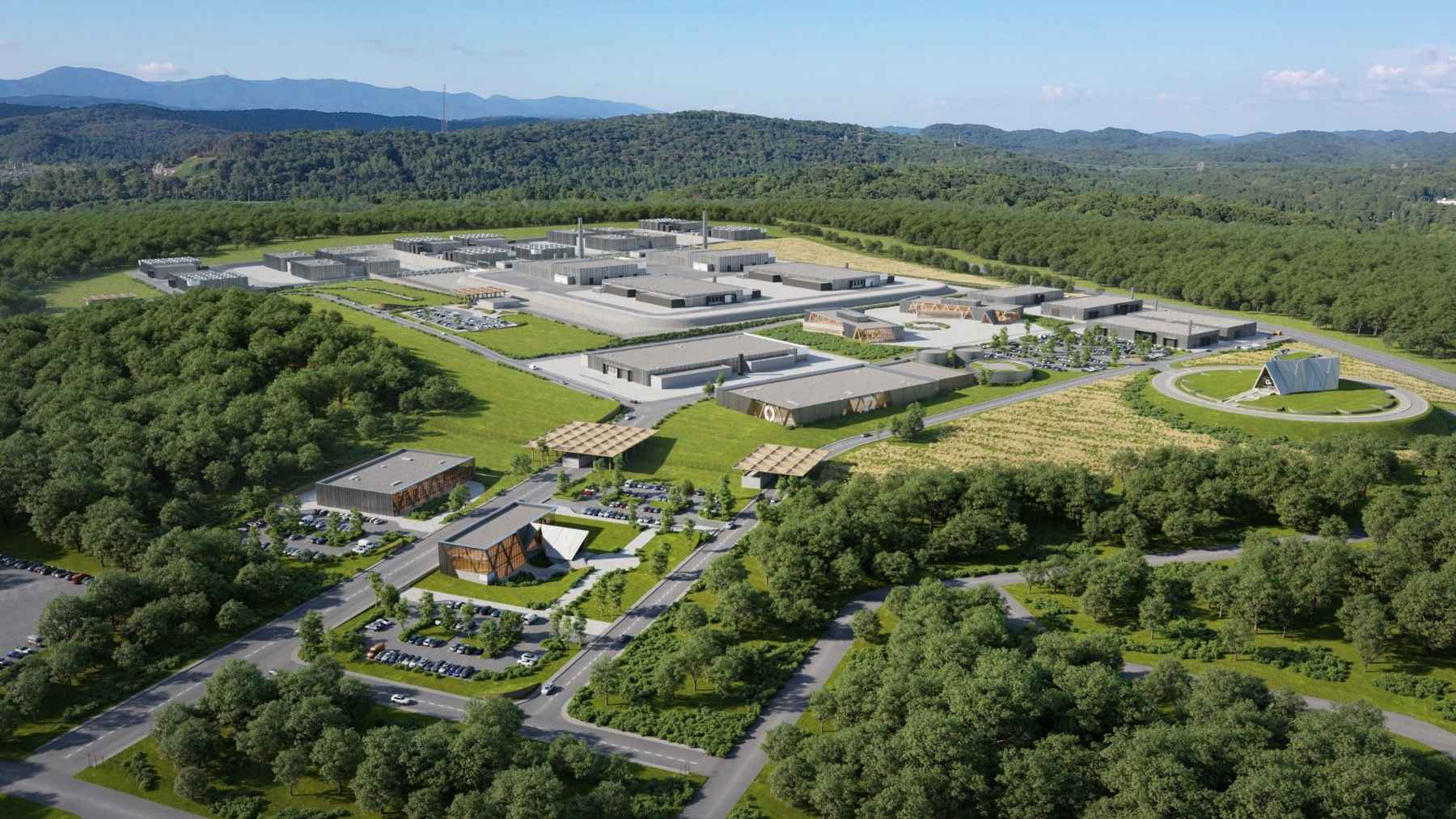

Back in August, we covered a factory going up in Oak Ridge, Tennessee, built to press uranium into billiard-ball-sized spheres called pebbles. At the time, most of the story lived on paper. The building itself was a steel skeleton with a fresh license and a very long to-do list.
That building is finished now. On September 24, TRISO-X, the fuel subsidiary of X-energy, announced it had completed vertical construction on TX-1, the company’s name for the plant. That means the 215,000-square-foot structure (frame, walls, roof, the whole envelope) is standing, and everything that happens from here on happens indoors.
So is that a milestone or an ordinary construction update?
A bit of both, frankly. “Core and shell” is the construction trade’s term for exactly what it sounds like: the load-bearing structure plus the skin that keeps the weather out, with none of the guts installed. Your average warehouse hits that stage and it’s basically done. A nuclear fuel plant hits that stage and the expensive phase begins.
Joel Duling, TRISO-X’s president, said in the announcement that the company is “moving from constructing the core and shell of the facility” to fitting out the utilities inside, putting in the manufacturing equipment, and raising the support buildings around the main plant.
And if you’re wondering whether the building landed on schedule, not quite. When X-energy started vertical construction in November 2025, it expected this phase to wrap up by mid-2026, and it wrapped up on September 24 instead. Call it three months behind, which by nuclear construction standards is pretty close to punctual.
So what’s actually left to do?
Three things, per the company: the interior utilities, the fuel fabrication line itself, and the supporting buildings on the campus.
That middle item is the piece I’d watch. Making this fuel isn’t bolting widgets together. Each particle starts as a kernel of uranium, carbon and oxygen, and machines then wrap it in layers of carbon and silicon carbide ceramic deposited from hot gas, a process that has to come out right at the scale of a poppy seed. One finished pebble holds more than 18,000 of those particles, and most of the fuel’s safety case rides on those coatings doing their job. We looked at what those coatings go through inside a reactor a few weeks ago, if you want the deeper version.
X-energy hasn’t said when the first fabrication machines arrive or how long the interior buildout will run. What the company and the Department of Energy have both put a date on is the finish line: fuel production at TX-1 is expected to start in early 2028.
The license is already in hand
One thing this plant doesn’t have to wait for is permission.
The Nuclear Regulatory Commission approved a 40-year license for the operation on February 13, covering fuel made with high-assay low-enriched uranium, the stuff enriched to between 5% and 20% that most advanced reactor designs call for. The Energy Department notes the NRC hadn’t issued a new license of this kind in about 50 years before this one, and it covers TX-2, the larger second plant planned for the same campus, as well. Tennessee added an $11 million grant in July to support the campus buildout, including that second plant and a research lab.
Which means the paperwork is running ahead of the hardware. That’s a strange sentence to write about anything nuclear, and I don’t expect to write it often.
What comes off the line in 2028
Once the machines are in and running, TX-1 is designed to turn out about 700,000 pebbles a year. The company counts that as 5 metric tons of uranium, a bit over five and a half short tons, and says it’s enough to keep up to 11 of its Xe-100 reactors fed. Around 500 people are expected to work there.
Those pebbles don’t sit still in a reactor the way fuel rods do, either. The Xe-100 loads fresh ones in at the top while spent ones drop out of the bottom, and the Energy Department has compared the system to a gumball machine, which is the clearest description of a nuclear core I’ve read all year. Each pebble makes up to six trips through the core over roughly three years before it’s spent.
The first batches are earmarked for the Xe-100 units X-energy wants to build at Dow’s Seadrift chemical site in Texas, a project that was still working through its federal safety review when we covered it in August. So the fuel plant keeps running ahead of the reactors it exists to feed, which is the same odd sequence we flagged two months ago, only with a roof on it now.
TRISO-X announced the completed structure on September 24, and the Energy Department’s stated target for the first fuel off the line remains early 2028. Between those two dates, there’s an awful lot of plumbing to put in.