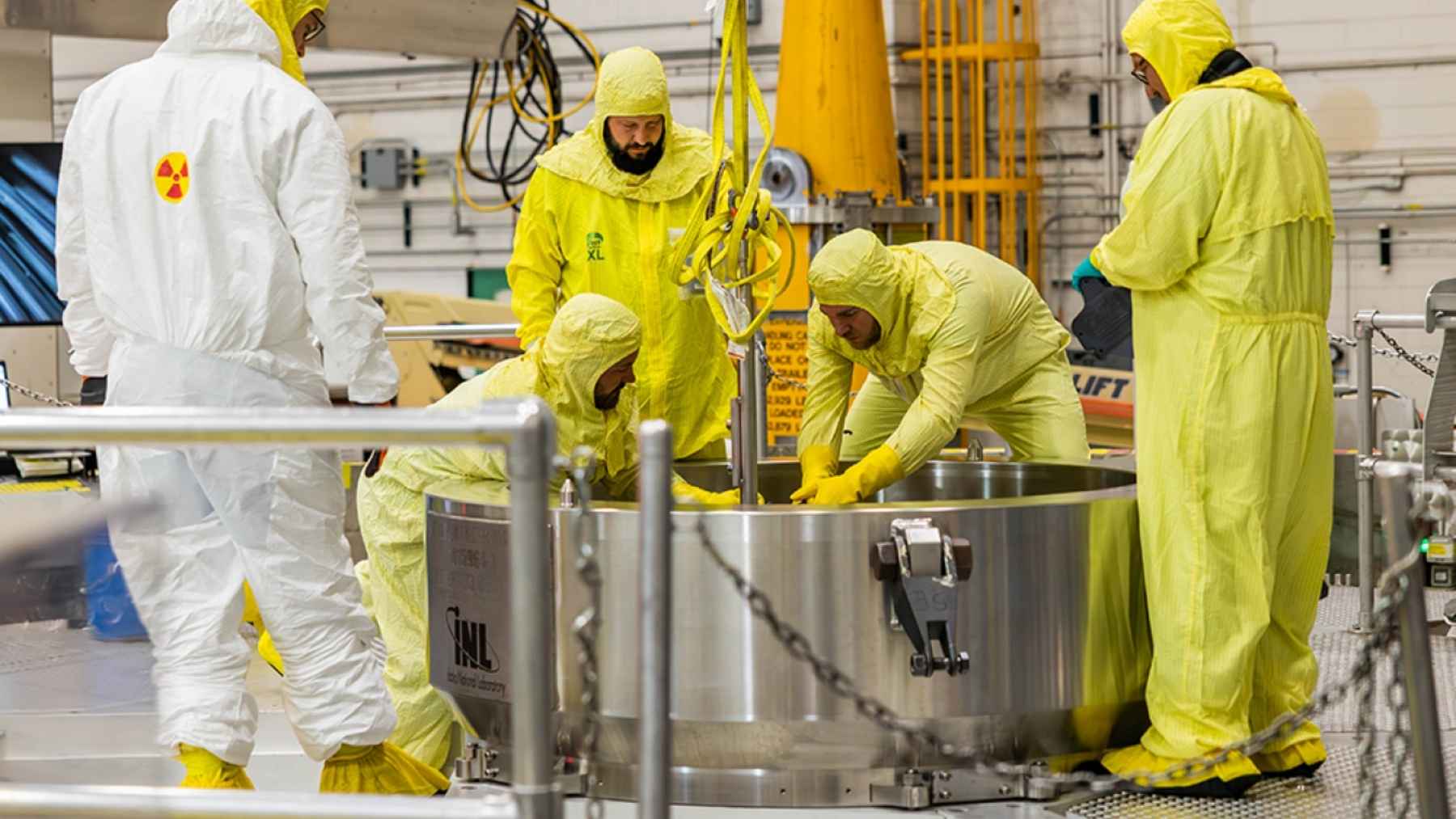

Topping-out ceremonies don’t usually travel beyond the local paper. A crew sets the last piece of structure, somebody signs a beam, and everybody’s back at work by lunch. But when the building in question is the first new commercial-scale nuclear fuel factory the United States has put up in more than 50 years, the shell itself is the news. And as of late September, it’s done.
On September 24, TRISO-X, the fuel-making subsidiary of X-energy, announced the completion of vertical construction at TX-1, its plant on the Horizon Center campus in Oak Ridge, Tennessee. That’s the frame and outer shell of the 214,812-square-foot building finished, and the work now moves indoors. “Completing vertical construction is a major milestone for TX-1,” TRISO-X President Joel Duling said in the announcement.
I went back and checked the original construction announcement from last November, and the schedule didn’t quite hold. Clark Construction Group started the above-ground work on November 17, 2025, with the shell expected to wrap by mid-2026. It wrapped on September 24 instead. For a first-of-a-kind nuclear building, landing a few months past target is frankly close to on time.
So what comes out of this factory?
Not fuel rods. TX-1 makes pebbles, spheres about the size of a billiard ball, and each one carries more than 18,000 TRISO particles inside. A particle is a poppy-seed-sized kernel of uranium sealed in layers of carbon and silicon carbide ceramic, and every layer works as its own tiny containment vessel. If you want the full story on the design, we dug into it back in August, when the campus was still buying land around a building that wasn’t finished.
The single production line inside TX-1 is sized for 5 metric tons of uranium a year. That comes out to roughly 700,000 pebbles, which X-energy says is enough to feed up to 11 of its Xe-100 reactors.
And if you’re wondering whether any of those reactors exist yet, they don’t. The anchor customer is a four-reactor plant Dow wants at its Seadrift site on the Texas Gulf Coast, and the NRC accepted that construction permit application in May 2025 and could rule on it before the end of the year. So the fuel factory finished its structure before its first customer had permission to pour concrete.
So when does it actually make fuel?
Early 2028, if the schedule holds.
Clark’s crews now shift to the interior: utilities, the process equipment and administration building, the fuel-making machinery itself, and a separate graphite matrix powder building going up next door. TRISO-X had already announced the start of that interior work in late August, while the shell was still going up, and the Department of Energy approved about $30 million so the company could order its long-lead equipment early. That kind of boring procurement detail is usually what decides whether a 2028 date survives.
Then the regulators take over from the construction crews. Before any uranium can enter the building, the Nuclear Regulatory Commission has to complete an operational readiness review, which is basically a final inspection of the safety systems, the procedures and the people who’ll run them. The plant already holds its 40-year fabrication license, the first new one the NRC has issued in about half a century, but holding a license and getting cleared to start aren’t the same stamp.
The cost and staffing figures aren’t in the company’s press release. They sit in the project’s environmental impact statement, and as POWER magazine reported from that document, the construction phase is estimated at $768 million over five years, peaking around 332 workers on site, with roughly 500 full-time staff once the plant is running.
Where does the uranium come from?
The plant doesn’t enrich anything. It takes finished uranium feedstock and turns it into fuel. The high-assay material, enriched past the 5% ceiling that ordinary power reactors use, is set to come from the American Centrifuge Plant in Piketon, Ohio, the single hall of centrifuges we’ve covered before. Lower-enriched feed comes from Urenco USA in New Mexico, and the Department of Energy’s Savannah River Site in South Carolina supplies dilute uranyl nitrate.
Once it’s running, the truck traffic is surprisingly light. Construction Review‘s project rundown counts about 36 deliveries of uranium feed per year and roughly 196 shipments of finished fuel going out. Your average Walmart distribution center sees more trucks before lunch.
TX-2 is already on the drawing board
TX-1 was never meant to work alone. A second plant, TX-2, is in design with two production lines sized for 20 metric tons of uranium a year, four times the output of the building that just topped out. Run both around the clock and the campus could turn out 25 metric tons annually. TRISO-X also added roughly 70 acres to the site over the summer, pushing the campus to about 180, and there’s a dedicated research and development building, TX-L, already under construction. X-energy hasn’t put a construction date on TX-2 yet.
Clark put the shell of the first building up in ten months and closed it out on September 24. TRISO-X says fuel fabrication at TX-1 should begin in early 2028, after the NRC wraps that final readiness review.