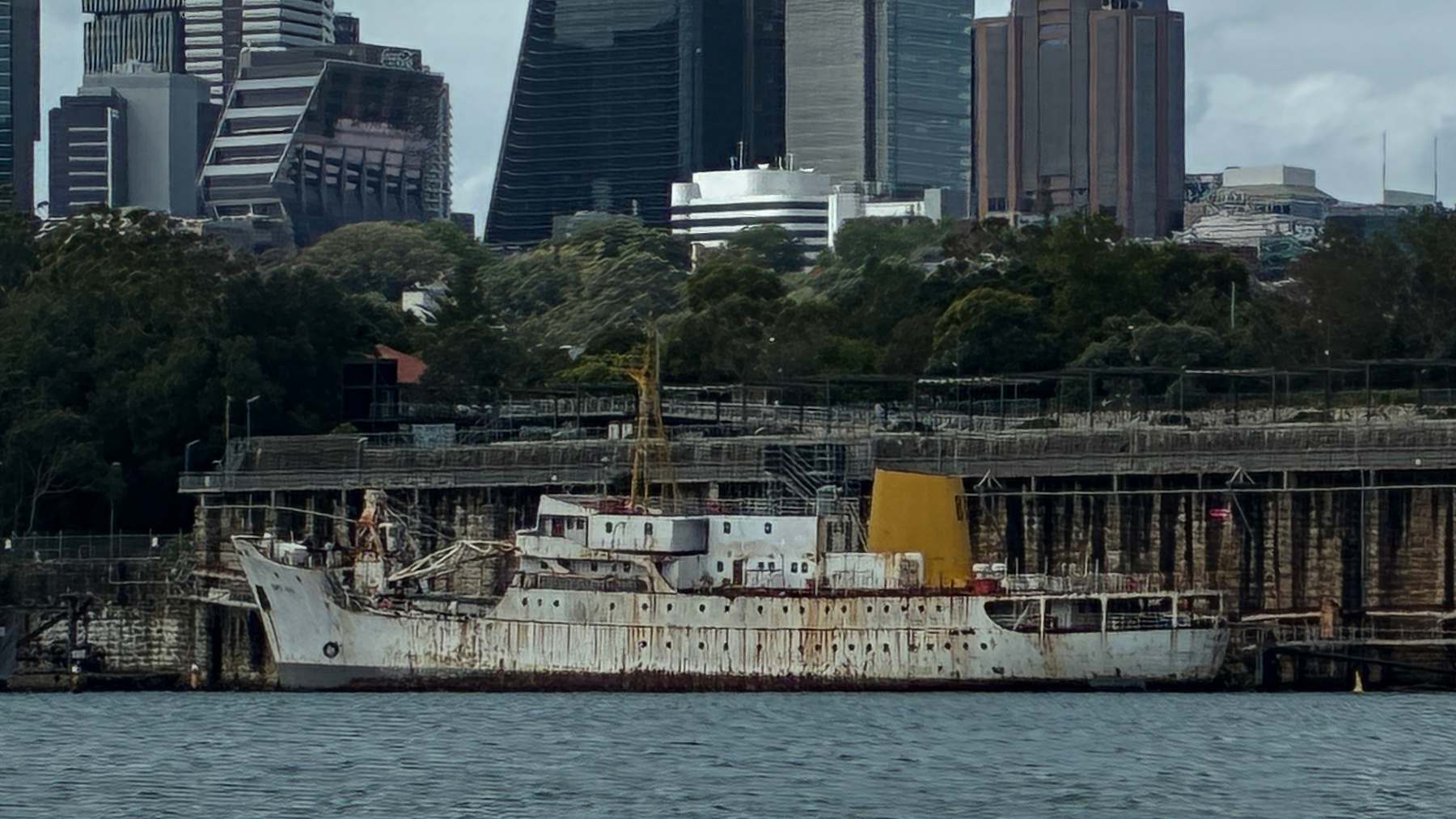

There’s a kind of boat you’ll find in pretty much every working harbor on Earth. It’s old, somebody loves it, it hasn’t moved under its own power in years, and everyone else who uses that harbor quietly assumes it’s going to sink one day. Sydney’s version is a 250-foot lighthouse tender called the Cape Don, and after more than 20 years tied to the same wharf, the state of New South Wales has decided it’s done waiting.
Water police boarded the ship at Balls Head, on Sydney’s lower north shore, on Tuesday, October 13, to make sure nobody was living aboard, and a seizure notice went up on the hull, according to the Sydney Morning Herald. The state’s roads minister, Jenny Aitchison, followed with a formal announcement on October 18 that NSW Maritime had taken the vessel and would dispose of it. The charity that owns her says she isn’t in any danger of sinking and intends to appeal.
So who’s right? That depends on which half of the ship you’re looking at, and I’ll get to that.
So what is a lighthouse tender, anyway?
If you’ve never heard the term, a lighthouse tender is the supply ship for the lighthouses. Before GPS, a coastline the size of Australia’s needed a lot of lighthouses and buoys, and somebody had to keep them fed. The Commonwealth Lighthouse Service ran three ships for that job, and the Cape Don was the first of them, launched from the State Dockyard in Newcastle, New South Wales, in May 1962 and in service from 1963. She’s 250 feet long, 42 feet across the beam and weighs in at about 2,140 tons, according to the Australian Register of Historic Vessels. There’s a crane on the foredeck for hauling buoys aboard, workshops below, and a spot on the port side for a LARC, which is basically an amphibious truck for landing gear on islands that don’t have a dock. Her patch ran from Esperance on the south coast of Western Australia all the way around the top of the country to the Gulf of Carpentaria, a stretch with huge tides and not many people.
She did some odd jobs, too. In 1973 her crew found and recovered two anchors off Esperance that Matthew Flinders had lost from HMS Investigator in 1803, the sloop that made the first lap around Australia. The register lists her as the only lighthouse supply ship left in the country.
She came out of service in 1990, got sold, got renamed, and spent a decade or so hauling passengers and cargo around the Solomon Islands and the South Pacific, as the Maritime Executive tells it. Then she came to Sydney, where the Sea Heritage Foundation took her on in 2004 and parked her at the old coal loader wharf at Waverton. She’s been there ever since, as a museum and a classroom. TAFE NSW, the state’s vocational college system, has run maritime and hospitality courses on board.
And that’s the whole problem, really. If you’ve ever owned anything made of steel that lives near salt water, you already know how this goes: a ship that sits still for 20 years doesn’t stop rusting just because somebody loves it.
The state says the hull has holes in it
NSW Maritime’s version goes like this. It’s been watching the ship deteriorate for several years. In June 2025, a day after the Herald started asking questions about her, the agency issued the foundation an unsafe vessel notice under section 46 of the state’s Marine Safety Act, and later a second one. Those notices ordered the owners to make repairs where she sat and to line up a dry dock for major hull work. Nearly 50 formal meetings followed. The state says recent inspections found severe corrosion along the waterline, and the Herald reports that a naval architect and an independent expert found the hull rusting and pocked with holes the size of a football. The ship hasn’t been in a dry dock for more than two decades, so nobody at NSW Maritime knows what the hull looks like below the water, and the agency calls that an unacceptable risk.
Aitchison’s release didn’t dress it up: “this is a last resort.”
Then there’s the money. The state figures that if the ship sinks or rolls over at the wharf, raising her and cleaning up whatever leaches out would cost around A$15 million, roughly $10.5 million in US dollars, and that seizing her now saves taxpayers that bill. That isn’t a hypothetical in this particular spot, by the way. On New Year’s Day 2022, the Baragoola, a 99-year-old former Manly ferry moored right beside the same coal loader, took on water and went down at her mooring, and 72 days later a local salvage operator was still photographing oil sheens on the surface, according to Baird Maritime. Same wharf, same basic story: a beloved old boat, decades of plans and not enough dry dock.
A community group called Save Our Sydney Harbour has been pushing the state for years to clear out what it calls a graveyard of derelict vessels, and its convener, Stuart King, told the Herald the seizure was a big step forward. His line on the whole thing is pretty hard to argue with: “It shouldn’t fall to the taxpayer to deal with these passion projects.”
The owners say the hull below the waterline is fine
Now the other half. The Sea Heritage Foundation put out its own statement on October 17, and it doesn’t dispute that the ship needs a dry dock. It disputes pretty much everything else. The foundation says the Cape Don has had three underwater inspections and several surveys above the waterline, that the underwater hull is sound, and that specialist contractors have already done hull repairs, pulled the fuel oil off the ship, and installed automatic pumps with alarms and cameras that run around the clock. Its chair, Dr. CJ Manjarres-Wahlberg, told the Daily Cargo News that the hull below the water is protected and looks nothing like the hull above it.
Which is a pretty specific claim, and one you could check with a dive team and a camera.
The foundation also says an independent assessment it commissioned in August concluded the ship could be towed to Garden Island, the navy base across the harbor, and put into Captain Cook Dock for permanent repairs, pending final approvals. The catch is that Captain Cook Dock belongs to the Australian Defence Force, so the foundation has been waiting on the navy’s calendar. What it wants from the minister is an independent review before anything irreversible happens, and it has asked Transport for NSW to show its math on the $15 million. Manjarres-Wahlberg’s argument boils down to one line from that statement: a decision like this should rest on professional evidence, “not on how a vessel looks from the water.”
And frankly, that’s a fair point as far as it goes. A ship can look terrible topside and be perfectly tight below, because the plating above the waterline takes sun and rain and nobody’s paying to paint it, while the hull underneath gets looked at by divers. But the reverse happens too, and the state’s whole case is that it can’t see the bottom either. Three underwater inspections arranged by the owner and a 20-year gap since the last dry docking can both be true at the same time. Which is more or less why dry docks exist.
So who tows a ship that’s too fragile to tow?
This is where it gets interesting for anyone who likes watching big objects get moved. The state has said contractors will begin disposing of the vessel in the near future, and that’s as specific as it has gotten. NSW Maritime hasn’t said whether that means a tow to a scrapyard, cutting her up where she sits, or something else, and I can’t find any announcement that names a destination. King, from the harbor group, told the Herald the ship is widely considered too fragile to tow to a scrapyard, which would make this a delicate and probably expensive job either way.
You may be wondering why a government in a hurry to get rid of a ship wouldn’t just let the owners tow it to the navy dock, since both sides apparently agree she has to leave the wharf. The honest answer is that the two tows end in very different places. The foundation’s version ends with the ship coming back restored, on a date the navy sets. The state’s version ends with her gone, on a date the state sets, and after nearly 50 meetings the state apparently stopped believing the first version would ever happen. Aitchison’s release says as much, calling the owners’ chances of restoring her untenable.
We’ve covered a couple of these lately. The Savannah, the world’s first nuclear merchant ship, is running out of time in Baltimore for similar reasons: volunteers, a plan, and a government that owns the clock. And Britain’s HMS Protector came home on a tow line this month while the ship she replaced sat tied up for seven years before a tug finally took her away for scrap. Old ships rarely get a dramatic ending. They get a meeting, then another meeting, and then a tug.
The Sea Heritage Foundation’s chair told the Sydney Morning Herald the charity intends to appeal the seizure notice. On the other side of it, Transport for NSW Maritime’s executive director, Nicole Watts, said in the October 18 release that the Cape Don had been formally seized that day and that contractors would start the disposal process in the near future.
Image Credit: commons.wikimedia.org