
- 2 MONTHS AGO · MILITARYA 19-foot American drone submarine rated for 19,700 feet sat dead in the water for more than a day at the mouth of the Strait of Hormuz, where the bottom runs 200 to 330 feet, until Iranian naval forces hauled it in, and the man who built it posted “rest in peace, little buddy”
- 2 MONTHS AGO · MILITARYA 115-pound underwater drone runs like a torpedo on two tail thrusters and spins a third pointing straight down to stop and hover over anything shaped like a mine, and the Spanish Navy launches the 5.2-foot machine from small boats so a diver doesn’t have to go down first
- 1 MONTH AGO · MILITARYAn American hypersonic missile left a shipping-container-style box on the back of a military truck in the first photo of its ground version, and the Army wants it firing from the same pods HIMARS loads, with the Pentagon ready to buy at least 500 a year once testing ends
- 3 HOURS AGO · MILITARYA 30-foot underwater drone, a compact experimental hull much smaller than the fiber-optic boat from the same yard, went into the water for the first time at a Taiwanese harbor on Wednesday, with no prior official announcement, to test autonomous navigation and modular payloads
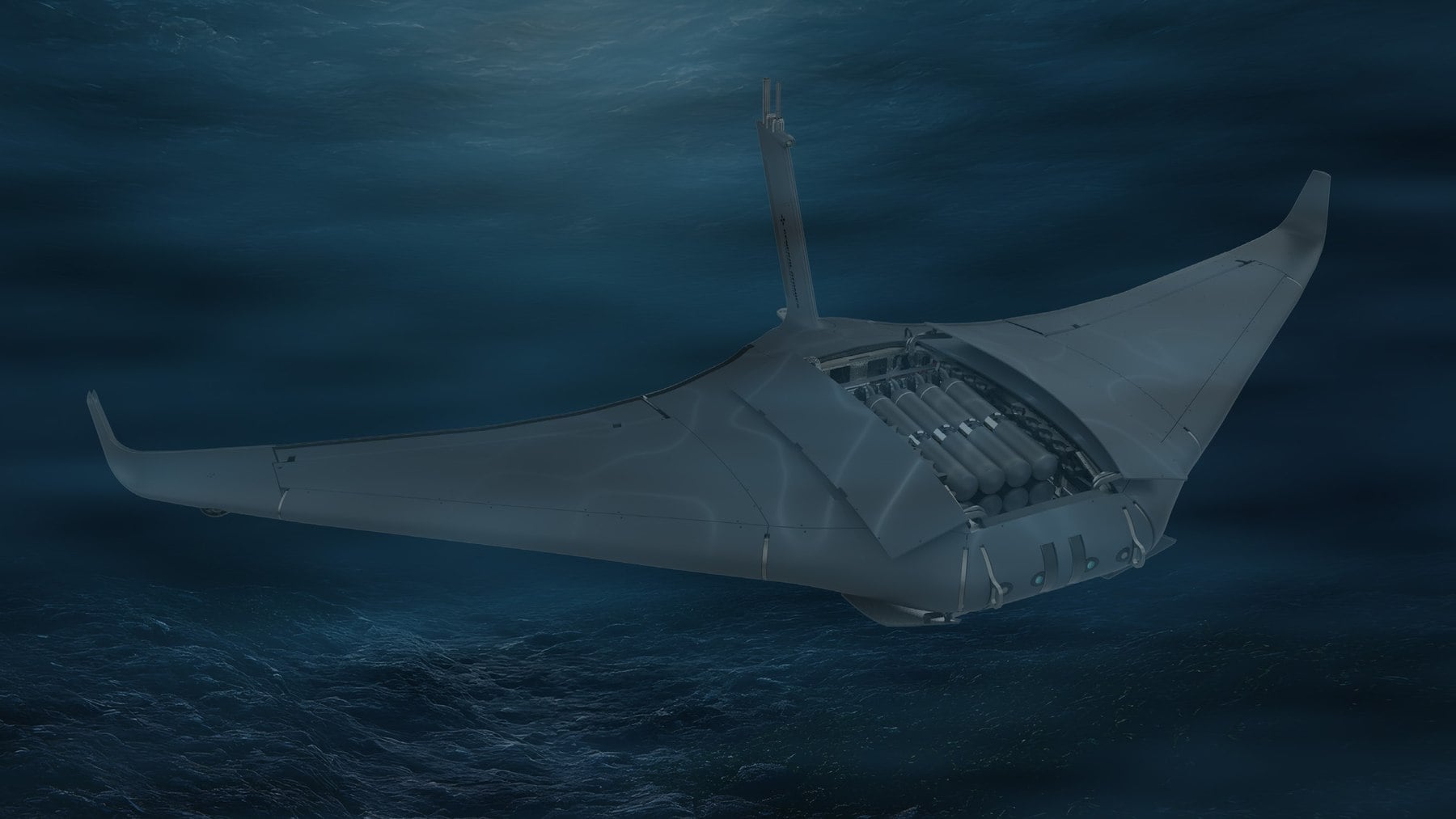
- TODAY · THIS ARTICLEA 22-foot underwater drone shaped like a stingray glides by sinking and rising, its American builder says tests have kept its drones submerged for up to 70 days, and the next version it wants is over 100 feet long, built to carry up to 96 smaller drones and stay out for years
Ask anyone who flies a camera drone what ends the fun, and you’ll get pretty much the same answer every time. The battery runs low, and the drone has to come home.
Underwater drones have the same problem, just with extra steps. There’s no backyard to land in down there and no quick battery swap, so somebody has to go out on a boat and haul the thing back up. Which is why a test program that kept drones submerged for up to 70 days caught my eye this week.
The company behind it is General Atomics, the San Diego defense group whose aviation arm builds the Predator and Reaper aerial drones. Its Electromagnetic Systems division (GA-EMS) put out a video of two underwater gliders to coincide with the Euronaval defense show in Paris, Army Recognition reports.
One of those gliders exists, and the other’s still a design, a pretty ambitious one at that.
The one that’s real is GA-Ray (GRay on General Atomics’ data sheet), a 22-foot glider that falls into what the company calls the large displacement UUV class and is built for missions lasting weeks or months. UUV stands for unmanned underwater vehicle, which is basically Navy-speak for underwater drone. According to Baird, it’s being used to cut down risk, work out the concept and release smaller drones.
The other is Ranger, an extra-large UUV that would measure 100 to 135 feet and stay out for years. It’s a planned vehicle, not a hull in the water.
So how does a drone glide underwater?
Gliders don’t really drive anywhere. They change their buoyancy so they sink, then change it again so they rise, and their wings turn that up-and-down bobbing into forward motion. Think of a paper airplane that can also fall upward.
It’s slow, but it uses very little power, which is why gliders have been doing ocean science and Navy sensor work for years. We wrote about 19 of them flying at once in a NATO exercise off Portugal back in September, and those were the classic shape: a torpedo with small wings.
GA-Ray isn’t built like that. It’s a blended wing, where the body and the wings merge into one flat shape, a bit like a stingray. The company told Baird Maritime the layout gives it more room inside for payload and makes it slip through the water more efficiently. It isn’t a pure glider either. Baird and Naval News both say the vehicles back up the buoyancy system with thrusters and control surfaces designed specifically for it.
That makes sense to me. A pure glider is pretty clumsy whenever it has to hold a spot or line up with something, and I’d imagine a host drone that releases smaller drones has to do a lot of both.
So which drone spent 70 days underwater?
GA-EMS’s vice president for maritime programs, Rolf Ziesing, told Baird Maritime that the company’s submerged tests have run as long as 70 days, mimicking the kind of missions these gliders are meant for. He gave Naval News the same figure at Euronaval.
This is where I have to be a little careful. That 70-day figure is the longest run, not the length of every test. Neither outlet says which vehicle stayed down that long. What Ziesing did say is that the host glider carries a smaller payload drone the company also developed, and that GA has operated both of them at sea. Baird’s own summary puts the host and that payload drone together in those tests. GA-Ray is the host General Atomics has actually built, but none of the coverage pins the 70 days on it by name, and GA hasn’t said where or when the tests took place.
The smaller drone has a trick of its own. The presentation included video of a quadcopter popping out of a tube on one of its smaller UUVs during a deployment test, so in theory one of these gliders could put an aerial drone in the sky with no ship anywhere nearby. Nobody’s released specs for that quadcopter yet.
Frankly, the slow-and-steady approach makes more sense to me than trying to cram a bigger battery into a torpedo. You’re trading speed for time on station, and for a lot of Navy jobs, more time on station is exactly what you want.
The 100-foot version is still a design
Ranger’s where General Atomics thinks big. The data sheet lists it at 100 to 135 feet with multi-year endurance, and Ziesing described one variant with a 98-foot wingspan. For scale, Boeing’s Orca, the Navy drone submarine that drove itself more than 1,000 nautical miles across the Pacific, is 85 feet long. Its cargo bay would be roughly the size of a CONEX box, the steel shipping container you’ve seen stacked on trains and trucks, and Army Recognition compares one cargo layout with a standard 20-foot container.
What goes in that bay depends on the variant. Naval News reports the payload can range from 16 to 96 smaller underwater drones, and Ziesing told Baird the big glider could carry two large displacement UUVs instead, the same class as GA-Ray. It could also drop off a container-style payload to stay on station, or settle on the seabed and open a top door to release whatever it’s carrying.
Range is where the sources wobble a bit. GA’s data sheet puts endurance at a five-figure number of nautical miles, depending on how the vehicle’s configured, while Naval News has Ziesing measuring it in years, or in kilometers instead of nautical miles. General Atomics hasn’t published a weight, a diving depth or a cruising speed for either glider, which is a bit frustrating when you’re trying to picture a 135-foot drone that mostly sinks and floats.
So who would actually use one?
Nobody’s announced a customer or a contract yet. General Atomics ties the family to the Navy’s planned Hedge Force, the autonomous-systems strategy announced by Chief of Naval Operations Adm. Daryl Caudle, and says the gliders could take over some missions that nuclear attack submarines handle today. A concept graphic in the presentation shows them launching from Okinawa and Guam.
Basically, the pitch is that a glider does the slow, patient watching and listening, and a crewed submarine goes off to do something else.
I’m a little skeptical about the full submarine-replacement idea. Gliders are slow by design, and I’d guess anything that needs to get somewhere fast will still need a sub. But if you just want to park sensors somewhere for months at a time, it looks pretty sensible.
Ziesing told Naval News at the show that there’s “a lot of interest” in the program. General Atomics released its video of both gliders on November 3, the day Euronaval opened in Paris.
 A 600-ton drone warship slid into the water at a Korean shipyard on Thursday, built to scout and watch at sea, and after trials in local waters it is due in the United States early next year for more testing aimed at the Navy’s growing unmanned fleetMilitary · 19 hours ago
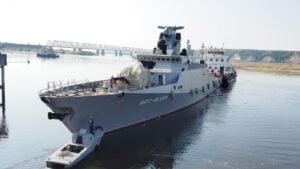 A 243-foot missile corvette armed with eight vertical launch cells for cruise missiles was struck by drones in the Gulf of Finland, Ukraine’s security service said, as the same overnight raid set oil tanks on fire at a Baltic export portMilitary · 1 day ago
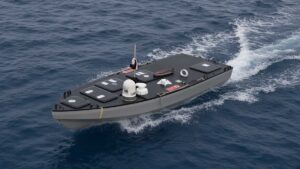 A 16-foot kamikaze drone boat weighing about 1,100 pounds went from first sketch to sea trials in six months, designed by the French government’s own engineers at a lab that normally builds scale models of warships, and because the state owns the plans, any shipyard can now be handed themMilitary · 1 day ago