
Hydropower has a reputation as the easy renewable. You don’t buy fuel, the river does the work, and the dam just sits there for 50 years. The catch is that rivers have things living in them, and every October in Maine, a few million of those things need to get past the dam in one piece on their way to the ocean.
On Saturday, October 10, a lot of them didn’t.
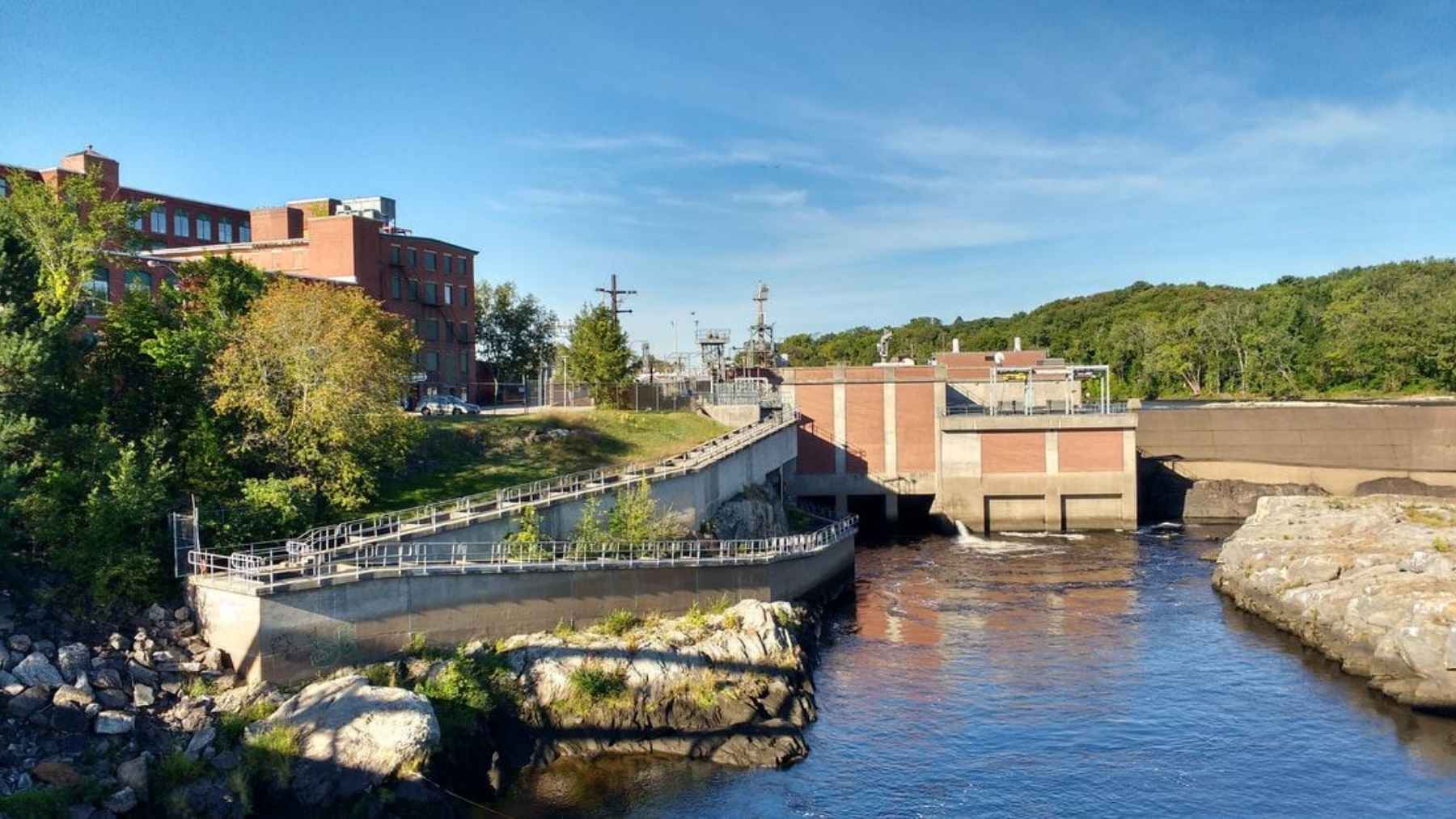
The dam in question sits on the Androscoggin River between Brunswick and Topsham, about 6 miles up from the sea. It’s the first dam the river hits coming inland, which means every migratory fish in the watershed has to deal with it twice: once on the way up to spawn, once on the way back down. It’s rated at 19 megawatts, which works out to about 90,000 megawatt-hours a year, or power for roughly 13,000 homes, and it belongs to Brookfield Renewable, the biggest dam owner in the state. The powerhouse holds three turbines, one 12-megawatt unit and two at 3.765 megawatts each, and together they can swallow 7,475 cubic feet of river every second.
That last number is the whole story, so hang on to it.
So what are alewives, and why were a million of them in the river?
Alewives are river herring, a silvery fish about the size of your hand. The adults swim up from the Gulf of Maine every spring to spawn in lakes and ponds, and the young they leave behind spend the summer growing before heading downstream to the sea in the fall. They’re basically the lunch of the Gulf of Maine. Cod, striped bass, seals and ospreys all eat them, lobstermen buy them by the barrel for bait, and that’s why Maine spends real money trying to get the runs back.
Upstream of Brunswick is Sabattus Lake, and Brookfield says it was told on Friday morning, October 9, that crews were about to lower the lake for the season. Dropping a lake flushes the young herring out of it and down the river, all at once. The company’s protocol for that situation, according to spokesman David Heidrich in an email to the Portland Press Herald, is to shut the turbines down overnight so the fish can go through the spillway instead of the machinery.
So far, so sensible. Then one turbine came back on.
Four hours on a Saturday
Brookfield’s own account, given to WGME, is that a single turbine ran for four hours on Saturday. By morning, dead herring were lining the rocks along Water Street in Brunswick, below the bridge. Chip Spies, who founded a local group called Free the Andro, walked a short stretch of bank and did the math out loud for the station: about 30 fish per yard, so roughly 3,000 fish in that one stretch. Nobody has published an official count, so if you see “thousands” in a headline, including this one, that’s a conservationist’s estimate and not a company figure.
The company’s response was to turn everything off. Heidrich said staff saw the dead fish on Saturday morning, shut down generation completely and were still offline as of October 13 “to support the estimated 1 million migrating herring.” That’s days of zero output from a 19-megawatt plant to let the rest of the run go by.
Why did the turbine come on in the first place? That’s the question WGME asked Brookfield, and as of this writing the company hasn’t answered it, which frankly is the one thing I’d want explained. Ed Friedman, who chairs Friends of Merrymeeting Bay and has been filing complaints about this dam for a decade, offered the uncharitable version: maybe somebody got confused about when the fish move. Eels migrate at night, pretty much exclusively. Young herring don’t keep those hours, and a night shutdown with a daytime restart isn’t going to help a fish that’s already in the water at 9 a.m.
What a turbine actually does to a fish
You might picture a blender, and that’s partly right. Some of the fish get hit by the blades, and a propeller turbine this size spins fast enough that a strike takes the head off. But the pressure is arguably the bigger killer. Water goes into the intake at one pressure and comes out the draft tube at a much lower one, and a fish with a swim bladder full of gas goes through that drop in a fraction of a second. The bladder expands and bursts. Friends of Merrymeeting Bay described the fish it found as killed by decapitation, blunt strikes and pressure, which lines up with every turbine kill I’ve read about, and there’ve been a few.
A fish isn’t supposed to be in the turbine at all, of course. Brunswick has a dedicated downstream bypass for that. The problem is where it sits, and you can see it from the bridge. Brookfield’s own report to federal regulators describes the bypass as a trashrack-covered sluice right next to the intakes for Units 2 and 3, and Friends of Merrymeeting Bay has told the regulators for years that it amounts to an 18-inch pipe between the turbine bays. The trash racks in front of the turbines have 3.5 inches of clear space between the bars. A juvenile herring is a lot thinner than 3.5 inches.
Which means that when a unit is running, a fish coming down the river has a choice between a pipe pulling a trickle and an intake pulling thousands of cubic feet a second, and it’s not really a choice. The night shutdown exists because the company and the state figured this out a long time ago. It goes back at least a decade, to an earlier kill at the same dam, after which Brookfield told the same TV station it would stop the turbines after dark.
The fish ladder isn’t doing much better going up
This is the part that turns a bad weekend into a relicensing fight. The upstream fishway at Brunswick is a vertical slot ladder from the early 1980s: 42 pools, each 8.5 by 10 feet, connected by 11-inch slots with a 12-inch drop between them. It’s been there since the powerhouse opened in 1983, and it was built, by the federal numbers quoted in filings on the project, to pass 85,000 American shad and a million river herring a year.
Shad haven’t shown up in anything like those numbers. Free the Andro told the Brunswick town council that sonar showed as many as 10,000 shad holding below the dam, and 14 of them made it through the ladder in all of 2023, then 91 in 2024. Friends of Merrymeeting Bay puts the total at 350 shad over the ladder’s first 33 years.
Brookfield’s own study is, if anything, more blunt. A 2022 telemetry study by Normandeau Associates tagged shad below the dam and found that 2.4 percent of them even entered the attraction flow at the ladder entrance, and none of them went in. River herring did better, with a 37.5 percent entrance rate and a third of those making it up the inside. The ladder pushes 100 cubic feet a second out its mouth to attract fish. The federal design guideline says it should be closer to 375, or 5 percent of what the powerhouse can pull, and Brookfield’s engineers write that even the fixes they’ve sketched won’t get there.
There’s an anecdote in Brookfield’s report that I keep coming back to. A member of Free the Andro who has worked with Bowdoin College students on the dam told the company’s engineers that one year, when Unit 1 was shut down for maintenance, about 1,000 shad went up the ladder, one of the best counts anyone has seen. Turn off the big turbine and the fish find the door. That’s pretty much the whole problem, going up and going down, and you don’t need a telemetry study to see it.
So what happens now?
Brookfield’s license on the dam was issued in February 1979 and runs out on February 28, 2029, and the company’s in the middle of applying for a new one. That’s the reason a 19-megawatt dam has been getting so much attention from two small Maine towns. The Federal Energy Regulatory Commission gets to decide what conditions come with the next license, and the menu on the table ranges from patching the existing ladder to a new fish lift to a nature-like channel around the whole structure. Friends of Merrymeeting Bay filed a complaint with FERC on Monday, October 12, arguing that any passage that depends on a person remembering to flip a switch is going to fail eventually, and that removing the dam has to be studied alongside the rest. Friedman told WGME he’d like to see it come down. Spies, for his part, wants to see what the company can build first.
I’ll admit the honest answer to “why did the turbine come on” might be boring, and you’re probably not going to get it from a press release. Somebody may have followed a schedule that said overnight and read it literally. But a 19-megawatt plant that has to go dark for days every time the fish move is, from the looks of things, a plant whose fish passage doesn’t work, and the company’s own engineers more or less say so in their report. There are turbines built so fish can go through them and live, like the reshaped runner that put 112 sturgeon through a spinning blade and lost one, and there are plants that kill fish by switching off, like the Minnesota reactor whose outage froze a bass tournament. Brunswick protects its fish mainly by not running, which is a pretty expensive way to do it and apparently still not foolproof.
Brookfield’s Phase 1 report on upstream passage alternatives went to FERC in August 2026, and the company’s spokesman told the Press Herald it was still reviewing what happened on the weekend of October 10 with state and federal agencies.