
- 2 MONTHS AGO · MILITARYA Danish drone boat sitting at anchor in the Baltic filmed a 330-foot Russian corvette running past at 650 feet with its transponder off, tagged the crew and the helicopter on the pad, and got the quadcopter wrong, from a hull 39 feet long that travels on a trailer
- 1 MONTH AGO · MILITARYA 38-pound underwater drone holds still against the current on seven thrusters, fires a demolition charge into a sea mine hard enough to stick, then backs away paying out the firing line — everything comes home except the charge, and Ukraine has already used it in combat
- 4 WEEKS AGO · MILITARYAn 18,750-ton submarine, the biggest America ever built, came home for the last time after firing in the strikes on Iran, and the week she tied up the Navy signed for nine attack submarines that haul 40 cruise missiles apiece, four of them to match the 154 she carried alone
- 2 WEEKS AGO · MILITARYA German listening network of three shore stations and two buoys heard underwater drones slip into a Portuguese fishing port on night raids and had a drone boat classified 30 seconds after picking it up, then pieced together a real crash when a fishing boat hit one of its buoys
- TODAY · THIS ARTICLEA 243-foot missile corvette armed with eight vertical launch cells for cruise missiles was struck by drones in the Gulf of Finland, Ukraine’s security service said, as the same overnight raid set oil tanks on fire at a Baltic export port
For most of this war, if you read about Ukrainian drones going after a Russian warship, that ship was somewhere in the Black Sea. The Baltic Fleet, based a long way north around St. Petersburg and Kaliningrad, has mostly been a background character.
That may be changing. Ukraine’s security service, the SBU, says it “planned and carried out” a strike on a Russian missile corvette called the Naro-Fominsk on the night of November 10 to 11. According to the SBU, that strike was part of a much bigger drone raid on Ust-Luga, an oil and gas export port on the Russian side of the Gulf of Finland.
If you haven’t run into the SBU before, it’s Ukraine’s main security agency, so on paper it’s closer to a domestic intelligence and counterintelligence service than a navy. In practice, it’s also run plenty of Ukraine’s long-range drone strikes inside Russia, including the Ust-Luga half of this raid.
The SBU’s post on Telegram is pretty light on the ship itself, though. It doesn’t give a position or a time for the hit. The damage is a blank too, including whether the corvette can still sail and fight. The Ukrainian word the agency uses means a hit, not a sinking, and that’s where I’m staying. No photo or video of the ship strike came with the post, either.
A few English-language write-ups went further and called the ship destroyed. The SBU’s own post doesn’t say that.
So what exactly is a Buyan-M?
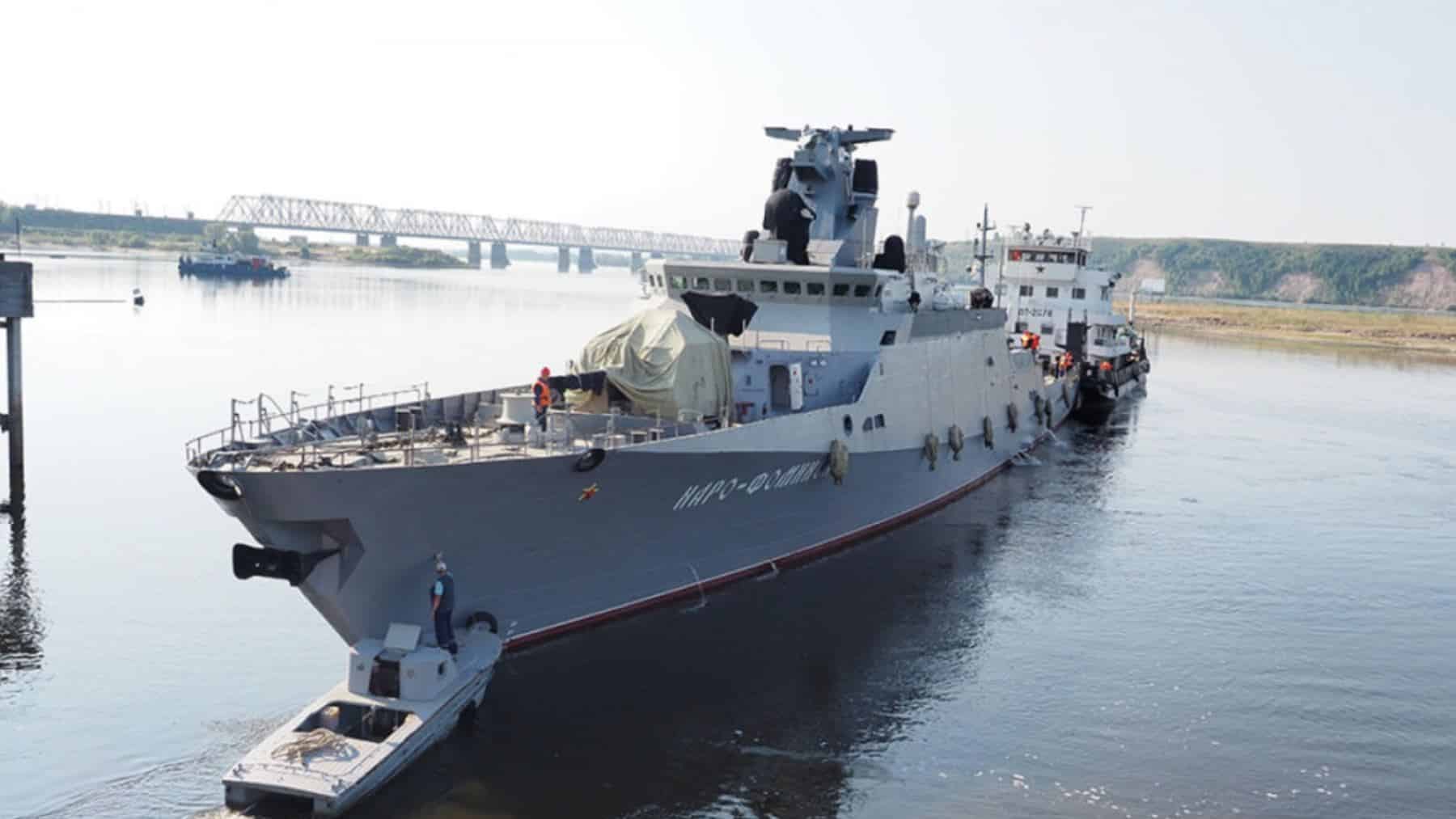
The Naro-Fominsk is a Project 21631 small missile ship, usually called by its class name, Buyan-M. It’s 243 feet long and about 36 feet wide, displaces about 1,050 tons fully loaded, and draws about 8.5 feet of water. By warship standards, that’s small.
Basically, Russia’s idea with these ships is to put a big punch on a small, shallow hull. The Naro-Fominsk carries one eight-cell vertical launcher, the 3S14, which can fire Kalibr land-attack cruise missiles or Oniks anti-ship missiles. If you’ve followed this war at all, you’ve heard of Kalibr. Russian ships have been launching it at Ukrainian targets for years.
The SBU describes the ship as a Kalibr and Oniks carrier. Being able to carry them and carrying them that night are two pretty different things, and nobody has said what was in the launcher.
Then there’s everything else on deck: a 100mm A-190 gun, a 30mm AK-630M-2 Duet close-in gun, and Gibka launchers for Igla-1M short-range missiles. That’s frankly a lot of hardware for a ship with a crew of 52.
The ship came out of the Zelenodolsk shipyard in Tatarstan, where its keel was laid on February 23, 2018. You’ll see some reports saying it was commissioned in 2022, but the SBU’s original Ukrainian says launched, which lines up with the Russian Defense Ministry’s launch announcement on December 9, 2022. It entered service on December 25, 2023, according to the russianships.info registry.
So who has actually confirmed anything?
You have to keep three separate stories apart here, because they aren’t the same confirmation.
Estonia’s defense minister, Martin Herem, told Estonian public broadcaster ERR that an explosion happened on a Russian Baltic Fleet ship in the Gulf of Finland at around 5:30 a.m. local time on November 11. He said smoke came from the ship afterward and that it turned back toward St. Petersburg. He was also careful about the cause: “Whether Ukrainians are behind this attack or some accident happened there, we can’t confirm.” He didn’t name the ship.
Finland’s version came in two pieces. A senior Finnish official confirmed to Yle that Finland picked up an attack near Gogland, a Russian-held island the Finns call Suursaari, about 25 miles south of Finland and 34 miles north of Estonia. Finland’s Defense Forces also restricted sea and air traffic in the gulf’s eastern end for a while as a precaution.
Then Brig. Gen. Markku Viitasaari, director of national defense at Finland’s Ministry of Defense, told Helsingin Sanomat that Finnish sensors caught flashes and smoke coming off the ship while it was in international waters. Apparently, the Finns first figured it was shooting at drones. Later sensor readings pointed to at least one explosion on board. Finland hasn’t said who did it or with what, and it didn’t name the ship either.
And Russia? Leningrad region governor Alexander Drozdenko confirmed a fire in the Ust-Luga port area after a drone attack, three injured workers, and 150 drones shot down over the region that night. Russia hasn’t confirmed a hit on the Naro-Fominsk by name.
So is the ship Estonia and Finland saw the Naro-Fominsk? Probably, but that’s me connecting the dots, not an official doing it. Telegram channels, Exilenova+ among them, are also claiming crew casualties. I can’t verify that, so I’d treat it as a rumor for now.
UNITED24 Media says defense analysts describe this as “the first Ukrainian attack on an operational Russian warship at sea in the region” since the full-scale invasion began. The qualifiers matter there. UNITED24’s own list of earlier Baltic Fleet hits includes a sister Buyan-M, the Serpukhov, damaged at the Baltiysk naval base in 2024, plus the corvette Boikiy in a Kronstadt dry dock.
If a Russian corvette in the Baltic sounds familiar, that was a different ship. In September we covered a 39-foot Danish drone boat that filmed a 330-foot Russian corvette cruising past it. Nobody hit anything that time.
Ust-Luga was burning the same night
The Ust-Luga half of the raid is better documented. The SBU says drones from its Alpha special operations center hit the Novatek-Ust-Luga terminal, damaging several tanks that hold about 33,000 tons each and causing a fuel spill. It also says tanks at the Ust-Luga Oil terminal were damaged and caught fire, and that fires broke out at the Faktor terminal and the Luzhskaya railroad station.
Ukraine’s General Staff added its own preliminary list: five petroleum product tanks with about 940,000 barrels of combined capacity, a hydrocracking unit that caught fire, an air-cooling unit, a pumping station, and a tanker-loading pier.
A hydrocracker, if you’re wondering, is the refinery unit that uses hydrogen, heat and high pressure to break heavy oil down into lighter fuels like diesel. It’s generally one of the more expensive units at a refinery.
On the Russian side, Drozdenko reported an emergency shutdown at a transformer substation. One of the three injured workers went to the hospital in satisfactory condition, and the other two declined, according to regional official Nikita Dontsov.
The raid spilled over borders a bit, too. Herem told ERR that some drones briefly crossed into Estonian airspace, and that NATO fighters were airborne during the attack but didn’t shoot any down. The SBU, meanwhile, says it’s still checking reports that Russian combat helicopters were destroyed that night.
Drones and hulls have had a busy few weeks elsewhere, too. Off Bulgaria, a 19,960-ton container feeder sank after three drone-boat hits, in an attack nobody has officially claimed.
Back at Ust-Luga, Drozdenko said on November 12 that the fire had been localized and that air in nearby villages tested within normal limits.
Credit: militarnyi.com
 A 16-foot kamikaze drone boat weighing about 1,100 pounds went from first sketch to sea trials in six months, designed by the French government’s own engineers at a lab that normally builds scale models of warships, and because the state owns the plans, any shipyard can now be handed themMilitary · 3 hours ago
 A 6,900-ton nuclear attack submarine at Norfolk pushed a 19-pound underwater drone out of a flooded 21-inch torpedo tube so sailors could run underwater inspections from inside the boat, using a 3D-printed resin housing instead of a temporary alteration that costs 200 times as muchMilitary · 1 day ago
 A 1,123-foot aircraft carrier with eight defueled reactors is under tow from Newport News to Mobile, where a scrapyard will cut the hulk apart around those reactors over the next four years while a 100-yard safety zone moves with herMilitary · 2 days ago