
- 2 MONTHS AGO · INDUSTRYA sealed German cutting head with nobody inside and no reverse met what its contractor counts as more than 2,000 boulders under a Canadian city, up to 15 crowding its face at once. It ground every one against a cone crusher into gravel small enough for a pipe and holed through 5,600 feet later
- 1 MONTH AGO · INDUSTRYThree tunnel boring machines pushed 42-, 48- and 66-inch sewer pipes beneath a Nebraska creek, 525 feet of tunneling through wet clay held open by slurry pressure, so a 90-inch steel pipe hanging in the open air over the water could come down
- 2 WEEKS AGO · INDUSTRYA 48-inch plastic water pipe was filled with 147,000 gallons of water so it wouldn’t float in the drilling mud while a rig pulled it 2,500 feet beneath a Florida creek, and the hole was bent down first and sideways second so the pipe never flexed both ways at once
- 1 WEEK AGO · INDUSTRYA 95,000-pound valve is going into a Tennessee dam on bolts instead of rivets, because the 11-foot one it replaces was riveted to a pipe that runs 3,700 feet through a mountain and could only come out by cutting through the whole pipe
- TODAY · THIS ARTICLEA 1,736-foot tunnel with a 13-foot steel pipe inside released about 4 million gallons from a California dam for the first time, after two 11-foot cone valves opened to 10 percent, a new outlet built to hold a reservoir at 3 percent through an El Niño winter
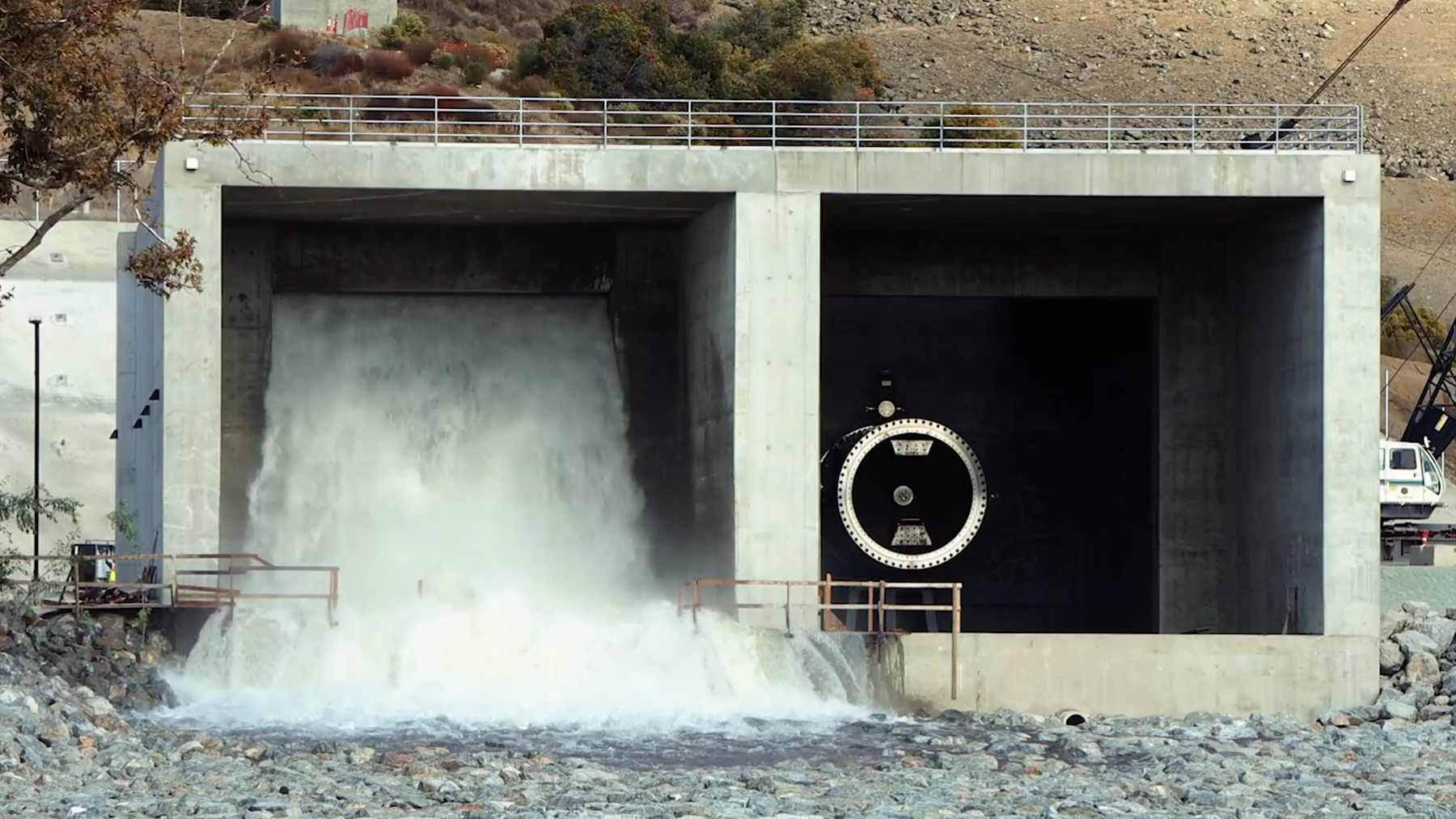
If you’ve ever moved into a new place, you’ve probably gone around turning on every faucet just to make sure water actually comes out. Valley Water did more or less the same thing on Oct. 30 at Anderson Dam in Morgan Hill, California. Its faucet just happens to be a brand-new tunnel, and the first test run sent about 4 million gallons into Coyote Creek.
That’s roughly six Olympic-sized swimming pools, according to the agency, which announced the release on Nov. 9. It’s also the first time any water has gone through the new tunnel.
We went through how that tunnel got built back in July, so I won’t rehash the digging here. What’s new is that it works. Contractors opened the tunnel’s two fixed cone valves one at a time, each to 10% of its capacity, and let the water run down into the creek.
Valley Water’s board chair, Tony Estremera, called it “a big moment and a major milestone for Valley Water and our community.” That’s pretty standard press release language, but I’d argue he’s earned it this time. Construction on the tunnel started in 2021, and the reservoir behind the dam has been sitting close to empty the whole time.
So why only 10 percent?
Why not crank the valves all the way open and see what they can do?
Valley Water hasn’t said why it picked 10% specifically. My guess is it’s the same reason you don’t floor a car you just drove off the dealer’s lot. You check that everything does what it’s supposed to before you lean on it. Testing each valve on its own fits that idea too, since you’d want to know both of them work, and not just that the pair does. Admittedly, that’s just me reading between the lines.
If you’ve never seen one, a fixed cone valve is basically the end of a big steel pipe with a cone parked in the opening and a sleeve that slides back and forth to control the flow. When it opens, the water sprays out in a wide hollow cone instead of one solid jet, so it loses a lot of its punch before it hits anything it could chew up.
And these valves aren’t small. Valley Water’s April construction update put each one at 11 feet across, at the end of a 13-foot steel pipe that runs inside the tunnel. The dam’s old outlet pipe is 4 feet wide. The tunnel’s 1,736-foot length comes from the Nov. 9 announcement, while the April update just called it more than 1,700 feet long.
What we don’t get is a number for what the outlet can move with both valves wide open. The Nov. 9 announcement doesn’t give one, so we’ll probably have to wait for a real storm to see the tunnel actually earn its keep.
Why does a nearly empty reservoir need a bigger drain?
It sounds a little backward, I know. Anderson Reservoir is already close to empty. Valley Water drew it down to 3% of capacity in December 2020 to comply with an order from the Federal Energy Regulatory Commission, according to the agency’s project page. FERC wanted the reservoir kept as low as possible until the dam is brought up to modern earthquake standards.
But rain doesn’t care what a regulator ordered. When storms push water into a reservoir faster than its outlet can let it out, the level goes up, and a 4-foot pipe doesn’t let out a whole lot. Valley Water said back in April that the 13-foot pipe would greatly increase how quickly it can empty the reservoir, and that it would let the agency dump water faster when a big storm or an emergency hits.
And this winter could get wet. Valley Water says a strong El Niño is possible, and NOAA’s Climate Prediction Center has had an El Niño Advisory in place since June. A strong El Niño doesn’t guarantee anyone a soggy winter (NOAA itself says the usual impacts aren’t a sure thing), but it does shift the odds. So the agency plans to use the new tunnel to hold Anderson at its roughly 3% limit through the rainy season, as needed.
Frankly, the timing looks pretty good. A brand-new outlet you’ve only tested at 10% isn’t exactly a full dress rehearsal, but it beats heading into an El Niño winter with nothing but a 4-foot pipe.
Anderson isn’t the only California dam that’s being kept on a short leash, either. Down in San Diego County, Hodges Dam is leaning on a 36-inch pipe to stay under the state’s cap until its spillway gets cut down.
The dam itself comes down next
The tunnel was always the warm-up act. Its whole job is keeping the reservoir under control while Anderson Dam gets rebuilt, and Valley Water says this test was the green light it needed for that work.
Getting there isn’t quick. In July, Valley Water awarded the $1.88 billion reconstruction contract to the Flatiron Dragados Sukut ADSRP Joint Venture. Next year brings more tunneling to boost release capacity, plus haul roads and temporary bridges. Then from 2028 through 2032, the dam and spillway get rebuilt, new outlet pipes go in and the seismic upgrades get done.
That’s a long time for Santa Clara County to go without its biggest reservoir. Valley Water supplies about 2 million people in the county and runs 10 dams and reservoirs, and Anderson is the biggest place the county has to store surface water. Once the rebuild’s done, the agency says the dam will be up to modern seismic standards and the reservoir can go back to full capacity.
If you live in the South Bay, you’re going to be looking at a mostly empty Anderson Reservoir for a good while yet.
Valley Water expects to finish the embankment in 2032 and wrap up restoring the site in 2033.
 A coal-era shaft that old records put at up to 180 feet deep opened under a working tram line in August, leaving the rails hanging over a void, and a roughly $2 million investigation is under way with no date given to reopen the 11 stops that are still shutIndustry · 2 hours ago
 Intake pipes are already set in the floor of a Texas lake at the end of a tunnel that runs to a 300-foot shaft, a deep intake built to send 145 million gallons a day to three cities when drought strands the floating barges they depend on nowIndustry · 5 hours ago
 A 55-foot-deep boat lock in Seattle has been pumped dry so its 800-foot filling tunnels can be scraped clean of barnacles, a job federal law requires once a year because young salmon pulled through with the water get dragged along the walls and cut openIndustry · 6 hours ago