
No one drives to a theme park for the parking lot. You put up with it at both ends of the day, and in Southern California, that usually means a long walk across hot asphalt to a car that’s been cooking since you left it.
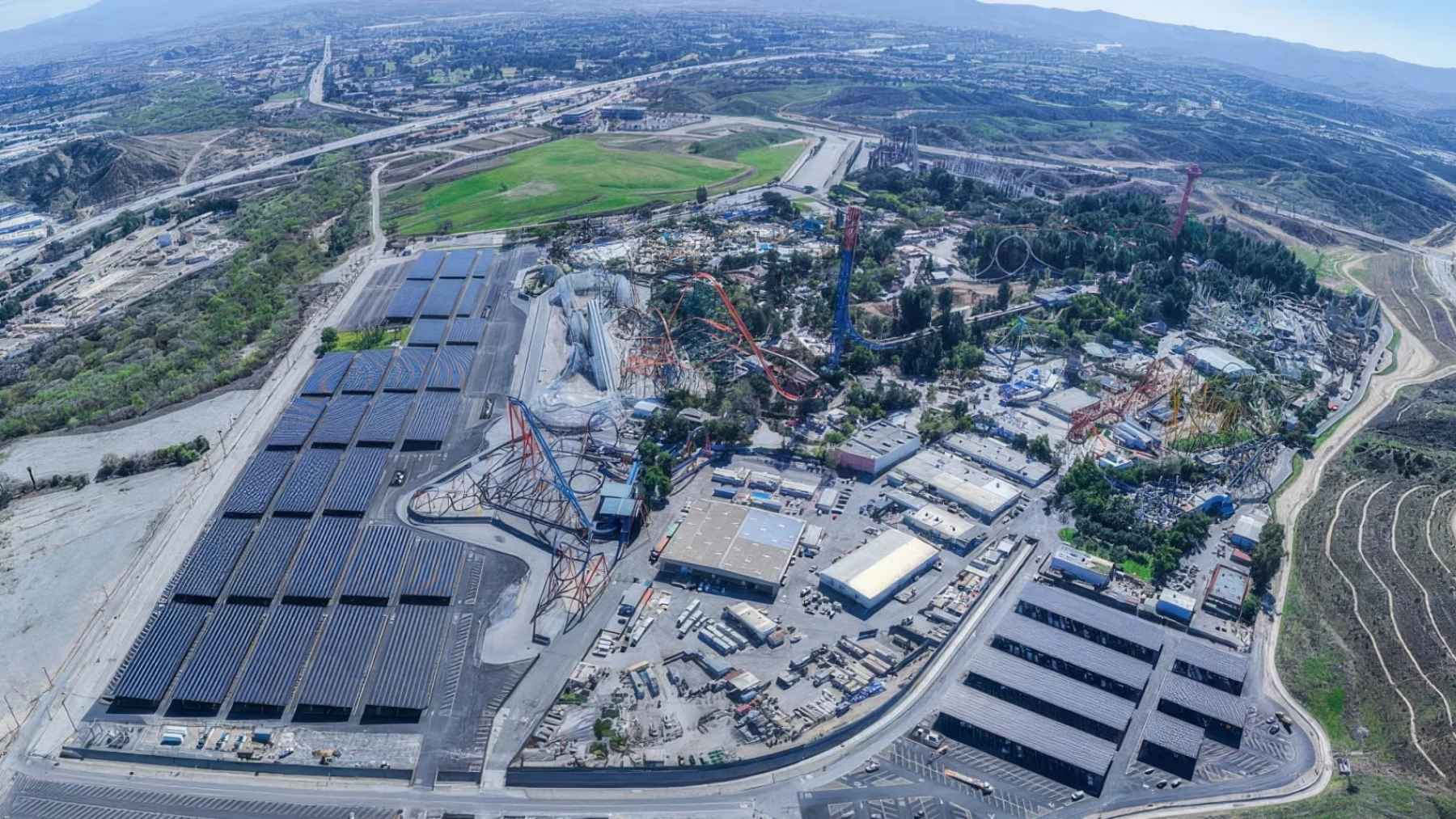
Now, Six Flags Magic Mountain thinks it’s found a fix for at least part of that. The Valencia park, north of Los Angeles, just switched on a solar carport over its parking lots, and Six Flags says it’s the biggest one in California.
The Signal, the Santa Clarita Valley’s local paper, covered the switch-on ceremony, where park president Brian Oerding pitched the shade as a perk for guests. He said it means your car won’t be scorching hot when you get back to it. Anyone who’s ever grabbed a hot seatbelt buckle in August knows what he means. Frankly, I’d bet that’s what most visitors will notice first.
The canopies cover a lot of asphalt
Six Flags says there are 22,908 solar panels up there, with 4,315 parking spaces underneath. All told, the canopy covers about 637,000 square feet. If you’re trying to picture that, it’s roughly 14.6 acres, or a little over 11 football fields if you count the end zones.
Six Flags developed the project with Solar Optimum, a solar company based in Glendale, and the panels sit on 36 long-span structures. Long-span carports generally put more distance between their support posts than standard ones do, so there are fewer posts in the way. Anyone who’s ever backed into a pole in a parking lot will appreciate that.
Each panel is rated at 540 watts. Multiply that by the panel count and you land on 12.37 megawatts, the exact figure Six Flags gives for the whole system. So Six Flags’ math checks out. I can’t say that about every press release I read.
The panels are bifacial, too. That means they make power from both sides. The front faces the sun, and the back picks up light bouncing off whatever’s underneath, which in this case is mostly cars and blacktop. Asphalt isn’t very reflective, so I wouldn’t expect a huge bonus from the back side here. People get pretty creative with bifacial panels, though, and a town utility in Germany stood 64 of them upright along a fence by a public pool’s parking lot.
So what does 100 percent actually mean?
Six Flags says the system is sized to offset all the electricity used in a year at Magic Mountain and at Hurricane Harbor Los Angeles, its water park next door. It expects the panels to make about 20.8 million kilowatt-hours a year, which it says is roughly what 2,874 homes use.
Offset is the key word there. Both parks are still hooked up to Southern California Edison’s grid. When the panels make more than the parks and the battery can soak up, the extra can go out onto the grid, and when they make less, like after dark, the parks pull power back in. Over a full year, the two flows are supposed to roughly cancel out.
Jason Freeman, a Six Flags senior VP who oversees park operations, helped lead the project, and he put it in pretty much those terms. The solar doesn’t power the park directly, he said, but it’s “feeding the meter and the meter is feeding us,” according to The Signal.
Freeman also stressed that the park is now energy-independent, according to the paper. I’d put it a little differently, since the park still leans on Edison whenever the panels come up short. Still, if the panels hit their numbers, breaking even with the grid over a full year is a pretty solid result for a place full of roller coasters.
Magic Mountain’s setup also works differently from the Disneyland Paris solar carport we covered in August. Paris has the bigger array, at 36.1 megawatts to Magic Mountain’s 12.37. But the company that built it sells everything those panels make, and the park doesn’t use any of that power directly. Magic Mountain’s panels feed the park’s own meter.
Six Flags also threw in a stat that’s about as theme park as it gets: roughly 1.5 kilowatt-hours from the panels for every ride. Divide the yearly output by that and you get just under 14 million rides a year. That sounds like it’s counting riders, not train runs, but Six Flags didn’t say.
Figures: Six Flags. Acreage and battery-hours math by AutoNotion.
There’s a battery in the mix, too
The system also includes a battery rated at 2 megawatts and 8 megawatt-hours. If those two units trip you up, think of them as horsepower and the size of the gas tank. Megawatts are how hard the battery can push, and megawatt-hours are how much it holds, so this one can run flat out for about four hours.
Six Flags only says the battery is there to improve reliability and efficiency, and it hasn’t said when it charges or discharges. My guess is that it’s mostly about the clock. Under Edison’s business time-of-use rates, power costs the most between 4 and 9 p.m., especially on summer weekdays. That’s right about when the panels start winding down, so saving some midday sun for the evening would make a lot of sense.
Then there are the chargers. Six Flags says there are 109 EV charging connectors, split between guest and employee parking. A connector is a plug, though, and some charging posts carry two, so the number of actual charging spots could be lower than that.
Six Flags hasn’t said whether they’re slower Level 2 units or DC fast chargers, or what it costs to plug in. So if you’re planning to top off your EV while you stand in line for a coaster, I’d check before you count on it.
What happens if Edison shuts the power off?
I’m asking for a reason. On October 14, Edison warned that it might cut power to almost 260,000 customers between the morning of October 15 and the night of October 16 because of wildfire risk. An Edison official told The Signal that many of them are Santa Clarita Valley customers. That’s where Magic Mountain is. I couldn’t confirm whether the park’s circuits are on that list.
A public safety power shutoff is pretty much what it sounds like. When strong winds, dry brush and low humidity line up, Edison turns off power lines in high-risk areas to cut the odds of its own equipment starting a fire.
So would 22,908 solar panels keep the coasters running through one of those?
Probably not. Grid-tied solar is generally built to shut itself off when the grid goes down, so it doesn’t push electricity into lines that repair crews think are dead. Six Flags describes this system as tied into Edison’s grid rather than an off-grid setup, and it hasn’t said whether the battery can keep any part of the park running during an outage.
Six Flags has been at this for a while
Six Flags says the idea goes back about a decade. Work started in November 2023, and back then, a company spokesperson expected it to be finished the following spring, according to the San Fernando Valley Business Journal. It took closer to three years, and anyone who’s ever waited on a home renovation won’t be too surprised.
October is apparently National Energy Awareness Month, and Six Flags held its switch-on ceremony on the first day of it, October 1. Representatives from the offices of County Supervisor Kathryn Barger and Assemblywoman Pilar Schiavo handed the park a proclamation and a certificate. Bugs Bunny showed up, too, and posed in front of the ceremonial switch.