
- 4 MONTHS AGO · INDUSTRYDubai just started casting the 25,000 concrete rings for a tunnel nobody has begun digging, 100 million pounds stacking up in a yard — the machine that installs them digs and lines at the same time, steered from a control room 8,000 miles away in Texas
- 3 MONTHS AGO · INDUSTRYAn Australian mining company drilled 89 holes 34 miles long in total into Saskatchewan, pumped them full of chilled brine to freeze 2,625 feet of waterlogged sand into rock, and is now thawing it back a degree at a time
- 2 MONTHS AGO · INDUSTRYA 1,430-ton machine named Debohra finished one tunnel under Vienna and could not reverse, so crews took her apart, drove the pieces seven miles across the city on a ten-axle low loader, dragged her trailing gantries back through the hole she had just dug, and started her again
- 1 MONTH AGO · INDUSTRYA shield of 12 cast-iron frames, nearly 8 tons apiece, held 36 men one to a cell as they dug the first tunnel under the Thames, 75 feet below high tide, each man screwing his cell forward off the finished brickwork — and every tunnel boring machine on Earth still runs on that idea
- TODAY · THIS ARTICLEA 900,000-pound boring machine started a nearly mile-long tunnel in a Texas city 29 days after it finished digging in another town, and the fight that followed is over how many miles the company has actually dug in nine years, a total it still has not published
I watched The Boring Company’s launch video from San Antonio a couple of times before the caption really clicked. The company posted it on November 10 with one line of text: “29 days from completion of tunneling in Bastrop to initiation of tunneling in San Antonio.”
That’s a brag about logistics. It’s the time it took to wrap up one job near the company’s Texas headquarters, haul the machine to another city and start cutting again. It’s not how many feet the machine dug in those 29 days.
That didn’t stop the post from turning into an argument about mileage. So let’s go through what actually got dug, and where the public numbers run out.
So what started digging in San Antonio?
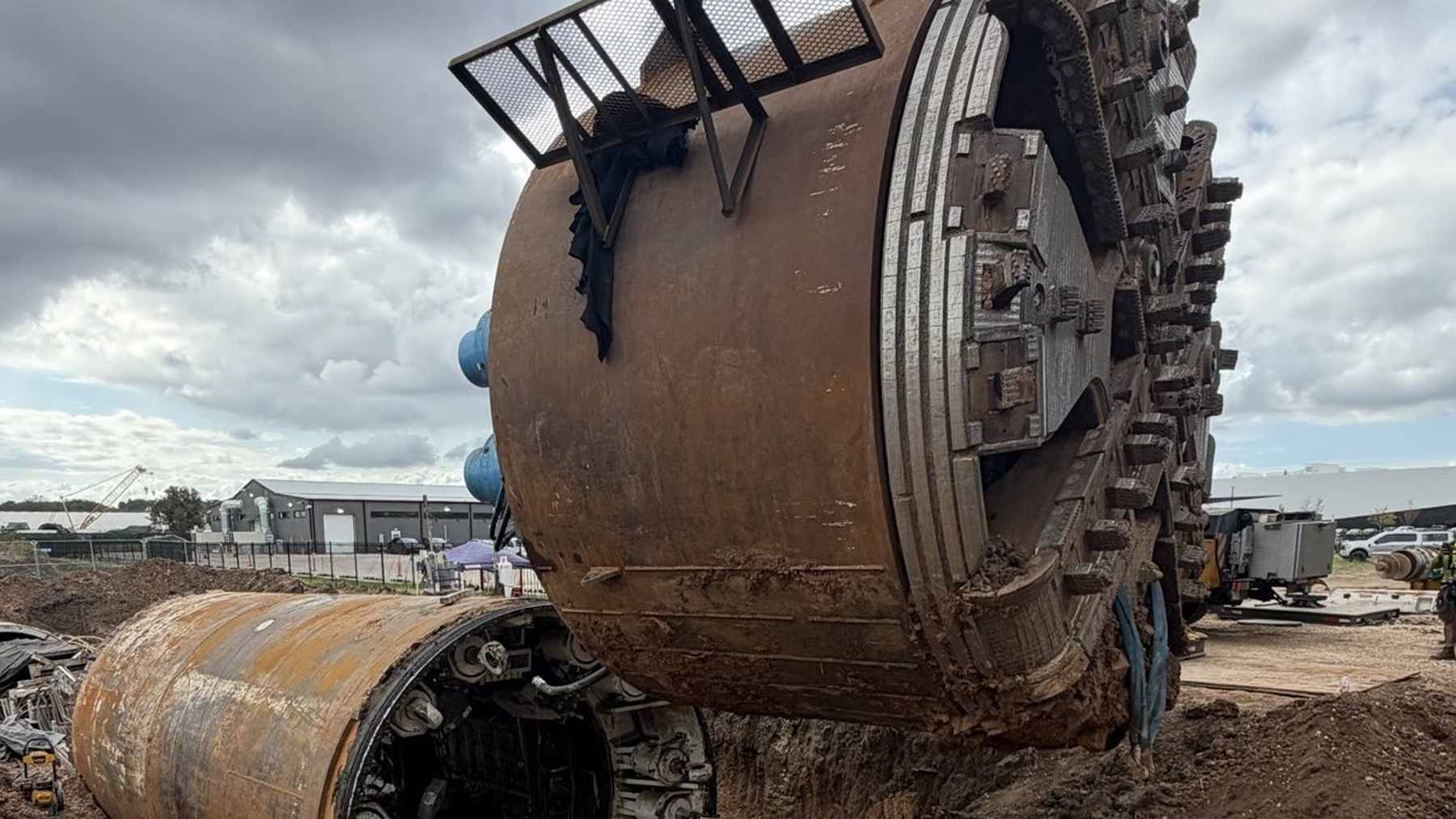
The machine is a Prufrock-5, and The Boring Company lists it at 900,000 pounds, which works out to 450 tons. It’s digging the Morgan’s Inclusion Tunnel, which the company describes on its tunnels page as nearly a mile long. The route links Morgan’s Hotel with the Morgan’s Wonderland theme park, with stops at Morgan’s Wonder Care and the Morgan’s Multi-Assistance Center.
The company calls it the first “Ultra-Accessible, fully inclusive tunnel of its kind.” That’s marketing language more than an engineering category, but the idea is pretty easy to get behind. Morgan’s Wonderland was built around visitors with disabilities, and the plan is a self-driving electric shuttle built for riders with physical, sensory and cognitive disabilities. Those shuttles are still being designed.
The start itself was low-key. According to Texas Public Radio and the San Antonio Report, guests watched a livestream from a party tent beside a soggy, fenced-off field, someone hit a button, and the cutterhead started turning. Morgan, the park’s namesake, appeared on screen too. Steve Davis, the company’s president, said his next stop after that was the control center, “and then we’re gonna dig.” The machine gets run from control centers on the site and in Bastrop.
Davis put the tunnel at about 30 to 40 feet down. If you’re wondering why it goes that deep, The Boring Company says the pipes and cables under a city mostly live in the top 10 feet or so, and its tunnels usually go deeper than 30 feet to stay clear of all that.
If you’ve never seen one of these things, a tunnel boring machine is basically a giant rotating cutting wheel with a long train of equipment trailing behind it. As it creeps forward, it lines the hole with concrete pieces, so the walls go in as the dirt comes out. Prufrock’s party trick is that it launches straight from the surface at an angle, which the company calls “porpoising,” so you don’t need to dig a big launch pit first.
How much does all this cost? Your guess is as good as mine. Gordon Hartman, who founded Morgan’s Wonderland, won’t say what it costs because he signed a confidentiality deal with The Boring Company, and an anonymous donor is footing the bill.
Where did “about 9 miles” come from?
A day after the launch post, Zack Nelson, the YouTuber better known as JerryRigEverything, quote-posted it with “Congrats on digging 500 more feet!” and then tallied up the company’s nine years at about 9 miles. He also brought up Elon Musk’s July 2017 claim that he had verbal government approval for an underground line from New York to Washington, D.C., and figured that at this rate the roughly 230-mile trip would take about 230 more years. He was pretty clear he didn’t believe the approval claim, either.
It’s a good joke.
But the 500 feet is sarcasm, not a measurement. The Boring Company hasn’t said how far Prufrock-5 got on day one, and I couldn’t find a published length for the Bastrop tunnel it finished in October. And the 9 miles is his estimate, not a company figure.
So is about 9 miles right? It’s pretty hard to square with what the company’s president has said about Las Vegas alone. In late 2025, Davis told the Las Vegas Review-Journal that the Vegas Loop had more than 10 miles of tunnel dug, with roughly 4 miles of it open to riders. In March 2026, the same paper reported 11 miles built in Las Vegas, with 3.5 miles in use while the rest waited on stations and permits.
Those are Vegas numbers, and they don’t include anything else. The company has two machines chewing through limestone under Nashville, which we covered when the second one started mining and again when the pair was racing toward the airport. It also lists seven R&D tunnels in Hawthorne, Adelanto and Bastrop, a short Hyperloop test tunnel in Bastrop and the Cybertunnel at Tesla’s Austin factory, none with a published length.
Which means the 9-mile figure looks low before you even leave Nevada, if the Review-Journal numbers are anywhere close.
To be fair to JerryRig, the company doesn’t publish a running total of miles dug, so anyone trying to keep score ends up stitching together press quotes. That’s arguably a bit of an unforced error for a company whose whole pitch is speed. The biggest number on its site is the 68 miles of approved Vegas Loop tunnel, and that’s easy to misread as tunnel already in the ground.
Is 29 days actually fast?
Honestly, I don’t have a clean industry benchmark for how long it takes to move a machine like this between two jobs, and The Boring Company didn’t offer one either. What the company does seem to be selling is reuse. In a reply on November 10, the company said all of its Prufrock machines are reusable, and that “Prufrock-1 has constructed 8 tunnels.” That’s a count of tunnels, not miles, but it tells you the business model is roughly “dig, pack up, drive to the next job.”
The other comparison doing the rounds came from an X user, @Ezzy525, who replied with the Channel Tunnel between England and France. The figure in that reply works out to about 93 miles, and that’s all three of its tubes added together, since the Channel Tunnel is two rail tunnels and a service tunnel, each about 31 miles long. If you’re counting total dirt moved, that’s a fair way to do it. If you’re counting how far you can actually travel, it’s about 31 miles.
As for the New York to Washington tunnel from that 2017 claim, it was never built. Big announcements can take a while to turn into holes in the ground, too. When we looked at the Dubai Loop in July, crews were casting concrete rings and hadn’t started digging. The company’s site still lists that pilot, about 4 miles of tunnel and four stations, as under contract.
San Antonio is a different kind of job, though. It’s a 450-ton machine already turning under a Texas theme park, and on paper it’s a pretty tidy one: a single short tunnel for a single private client.
According to Texas Public Radio and the San Antonio Report, Prufrock-5 should pop back up roughly a mile from its launch spot at Morgan’s Wonderland by late 2027, with the tunnel and the facilities that connect it finished.
 A nearly 23-foot tunnel boring machine just broke through into its first station under downtown Toronto after cutting about 4,265 feet and lining the tunnel with roughly 780 concrete rings, and its twin is due to punch through right beside it in DecemberIndustry · 4 days ago
 A Texas campus that will generate its own electricity without drawing from the public grid sits in a more than $74 billion plan, after an earlier filing described about 35 turbines and roughly 748 megawatts, while a second campus would use dry cooling and no planned industrial groundwaterIndustry · 2 hours ago
 A 44-inch pipe 121 miles long climbs from a desalination plant on the Chilean coast to a copper mine more than 14,400 feet up in the Andes, through five pumping stations across one of the driest deserts on Earth, built to carry 24 million gallons of desalted seawater a dayIndustry · 2 hours ago