
- 2 MONTHS AGO · ENERGYSeven emergency diesel generators kept six shut-down reactors cool when Europe’s largest nuclear plant lost its last power line, but crews ended up running just two of them to stretch the fuel over 18 days, and they’ve burned through almost all of it
- 4 WEEKS AGO · ENERGYThree 365-ton steam generators, each as tall as a six-story building, crossed the world by ship and rode a river barge and a special trailer into a French nuclear plant, where they’ll sit in storage until the reactor shuts down for an eight-month overhaul
- 4 WEEKS AGO · ENERGYA 12-foot bundle of 216 fuel rods leaning 30 degrees inside the first American reactor brought back from retirement will be laid flat in a 49,000-pound steel canister and hoisted out of the water by the crane that lifts the reactor head, a move no plant has made before
- 6 DAYS AGO · ENERGYA 44-ton machine that can work almost 65 feet up just finished factory tests in Germany and will lift a remote-controlled demolition robot inside a retired nuclear plant, where eight steam separators weighing up to 330 tons each have to be cut apart
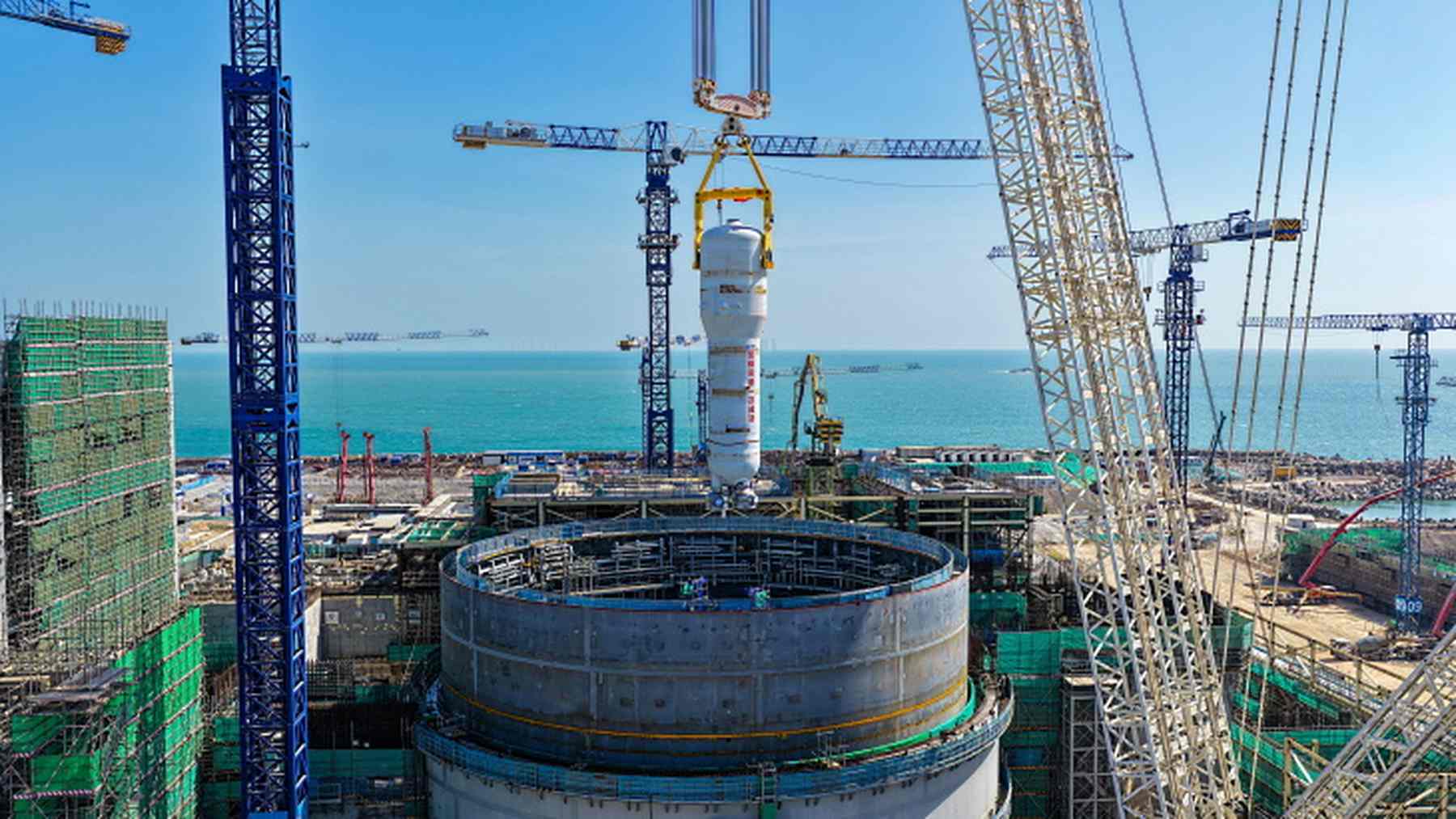
- TODAY · THIS ARTICLEA 79-foot steam generator weighing about 694 tons, nearly 20 feet across, was hoisted into a Guangdong reactor building on Wednesday, the first of two for a 1,250-megawatt unit whose steel vessel went in this summer, a lift its builder said was kept stable and precisely controlled
Ask most people to picture a nuclear power plant and they’ll probably describe the cooling towers. Some will mention the reactor. Fair enough. But a reactor doesn’t make electricity on its own. It makes heat, and something has to turn that heat into steam before a turbine can do anything useful with it.
That something is called a steam generator, and on Wednesday one of them went into the reactor building of Lufeng unit 1, a plant under construction in China’s Guangdong province. It’s about 79 feet long and nearly 20 feet across. It weighs about 694 tons, too, and it’s only the first of two that unit needs.
The builder is China Nuclear Industry 23 Construction Company, or CNI23, a subsidiary of state-owned China National Nuclear Corporation. CNI23 is putting the unit up under contract to China General Nuclear (CGN), and it announced the lift itself. World Nuclear News picked the story up on Thursday, with CNI23’s summary of the job: “The entire process was safe, stable, and precisely controlled.”
Which is pretty much the only acceptable way to describe moving 694 tons of anything around inside a reactor building.
So what is a steam generator?
Lufeng 1 uses a design called the CAP1000, China’s version of the Westinghouse AP1000. If that name rings a bell, it’s because the AP1000 is the design running at Plant Vogtle in Georgia. Both are pressurized water reactors, and the basic idea is easier to follow than you’d think.
Water flows through the reactor core and picks up heat, but it’s kept under so much pressure that it can’t boil. That hot water then gets pumped through a big bundle of thin metal tubes inside the steam generator. On the outside of those tubes sits a separate supply of water at lower pressure, and that water does boil. The steam heads off to spin the turbine.
That means the water that touches the fuel never gets anywhere near the turbine, which is kind of the point. Basically, a steam generator is a giant heat exchanger that keeps two batches of water apart while passing heat from one to the other.
The CAP1000 uses two of them per reactor, each one serving its own coolant loop. And if you’ve followed our coverage of French reactors, you’ll know they do things a little differently. The Paluel plant’s unit 3 is getting four replacement steam generators at 474 tons each, while a reactor at Cruas-Meysse is getting three that weigh about 365 tons apiece.
So why is Lufeng’s so much heavier?
It comes down, at least partly, to the number of loops. With only two steam generators sharing the heat from a 1,250-megawatt reactor, each one has to handle a bigger slice of it than its French cousins do. And as you’d expect, a bigger slice means a bigger machine.
Flipping it was arguably harder than lifting it
A Chinese-language write-up on CINIE, a nuclear construction news site, fills in some detail WNN’s piece doesn’t. It matches WNN on the weight, then describes the job as a stack of headaches: the sheer tonnage, a tricky flip on site, and very little room to maneuver inside the nuclear island.
Steam generators usually travel lying on their side, so “flipping” most likely means tilting this one up to vertical before it went down into the containment. Doing that with 694 tons on the hook isn’t something you’d want to improvise.
And they didn’t. According to CINIE, the team went through several rounds of plan reviews, tabletop rehearsals, digital modeling and process simulation before the lift. It also mapped out stress risk points, tweaked the lifting path and had custom lifting fixtures made. During the lift, 3D collision checks and guide devices helped steer the steam generator through the flip, into the containment cavity and into position. CINIE says the final placement landed within the design tolerance.
That’s a lot of rehearsal for one lift.
Neither write-up says how long it took or names the crane that did it. I’d have liked to see both, frankly, since the crane was arguably the hardest-working machine on that site this week.
Lufeng is a six-reactor site
If Lufeng sounds familiar, that’s because we were at Lufeng back in July, when a steel structural module of about 2.1 million pounds was lowered into the reactor building of unit 2 next door. That was a different piece of hardware on a different unit, but it’s the same reactor design.
According to WNN, Lufeng is laid out for six units in total. Units 1 through 4 are CAP1000s. Units 1 and 2 already have State Council approval, while 3 and 4 haven’t gotten theirs yet. Units 5 and 6 use a different Chinese design called the Hualong One, and they’re further along, with unit 5 expected to enter service in 2027 and unit 6 in 2028.
Unit 1 itself got its first safety-related concrete in February of last year. Its reactor pressure vessel, the thick steel pot that holds the fuel, went in this July, and now the first steam generator is in place about four months later. From where I’m sitting, that’s a pretty brisk rhythm for a reactor build.
It’s also a bit of a contrast with how the AP1000 fared in the US, where Georgia eventually got its Vogtle reactors running but South Carolina left a half-built plant behind. China seems pretty happy to keep building the design in batches.
There’s still a lot of welding to do
The second steam generator hasn’t gone in yet. After that, CINIE says the next big job is assembling and welding the main coolant piping, the heavy pipes that tie the reactor vessel and the steam generators together into one sealed circuit. The project team also has more large nuclear island equipment to install, and it’s pushing to hit its construction targets for the year before the fourth quarter wraps up.
So if you were hoping to see Lufeng 1 send power anywhere soon, don’t hold your breath. WNN says units 1 and 2 are both expected to enter service in 2030, and as of Wednesday, unit 1 has the first of its two steam generators in place.
 A 100-watt nuclear reactor sitting in a 35-foot concrete pit under Texas ranch land has been cleared by the Energy Department for unrestricted operations three months after its first chain reaction, and its maker will use it to train operators and check its math for an isotope reactorEnergy · 3 hours ago
 An 882-ton boiler, one of eight at a closed nuclear plant on the English coast, is slated to be jacked and slid out of its bay under a contract announced late last month, a job meant to take away about a third of the buildings still standing on the siteEnergy · 18 hours ago
 A 216-foot steel vessel 60 feet high is being assembled nearly a mile underground in South Dakota, one of two tanks that will take 2,600 beams lowered one by one down a shaft and will each hold about 17,000 tons of liquid argon at about 300 degrees below zeroEnergy · 20 hours ago