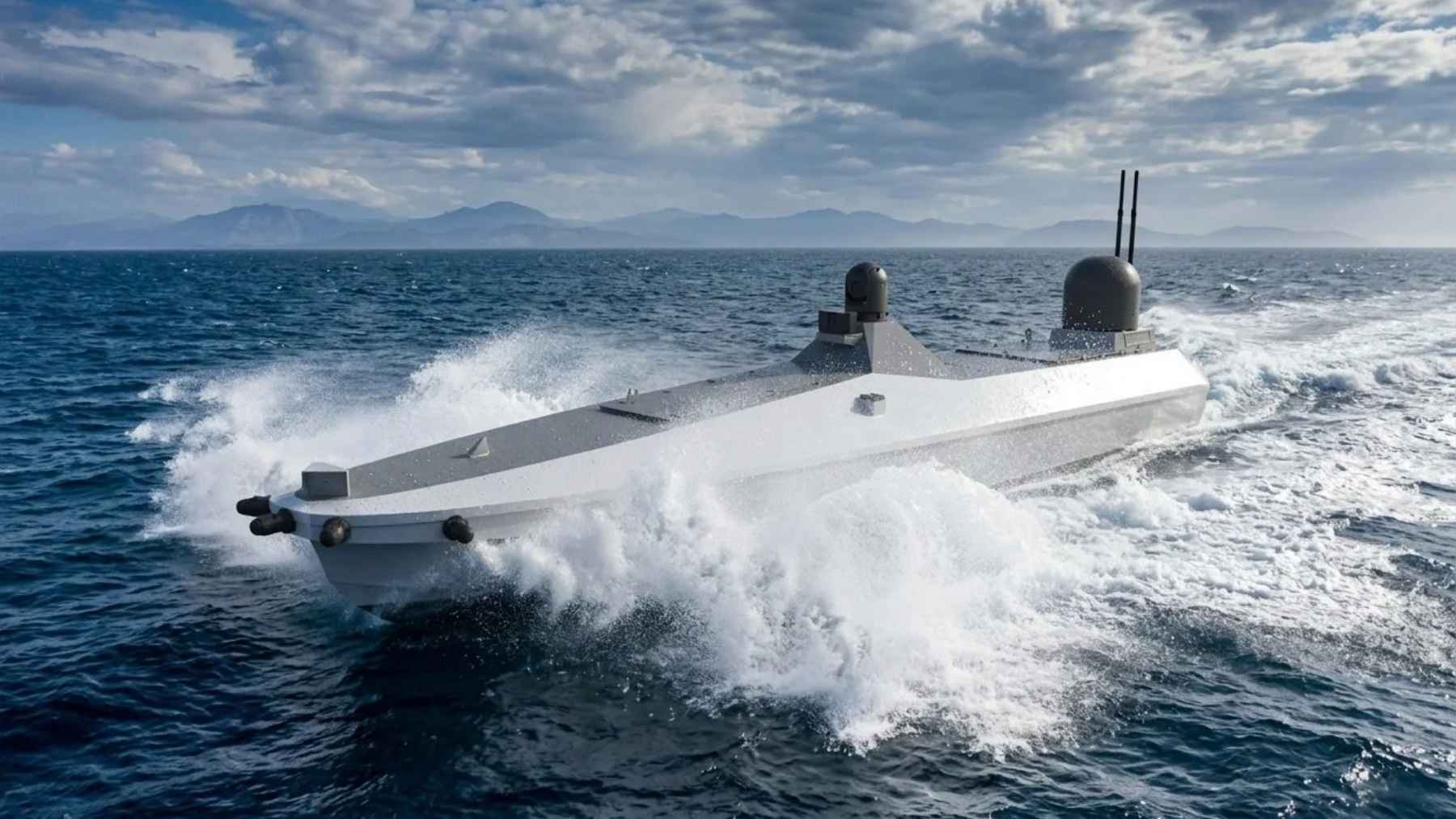

A 26-foot boat with a gasoline engine turning a waterjet isn’t an exotic machine. That’s roughly the setup on the rental jet boat you’d take out on a lake for an afternoon, and it’s why a hull like that is cheap to build and easy to thrash.
This one carries a 550-pound payload in the nose and isn’t meant to come back.
It’s called Tufan, and last month it went in the water in front of a crowd for the first time, at the Gölcük Naval Shipyard Command on the Sea of Marmara. The occasion was Teknofest Mavi Vatan, four days of naval and underwater technology displays that ran August 20 to 23. Ares Shipyard, which leads the hull design and the build, said on August 21 that the boat was in the water and its sea trials were finished. It didn’t say where those trials happened or how long they ran.
Aselsan, the Turkish defense electronics company behind the system, had only put Tufan on a stand in Istanbul back in May. Going from an exhibition hall to a boat that swims in about three months is quick, and I’d file the sea trials claim under things a company has said about itself, because right now that’s all it is.
So what’s in the nose?
Aselsan calls Tufan an expendable strike platform, which is the polite way of saying the delivery method is driving into the target at speed. It’s meant for ships and coastal infrastructure.
Defense News described the payload as equivalent to a single Mk 82, the plain 500-pound bomb American aircraft have been dropping since Vietnam. EDR Magazine, whose reporter walked around the boat in Istanbul, put the payload capacity at 250 kilograms, about 550 pounds, and counted six sensors at the bow that set the charge off.
Why six and not one?
My guess is the angle of impact. Hit a steel hull at speed and there’s no promise that the single sensor you fitted is the piece touching metal first. Spread six across the bow and you’re covered whichever way the boat comes in.
The filler is a polymer-bonded explosive called PBX-10, and Aselsan makes a point of the fact that it’s insensitive. Insensitive munitions are built so a fire on the dock, a dropped crate or a stray rifle round can’t set them off, and only the fuze can. For something that spends its working life on trailers, cradles and small piers, that’s worth more than it sounds like it should be.
Aselsan hasn’t published a warhead weight of its own, and Naval News said so plainly when it covered the launch. So the 550 pounds is EDR’s reporting and the Mk 82 line is Defense News’s, rather than something off a spec sheet.
The performance figures come from Aselsan too, and no one outside the program has checked them. EDR was told the boat holds its top speed in Sea State 4, which on the international scale means waves running roughly 4 to 8 feet. That top speed is listed at more than 50 knots, or about 57.5 mph. A planing hull this small doing that through water like that is a rough ride for whatever’s bolted down inside it, which I’d guess is most of what the sea trials were for.
Aselsan says the cameras take over when the GPS goes
Every drone boat hits the same wall eventually. Warships jam, and they’re good at it. A GPS signal comes down from a satellite about 12,000 miles up and it’s faint by the time it reaches sea level, so a ship with a decent electronic warfare suite can bury it for miles around, and a boat that steers by satellite suddenly doesn’t know where it is.
Tufan’s answer, according to the company, is to look instead of listen. A fixed day and night camera suite sits amidships, doing navigation and obstacle avoidance. Up on the roof of the superstructure there’s a gimbal that picks out the target and steers the attack run, and EDR reported that it’s built to keep working in GNSS-denied conditions, which is the industry’s way of saying someone is jamming you.
You can keep a person in the loop as long as the link holds. Aselsan lists radio line-of-sight in the L and S bands, a mesh network for when several boats are out together, 4G LTE and satellite. If all of that drops, the software’s supposed to finish the run on cameras alone.
The swarm claim is the same idea multiplied. Aselsan says the boats can break into sub-groups, some scouting and some striking, and pass jobs around between themselves without a person handing out assignments. It also says Tufan is built to STANAG 4817, which is the NATO agreement that sets a common standard for commanding unmanned systems. In plain terms that means an allied command network could task the boat without someone writing custom software first. That’s a fairly big claim for a boat designed to be used once, and no one has tested it in public.
Turkey already ordered 40 of them
This is where Tufan stops being a trade show model.
In February, Turkey’s Defense Industry Executive Committee, the country’s top decision-making body for defense procurement, approved buying 100 expendable unmanned surface vessels for the navy, with the Secretariat of Defense Industries running the program. Defense News reported the split three months later: 40 boats from Aselsan and Ares, 32 from STM with Yonca Shipyard, and 32 from Havelsan with Sefine Shipyard.
Add those up and you get 104. Defense News reported that the authorized total will need adjusting to fit a doctrine that sends the boats out four at a time, and 104 happens to divide into 26 packs of four.
What strikes me is that Turkey is buying three different kamikaze boats from three different teams instead of picking a winner. That keeps three supply chains warm, and a bad design in one of them doesn’t take the whole program down. It’s more expensive than backing one horse, and that’s presumably the point.
Naval News also pointed out that Tufan turned up at Gölcük as a company display and not as a navy boat in service, and that the two firms have stayed quiet on orders, quantities and delivery dates. They’re both true at the same time. We know about the program because a government committee decided it and reporters wrote it down, not because Aselsan or Ares sent out a release.
It’s also the same basic weapon Ukraine has been using against the Russian fleet in the Black Sea, and Turkey sits on the other side of that water. The Ukrainian version has already moved on to other work: a 39-foot boat that used to drive explosives into Russian warships now carries 18 interceptors standing upright in boxes on its deck. Britain’s 36-foot K5 Kraken runs to the same 50 knots on two diesels and swaps its whole mission package on the same deck in minutes.
Aselsan representatives told EDR Magazine in May that a diesel version is on the way to replace the gasoline engine in the prototype, and that the goal is for Tufan to be in Turkish Armed Forces service in 2027.