
- 2 MONTHS AGO · MILITARYA 6.5-pound drone thrown off a dock by hand sprints across the surface at 8 mph, stops, dives 197 feet straight down for a reading and pops back up, and the Navy spent two days in August watching pods of them hunt other underwater drones in a harbor
- 2 MONTHS AGO · MILITARYA UK company just showed a drone boat that takes loitering munitions, mini torpedoes, drones or sonobuoys as cassettes two people exchange in the field without touching the hull, and it says an Anduril ALTIUS has already gone out of one
- 2 MONTHS AGO · MILITARYA 19-foot American drone submarine rated for 19,700 feet sat dead in the water for more than a day at the mouth of the Strait of Hormuz, where the bottom runs 200 to 330 feet, until Iranian naval forces hauled it in, and the man who built it posted “rest in peace, little buddy”
- 2 MONTHS AGO · MILITARYWhile Britain introduced its first drone submarine as a demonstrator that would not perform operational duties, the 39-foot boat fired a heavyweight torpedo in UK waters 16 months later, the first launched from an uncrewed submarine by Britain or the US
- TODAY · THIS ARTICLEA 23-foot American drone sailboat that rides the wind on a 15-foot rigid wing turned up burning in an Iranian video at the mouth of the Strait of Hormuz, and four days later a US drone put two missiles into boats grabbing at another Navy surface drone
You’ve probably seen more news out of the Strait of Hormuz this year than in the previous ten combined. Tankers, mines, warships, oil prices doing unpleasant things. But the latest machine to turn up burning on camera there isn’t a tanker or a destroyer. It’s a sailboat. A 23-foot robotic sailboat with nobody aboard, which Iran says it hit. The US says it’s perfectly fine.
On September 10, Iran’s Islamic Revolutionary Guard Corps announced that its navy had struck an American unmanned surface vessel, hull number 5838, at the entrance to the strait, and put out video of a small boat burning on the water. The IRGC statement, carried by Naval Today, said the vessel had been stopped from carrying out an “aggressive mission.” A US official’s answer, given to Military Times, was short: “All of our Saildrones are accounted for and fully operational.”
Both of those can’t be fully true at once, and I can’t tell you whose version has the hole in it.
What I can tell you is that four days later, according to US officials, IRGC small boats made a grab at another Navy surface drone in the same strait, and that time the US shot back with missiles. So somebody in Tehran apparently thinks these boats are worth going after. Which raises a fair question: what exactly is the Navy doing parking robotic sailboats at the mouth of what’s arguably the most contested waterway on the planet right now? Bear with me, because the answer’s pretty good.
So what is this thing?
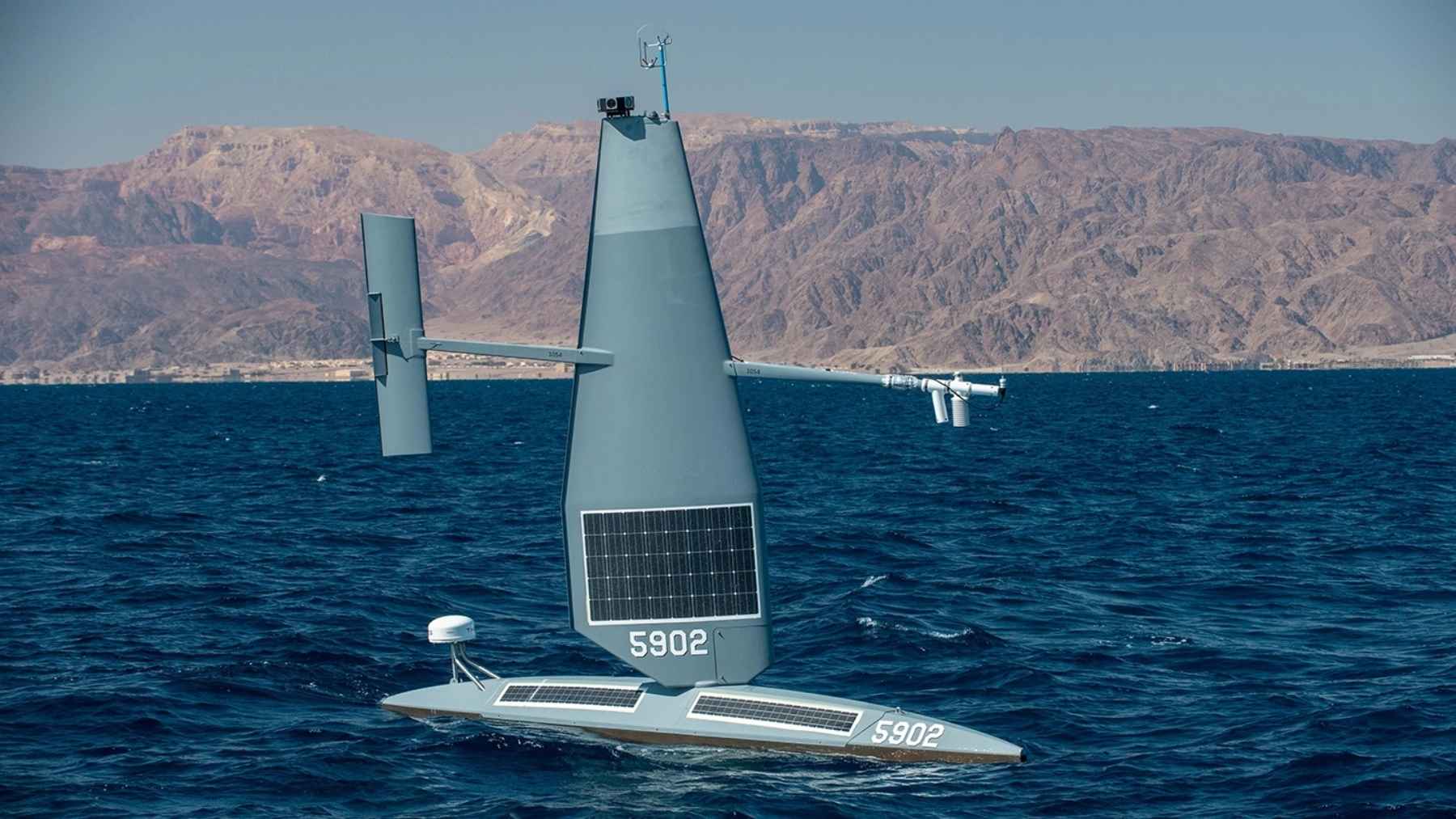
The boat in the September 10 video is a Saildrone Explorer, going by Iranian media’s identification and by analysts who reviewed the footage. Saildrone is a company out of Alameda, California, that builds uncrewed sailboats, and the Explorer is its smallest one: 23 feet long, with a 15-foot rigid wing where a normal sailboat would carry a cloth sail. The wing works less like a sail and more like an airplane wing stood on end. Wind flowing over it produces thrust, and a small tab on the tail trims the angle. That’s the entire propulsion system.
There’s no engine anywhere on the boat. Solar panels feed the cameras, the radar and the satellite link, and the wind does the moving, at an average of about 3 knots. Which sounds slow, and it is, but this boat isn’t trying to get anywhere. According to Saildrone, an Explorer can stay at sea for more than 12 months at a stretch. A year on the water without burning a drop of fuel.
If that setup sounds familiar, it’s because we just covered a 4-foot drone sailboat that crossed the Atlantic by itself in 117 days. Same recipe, scaled up and sent somewhere far less friendly.
The Navy has been running Explorers in the region since early 2022, when Task Force 59, its unmanned-systems unit based in Bahrain, put them to work in the Arabian Gulf. The job’s boring on purpose: sit in one patch of water, watch everything with cameras and radar, and pass anything odd up the chain. The Navy calls it maritime domain awareness. I’d call it a very patient robotic lookout.
Why a sailboat, though?
Because holding a station is one of the most expensive things a navy does. A destroyer parked at the mouth of Hormuz needs roughly 300 sailors, fuel, food, and eventually another destroyer to relieve it. A 23-foot sailboat needs wind. If somebody shoots it, you’ve lost a boat instead of people, and the whole pitch is that a lost boat is basically an accounting problem.
Iran’s apparently decided that grabbing them is the countermove, and this isn’t a new hobby. Iranian vessels grabbed at Saildrones twice in 2022, once towing one in the Arabian Gulf and once lifting two out of the Red Sea, and handed them back when American destroyers showed up. This month has been busier. On September 8, two days before the burning-sailboat video, the IRGC hauled in a 19-foot Anduril Dive-LD, an American underwater drone, at the entrance to the strait. A Pentagon spokesperson told Reuters that one had “malfunctioned more than a day ago” and carried nothing classified. We looked at that class of undersea drone when a German rival built to fit a torpedo tube showed up days later.
Then somebody tried to steal one
The September 14 incident is the sharper of the two, because that time the US used force. According to Axios, which broke the story, IRGC small boats moved in to capture a Navy surface drone patrolling the strait, US forces spotted the attempt, and an American drone fired two missiles that destroyed both boats and killed most of the people on them. Central Command’s spokesman, Capt. Tim Hawkins, confirmed the attempted seizure and said “the surface drone remains under U.S. operational control.”
The Iranian account is different. Iranian media reported two fishing boats struck off the port of Kargan and near Larak Island, with an unspecified number of fishermen missing, and the province’s deputy governor for security affairs, Ahmad Nafisi, blamed the US military. Nobody disputes that two boats were destroyed by American missiles. What those boats were doing at the time depends on which capital you ask.
And I can’t tell you which model of drone the Iranians went after on the 14th, because no official statement names it. Hawkins called it an unmanned surface vessel and left it at that, and that’s probably deliberate, given that the last one had its hull number read out on Iranian state media.
You may be wondering why anyone would bother capturing a slow sailboat that won’t shoot back. Basically, the sensors are the prize. The hull’s the cheap part. The cameras, radar and software on board tell you what the US can see and how far, and parading one on state TV is worth something all by itself. Which is also why the US answered a grab attempt with missiles rather than a radio warning.
Axios reports that about 40 ships a day now move through the strait under US military guidance and protection, roughly 14 million barrels of oil leave through the waterway daily, and tankers have started making the run in daylight again after months of night-only transits. And as of Hawkins’ September 15 statement, the surface drone Iran’s boats went after was still on station, doing the slow, unglamorous watching it was built for.
 A 1,123-foot aircraft carrier with eight defueled reactors is under tow from Newport News to Mobile, where a scrapyard will cut the hulk apart around those reactors over the next four years while a 100-yard safety zone moves with herMilitary · 7 days ago
 A 13-foot-wide US Navy nuclear mini-sub rolled across the seabed off Scotland on wheels, found an F-14 upside down in fishing nets nearly 1,900 feet down and brought its secret Phoenix missile up with a Soviet spy trawler watching, after a month of sonar ships had come up emptyMilitary · 7 days ago
 Drone boats that ride almost awash like a drug smuggler’s semi-submersible just went to three American companies to prototype, and the Pentagon’s spec asks each one to haul 18,000 pounds of Marine supplies up to 2,000 nautical miles alone and sink itself on commandMilitary · 1 week ago