
When somebody says “drone boat,” you probably picture a jet ski with explosives bolted to the nose, aimed at a warship and never seen again. That was a fair description for about a year. It isn’t anymore.
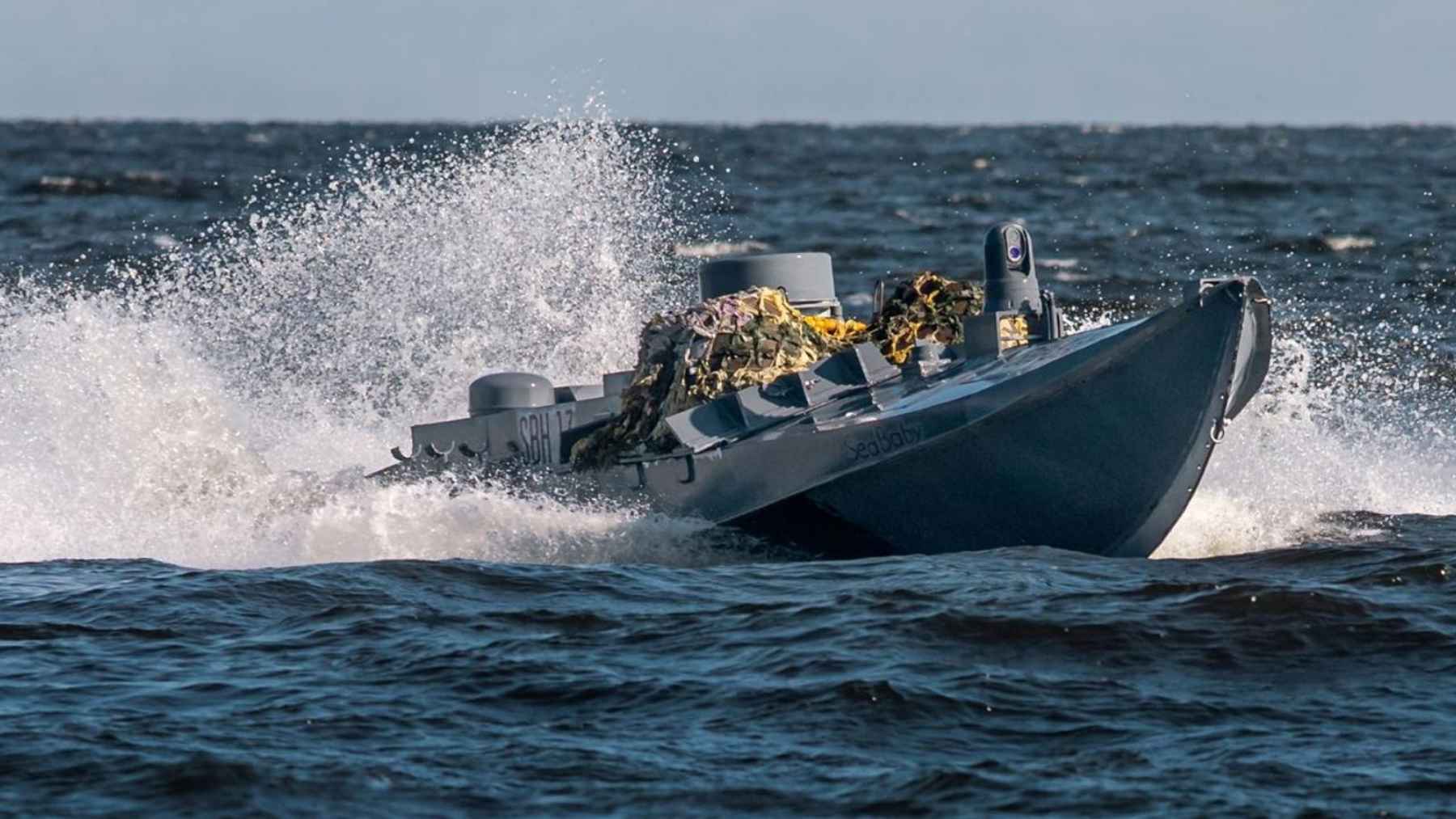
The boat Ukraine’s security service runs in the Black Sea now hauls 4,400 pounds (2,000 kg), covers 930 miles (1,500 km), carries a ten-tube rocket launcher on its deck and is built to come home afterward. It’s called the Sea Baby, and for a secret service weapon, the SBU hasn’t exactly been shy about showing it off.
So what happened off Yalta?
On the morning of July 8, the SBU says one of these boats hit the stern of a tanker called the Blue, near occupied Yalta and inside Ukraine’s exclusive economic zone. Russian aircraft went after the drone on its way in, dropping aerial bombs at it, and couldn’t stop it. They’ve put the video out.
The Blue is a Suezmax, which is shipping shorthand for the biggest tanker that’ll fit through the Suez Canal loaded. Registries list this one at 899 feet (274 meters), built in 2003, flagged in Cameroon. The EU, the UK, Canada, Australia and Ukraine have all sanctioned it for hauling Russian crude around the embargo, and it sits in Ukraine’s public shadow fleet register with the paperwork attached.
So why the stern, every single time?
Because that’s where the engines and the propeller shaft live. Punch a hole in the middle of a loaded tanker and you’ve got a spill, a cleanup bill and a genuinely awful week in the international press. Punch the stern and the ship stops moving while the oil stays in the tanks.
CNN’s footage of an earlier strike, on the tanker Dashan in December, shows a Sea Baby ducking under the hull before the blasts go off at the back end. That’s a mission kill rather than a sinking, and as tactics go it strikes me as fairly ruthless housekeeping.
It stopped being a one-way weapon
The first Sea Babies were kamikaze craft. You’d aim one at something, it went off, and that was the end of the boat. What the SBU unveiled in October 2025, as the Kyiv Independent reported at the time, isn’t that.
Range went from 620 miles (1,000 km) to 930 miles (1,500 km), which the SBU says puts any corner of the Black Sea inside a single trip. Payload roughly doubled, to 4,400 pounds (2,000 kg). The engines are reinforced and the navigation suite is new, and crews run the boats from a mobile control station built into a van, watching a bank of screens.
SBU chief Vasyl Malyuk called the new generation “even more effective” than the old one, which is the sort of thing the boss of a spy agency says about his own hardware. The range figures back him up anyway.
Two armed versions got shown off. One mounts a gyro-stabilized machine gun turret that finds and tracks targets by itself. The other carries a Grad rocket launcher with ten tubes bolted to the deck, which is an idea I’d have filed under “surely not” five years ago.
Then there’s the newest trick. The Sea Baby can now carry six to eight FPV attack drones in compartments along its sides that open mid-mission, along with thermobaric Shmel rockets, Defense News reported in July, citing Russian accounts of the boats working near the Kinburn Spit, about 40 miles east of Odesa. Some of those FPVs don’t fly on radio at all.
That bit deserves two plain sentences. A normal FPV takes its commands over a radio link, so a jammer can cut the link and drop it out of the sky. A fiber-optic drone trails a physical cable back to the operator instead, thin as a hair and spooling out behind it, so there’s nothing to jam.
Russia’s electronic warfare over the Black Sea is why anybody went to that trouble. You don’t reinvent the control link on a cheap drone because you’re bored.
The Crimea Bridge is on its record
The SBU says Sea Babies were used in the June 3, 2025 attack on the Crimea Bridge, the third strike on it since 2022. The boats delivered the explosives that were then used to mine the bridge’s underwater supports.
Ukrainian naval drones have sunk or damaged roughly a dozen Russian warships since 2022, and the Black Sea Fleet pulled its main operations from Sevastopol back to Novorossiysk. In December the SBU sent an underwater cousin, the Sub Sea Baby, into Novorossiysk after an Improved Kilo class submarine tied up at its pier. Russia said nothing was damaged. Satellite imagery the next day showed a 30-foot (9-meter) crater in the pier and the submarine sitting lower in the water, and it hadn’t moved a month later.
The US Navy is paying close attention
Here’s where it stops being somebody else’s war. Each of these boats costs a few hundred thousand dollars, which Defense News puts below the price of a single modern torpedo. On June 24, American special forces sank a target ship with a Ukrainian Magura at the Balikatan 2026 exercise off the Philippines, the first time the technology had been used in the Indo-Pacific. The Magura is the other Ukrainian drone boat family, built by a different company for military intelligence rather than the SBU.
The Navy wants thousands of small uncrewed surface vessels across the Indo-Pacific by 2030, Capt. Garrett Miller of Surface Development Group One said at a symposium in April. A cheap boat that can carry a cluster of attack drones close enough to matter is pretty much the exact shape the Pentagon keeps drawing on the whiteboard for a Pacific fight. The American ones aren’t there yet, and the boat the Navy has been teaching to refuel itself off Virginia still needs a human on the probe.
Every number here comes from Kyiv
That’s the caveat, and it’s a real one. The range, the payload, the damage assessments and the video all come from the SBU, which has an obvious interest in how impressive its own boat looks. Russia has denied several of the claims flat out, and I wouldn’t take any of it as gospel. The Kyiv Independent said plainly that it couldn’t verify the Dashan strike or the extent of the damage.
I also can’t find a published length or weight for the new generation anywhere, which is a slightly odd gap in a spec sheet the SBU is otherwise happy to read out loud. If you’ve seen a 20-foot figure quoted online, that’s the 2023 boat, and it carried less than half as much.
And the campaign didn’t stop with the Blue. On July 16, the SBU and the Ukrainian Navy said they’d hit two more shadow fleet tankers in the Black Sea, the Louise 1 and the Banda, and that Russian aircraft came at the drones with machine gun fire and bombs and missed again.