
Lake Pend Oreille is shrinking right now, and that’s completely normal. The Army Corps of Engineers started letting it down on September 21, and by November 15 the lake should sit between 2,051 and 2,051.5 feet, measured at the gauge in Hope, Idaho. That’s about 11 feet below where it spent the summer.
The Corps does this every fall. It gives the lake’s kokanee (a landlocked sockeye salmon) steady water to spawn in, and it frees up room for winter power generation.
But what caught my eye is the route the water takes. It’s going out through the turbines at Albeni Falls Dam, not over the spillway. And that’s probably for the best, because the spillway there has been working under a pretty strange rule for about two and a half years. Its gates go all the way open or all the way shut, and that’s it.
So why would anyone run a dam like a light switch?
So what’s going on at Albeni Falls?
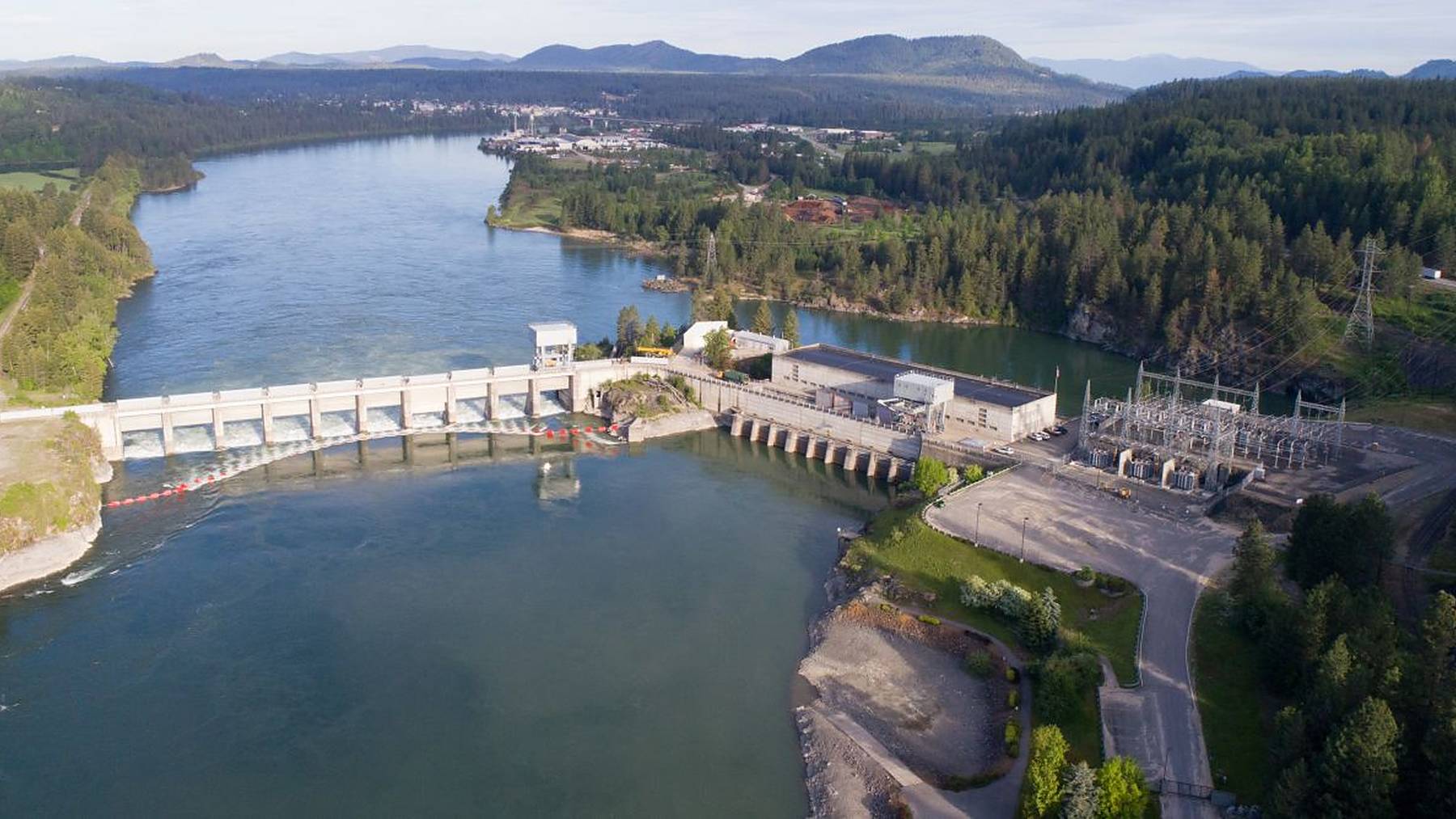
Albeni Falls Dam sits on the Pend Oreille River at Oldtown, Idaho, about 27 miles downstream of that gauge at Hope. It dates to 1955 and holds 136,000 cubic yards of concrete, which the Corps puts at 61 million pounds. Three Kaplan turbines inside can make up to 42.6 megawatts, and the Corps says that’s enough for about 15,000 homes.
If you’ve never thought much about how a dam like this works, you’re in good company. The turbines can only swallow so much river. Anything extra goes through the spillway, and the spillway gates are basically giant steel doors that a crane lifts or lowers to decide how much water gets past. Crack one open a little and you nudge the lake. Pull it all the way up and you’re passing everything that bay can handle.
Albeni Falls has 10 of those gates in service, plus a spare. They’re about 70 years old. And it turns out the steel they’re made of was a problem from day one.
So what’s actually wrong with the steel?
About three and a half years ago, the Corps pulled Gate 3 out of its slot for what was supposed to be routine rehab work and dropped the spare in its place. Once the paint came off, inspectors started finding things. The following April, the Corps’ own weld experts reported rolling flaws, delaminations and other defects in the gate’s fracture-critical girders. “Fracture critical” is engineer-speak for a part where one crack can bring down the whole structure.
I went through the slide deck the Corps showed local officials a few weeks later, and the explanation is kind of fascinating if you like metal. When a mill makes steel, it normally adds things like silicon or aluminum to mop up the oxygen dissolved in the molten metal. Steel that gets the full treatment is called “killed” steel, because it sits quietly in the mold instead of bubbling away. According to the Corps, the Albeni Falls gates were made from recycled steel that wasn’t fully killed, so some of that oxygen stayed trapped inside as tiny voids.
Those voids don’t show up on day one. They surface when somebody cuts into the steel to weld it, or when the steel gets loaded with stress, and they open up into layers. That’s the delamination. All the gates were built at the same time from the same type of steel, so the Corps assumed the rest probably shared the flaws, and its later analysis found similar damage in the other gates.
Open or shut turns out to be the safe setting
The Corps says a gate could give way with no warning at all, and the riskiest moment is when it’s in motion. That puts the crane operator, the crane itself, the gate and the Corps’ control over the lake all at risk in one go.
So the Corps did the only thing it really could. Gates now move fully open or fully closed when possible, one gate at a time, and only when it’s needed to refill the lake or manage flood risk. Fewer moves means fewer chances for a stressed girder to let go. It’s a bit of a blunt instrument, but frankly I’d make the same call.
“We are taking a conservative approach,” Amanda Smith, the dam’s operating project manager, told Renewable Energy World back when the restrictions started. She also said a compromised gate could push downstream flows up by about 15,000 cubic feet per second. A cubic foot is roughly 7.5 gallons, so that’s somewhere around 112,000 extra gallons every second heading down the river.
The people living around the lake felt it pretty quickly. Two summers ago, Lake Pend Oreille topped out at about 2,061.75 feet around June 19, roughly three inches under the bottom of its normal summer band of 2,062 to 2,062.5 feet. Idaho Sens. Mike Crapo and Jim Risch and Rep. Russ Fulcher wrote to the Corps asking it to give the dam its highest priority. The Lakes Commission later backed a study claiming the local economy lost $43 million last year to inconsistent lake levels and a shorter season, though Col. Kate Sanborn, who commands the Corps’ Seattle District, said the study only looked at one issue and that the Corps hadn’t fully reviewed it.
This year, the Corps aimed to hit 2,062 feet by June 19. I couldn’t find a Corps statement confirming the exact day the lake got there, so I won’t pretend to know.
Gate 3 got a patch job
Gate 3 came back to the dam in May of last year. Over that June and July, crews wrapped it in fiber-reinforced polymer, which is layers of polymer fabric stuck on with adhesive and epoxy, a bit like the carbon fiber wraps you see on old bridge columns. It went back into service that August.
The Corps itself calls that fix a “bandage,” which I appreciate as an unusually honest bit of government phrasing. Gate 3 also picked up sensors and, according to Sanborn, it can now be moved differently from the others. That gives the Corps a little more control. The other nine are still stuck on open-or-shut.
The new gates won’t all be here until the 2030s
On February 26, the Corps awarded a $20,395,700 contract to Knight Construction & Supply, a company based in Deer Park, Washington, to replace all 11 gates, spare included. The Corps’ Walla Walla District handled the design, and the dam keeps running while the new gates go in.
The catch is the schedule. Sanborn said at a public meeting in Sandpoint on May 7 that the first replacement gate should land in mid-2027, with the rest following at six-month intervals. The Corps has said that timing depends on “industry capability,” which is a polite way of saying there aren’t many shops that can build steel gates this big. I ran the math, and 10 more gates at six months apart puts the last one somewhere around 2032. That lines up with the Corps saying the work wraps up in the early 2030s.
And the open-or-shut rule doesn’t go away gate by gate. Sanborn said the dam stays on restricted operations until the final gates arrive.
The Corps hasn’t published how big or how heavy each gate is, at least not anywhere I could find. That’s a slightly frustrating gap in a story that’s basically all about steel.
And yes, the Navy tests submarines in that lake
Lake Pend Oreille is Idaho’s largest and deepest lake, at 1,150 feet. That depth, plus how quiet the water is, is why the Navy runs its Acoustic Research Detachment at Bayview at the lake’s southern end. The Navy tests submarine stealth tech there, including on LSV-2, a large-scale model of a Virginia-class submarine, without the cost and hassle of doing it at sea.
Does a sticky spillway on the river below the lake mess with any of that? As far as I can tell, no. The dam controls roughly the top 11 feet of a lake that’s more than 1,100 feet deep, and nothing the Navy or the Corps has published ties the two together. Still, it’s a pretty funny pairing. One end of the lake hosts some of the most precise acoustic testing the Navy does, and the other end is managed with what’s essentially an on-off switch.
If you want the Corps’ own account of the gate work, the Seattle District laid it out in an Army.mil feature in May, and the restricted operations briefing Bonner County posted has the steel details. We’ve also covered the Army Corps’ four Omaha flood-control dams that hit record lake levels, and a much bigger turbine job at the Robert Moses plant below Niagara Falls.
The drawdown is still running through the powerhouse. The Corps plans to have Lake Pend Oreille at 2,051 to 2,051.5 feet by November 15 and hold it there until the kokanee finish spawning, usually in late December, with the first of Albeni Falls’ 11 new spillway gates due on site in mid-2027.